Work, energy and power
Work done by a force, kinetic and potential energy, the work–energy principle, conservation of energy, power and efficiency.
Work
A force does work when its point of application moves in the direction of the force: $$W = Fs\cos\theta$$ where $\theta$ is the angle between the force and the displacement. The unit is the joule ($1\ \text{J} = 1\ \text{N m}$). A force perpendicular to the motion does no work. Examples are the tension in a string whirling a stone in a circle and the normal reaction on a body sliding along a level floor.
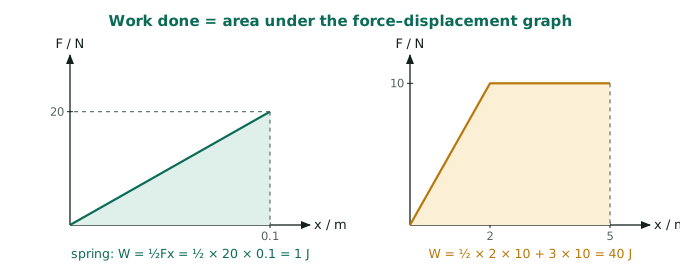
For a varying force, the work done is the area under the $F$–$s$ graph. Stretching a spring obeying $F = kx$ needs $W = \tfrac{1}{2}kx^2 = \tfrac{1}{2}Fx$, which is stored as elastic potential energy.
Kinetic and potential energy
- Kinetic energy $E_k = \tfrac{1}{2}mv^2 = \dfrac{p^2}{2m}$. If the momentum is doubled, the kinetic energy becomes four times as large.
- Gravitational potential energy near the Earth's surface: raising a mass $m$ by $h$ stores $mgh$.
Work–energy principle: the net work done by all the forces on a body equals the change in its kinetic energy: $$W_{net} = \tfrac{1}{2}mv^2 - \tfrac{1}{2}mu^2$$
Example: A $2\ \text{kg}$ block slides $5\ \text{m}$ down a rough slope, falling $3\ \text{m}$ vertically. It starts from rest and friction is $4\ \text{N}$. Work by gravity $= 2 \times 10 \times 3 = 60\ \text{J}$, work against friction $= 4 \times 5 = 20\ \text{J}$. So $E_k = 40\ \text{J}$ and $v = \sqrt{40}\approx 6.3\ \text{m s}^{-1}$.
Conservation of energy
Energy cannot be created or destroyed, only changed from one form to another. When only gravity does work (no friction), $E_k + E_p$ stays constant. A pendulum bob released from height $h$ above its lowest point passes the lowest point at $v = \sqrt{2gh}$, whatever its mass.
Power
Power is the rate of doing work: $P = \dfrac{W}{t}$, unit the watt ($1\ \text{W} = 1\ \text{J s}^{-1}$). For a force moving its point of application at velocity $v$: $$P = Fv$$ A vehicle at constant speed has zero resultant force. So the engine's driving force equals the total resistance $F_r$, and $P = F_r v$.
Example: A $1200\ \text{kg}$ car moves at a steady $20\ \text{m s}^{-1}$ on a level road with $22\ \text{kW}$, so the resistance is $\dfrac{22000}{20} = 1100\ \text{N}$. To climb a $3^\circ$ slope at the same speed it must also supply $mg\sin\theta \approx 1200 \times 10 \times \dfrac{3\pi}{180} = 600\ \text{N}$ (with $\pi = 3$). The power needed is $(1100 + 600) \times 20 = 34\ \text{kW}$. (A 2023 Paper I question.)
Efficiency
$$\text{efficiency} = \frac{\text{useful energy output}}{\text{total energy input}} \times 100%$$ A motor that lifts $50\ \text{kg}$ through $6\ \text{m}$ in $10\ \text{s}$ does useful work at $\dfrac{50 \times 10 \times 6}{10} = 300\ \text{W}$. If it takes $400\ \text{W}$ from the supply, its efficiency is $75%$.