The first law of thermodynamics
Internal energy, work done by a gas, the first law ΔQ = ΔU + ΔW, isothermal, adiabatic, isochoric and isobaric processes, cycles and molar heat capacities.
Internal energy and work
The internal energy $U$ of a system is the total kinetic and potential energy of its molecules. For an ideal gas it is only kinetic and depends only on the temperature.
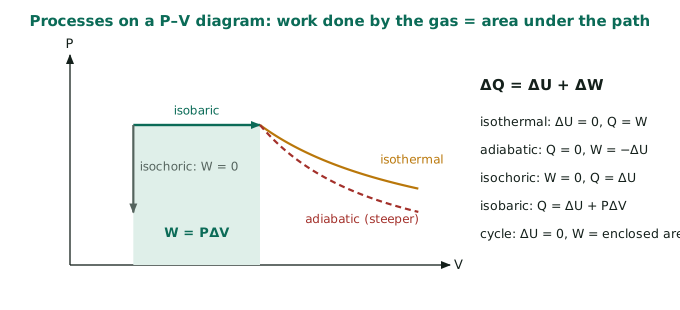
A gas expanding against a piston at pressure $P$ does work $\Delta W = P\Delta V$. In general the work done by the gas is the area under its $P$–$V$ graph. It is positive for expansion and negative for compression.
The first law of thermodynamics
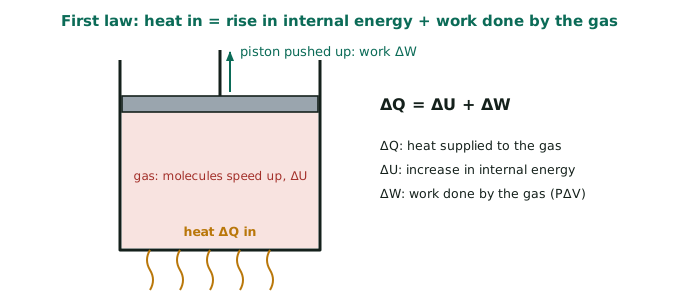
$$\Delta Q = \Delta U + \Delta W$$
- $\Delta Q$: heat supplied to the gas (negative if heat leaves)
- $\Delta U$: increase in internal energy
- $\Delta W$: work done by the gas (negative if work is done on it)
This is the law of conservation of energy applied to heat and work.
The four standard processes
| Process | Condition | First law becomes | Notes |
|---|---|---|---|
| isothermal | $T$ constant | $\Delta U = 0$, $\Delta Q = \Delta W$ | slow, in good thermal contact; $PV = \text{constant}$ |
| adiabatic | no heat exchange | $\Delta Q = 0$, $\Delta W = -\Delta U$ | fast or well insulated; $PV^\gamma = \text{constant}$; expansion cools the gas |
| isochoric | $V$ constant | $\Delta W = 0$, $\Delta Q = \Delta U$ | all heat raises the temperature |
| isobaric | $P$ constant | $\Delta Q = \Delta U + P\Delta V$ | needs more heat than isochoric for the same $\Delta T$ |
Example: In which processes is all the heat supplied to an ideal gas turned into work? Only in an isothermal process, because there $\Delta U = 0$. At constant volume no work is done. At constant pressure part of the heat raises $U$. (A 2023 Paper I question.)
- A bicycle pump gets hot because the quick compression is nearly adiabatic: work done on the gas raises $U$.
- Air rising in the atmosphere expands adiabatically and cools, which forms clouds.
- On a $P$–$V$ diagram an adiabatic curve is steeper than an isothermal one through the same point.
Cycles and heat engines
In a complete cycle the gas returns to its starting state, so $\Delta U = 0$ and the net heat supplied equals the net work done, which is the area enclosed by the loop. A clockwise loop on a $P$–$V$ diagram is an engine: work is done by the gas.
Molar heat capacities
- $C_v$: heat to raise $1\ \text{mol}$ by $1\ \text{K}$ at constant volume. All of it goes into $U$.
- $C_p$: the same at constant pressure. It is larger, because the gas also does work: $C_p - C_v = R$.
- $\gamma = \dfrac{C_p}{C_v}$: $\tfrac{5}{3}$ for a monatomic gas, $\tfrac{7}{5}$ for a diatomic gas such as air.