Temperature, thermometers and thermal expansion
Thermal equilibrium and temperature scales, kinds of thermometer, linear, area and volume expansion of solids, and the expansion of liquids.
Temperature and thermal equilibrium
Heat flows from a hotter body to a colder one until both reach the same temperature. They are then in thermal equilibrium. If A and B are each in equilibrium with C, they are in equilibrium with each other (the zeroth law of thermodynamics). A thermometer reads its own temperature, which equals the body's once they are in equilibrium.
The SI temperature is the thermodynamic (kelvin) temperature $T$. The Celsius temperature is $\theta = T - 273.15$, usually taken as $T = \theta + 273$. Absolute zero is $0\ \text{K} = -273\ ^\circ\text{C}$. A change of $1\ \text{K}$ equals a change of $1\ ^\circ\text{C}$.
Thermometers
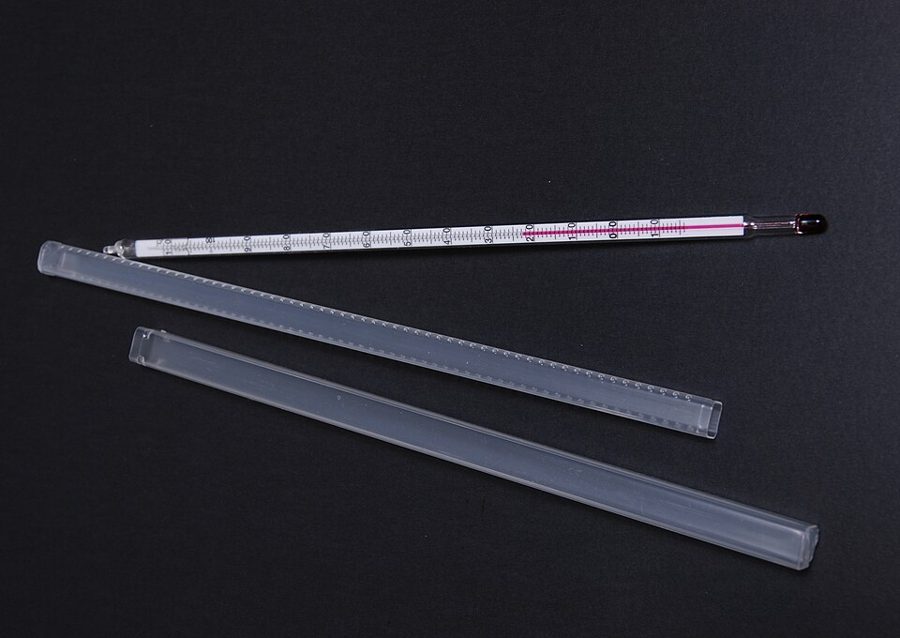
Any property that changes steadily with temperature can make a thermometer. Examples are the length of a liquid column, the pressure of a gas at constant volume, electrical resistance and the emf of a thermocouple.
| Thermometer | Good for |
|---|---|
| mercury- or alcohol-in-glass | everyday use, simple and direct |
| constant-volume gas | the standard; very accurate, but large and slow |
| platinum resistance | accurate over a wide range |
| thermocouple | small, fast response, very high temperatures, remote reading |
A thermometer for the method of mixtures should have a range just covering the temperatures expected and the smallest suitable least count.
Example: In a 2023 Paper II question a student had to choose between thermometers of ranges $0$–$50\ ^\circ\text{C}$, $-10$–$110\ ^\circ\text{C}$ and $0$–$360\ ^\circ\text{C}$ for an experiment at room temperature with ice. The best choice has the smallest least count while still covering $0\ ^\circ\text{C}$ to room temperature.
Expansion of solids
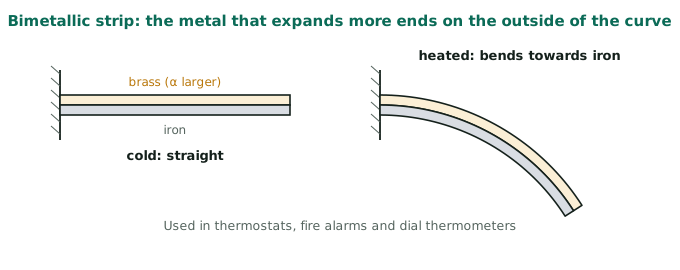
Most solids expand when heated because their atoms vibrate with larger amplitude about positions slightly further apart. $$\Delta l = l_0,\alpha,\Delta\theta, \qquad \Delta A = A_0,\beta,\Delta\theta, \qquad \Delta V = V_0,\gamma,\Delta\theta$$ with $\beta \approx 2\alpha$ and $\gamma \approx 3\alpha$ for an isotropic solid. $\alpha$ is the linear expansivity, unit $\text{K}^{-1}$.
- A hole in a metal plate gets larger on heating, as if it were filled with the metal.
- Thermal stress: a rod clamped so that it cannot expand pushes on its supports with $F = YA\alpha\Delta\theta$, where $Y$ is Young's modulus.
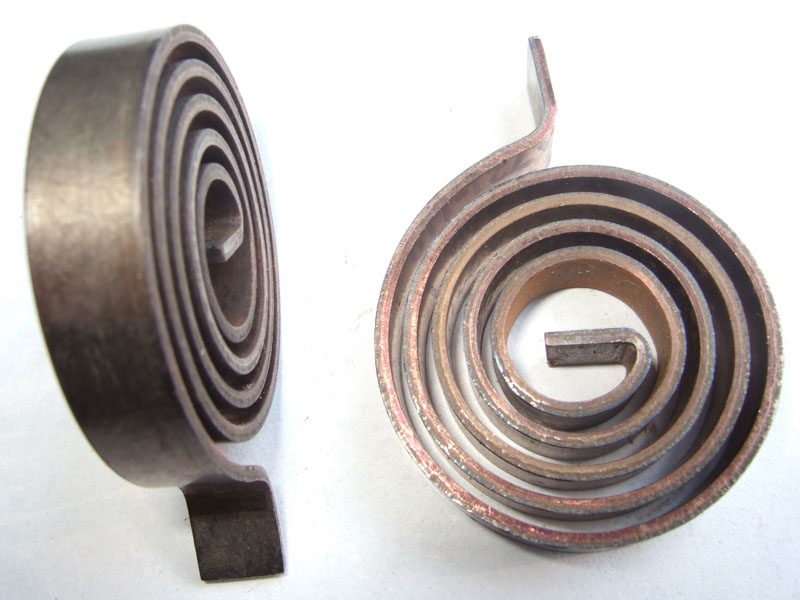
- Expansion gaps in railways and bridges, loose telephone wires in hot weather and bimetallic thermostats are everyday results.
Example: A steel tape calibrated at $20\ ^\circ\text{C}$ reads $50.00\ \text{m}$ at $40\ ^\circ\text{C}$ ($\alpha = 2 \times 10^{-5}\ \text{K}^{-1}$). Each "metre" of the tape is now longer by a factor $1 + \alpha\Delta\theta = 1.0004$. So the true length is $50.00 \times 1.0004 = 50.02\ \text{m}$. (A 2023 Paper I question.)
Expansion of liquids
A liquid has only volume expansivity. Its container expands too. So what you see, the apparent expansion, is less than the real expansion: $$\gamma_{real} = \gamma_{apparent} + \gamma_{container}$$ The density of a liquid falls with temperature: $\rho_\theta = \dfrac{\rho_0}{1 + \gamma\Delta\theta}$.
Anomalous expansion of water: between $0\ ^\circ\text{C}$ and $4\ ^\circ\text{C}$ water contracts on heating, so it is densest at $4\ ^\circ\text{C}$. In winter the water at $4\ ^\circ\text{C}$ sinks to the bottom of a lake, and ice forms on the top and insulates the water below. Fish survive.
Photo credits: Laboratory thermometer-01.jpg by Lilly_M, CC BY-SA 3.0; Bobina Bimetálica termostato.jpg by Shorenster, CC BY-SA 3.0.

