Surface tension and capillarity
Unit 10 · Mechanical Properties of Matter
Surface tension and surface energy, cohesion and adhesion, angle of contact, excess pressure in drops and bubbles, capillary rise and everyday effects.
Surface tension
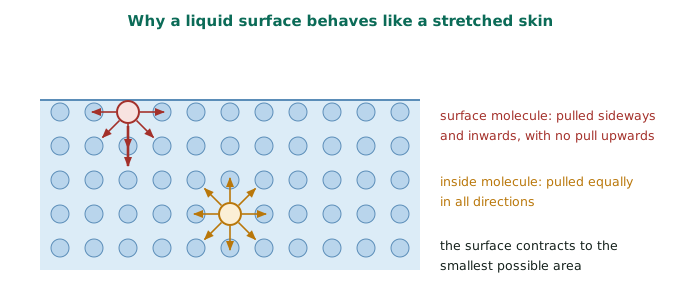
Molecules inside a liquid are pulled equally in all directions. Those at the surface are pulled inwards by the molecules below. So the surface behaves like a stretched elastic skin. Surface tension $T$ is the force per unit length acting along the surface, perpendicular to a line drawn in it: $$T = \frac{F}{l}\quad(\text{N m}^{-1})$$ It also equals the surface energy: the work needed to make $1\ \text{m}^2$ of new surface at constant temperature ($\text{J m}^{-2}$).
Example: A light ring of radius $2\ \text{cm}$ lies just below a liquid surface and needs $0.04\ \text{N}$ to pull it out. The film touches the ring along both its inside and outside, so $F = T \times 2(2\pi r)$ and $T = \dfrac{0.04}{4\pi \times 0.02} = \dfrac{1}{2\pi}\ \text{N m}^{-1}$. (A 2024 Paper I question.)
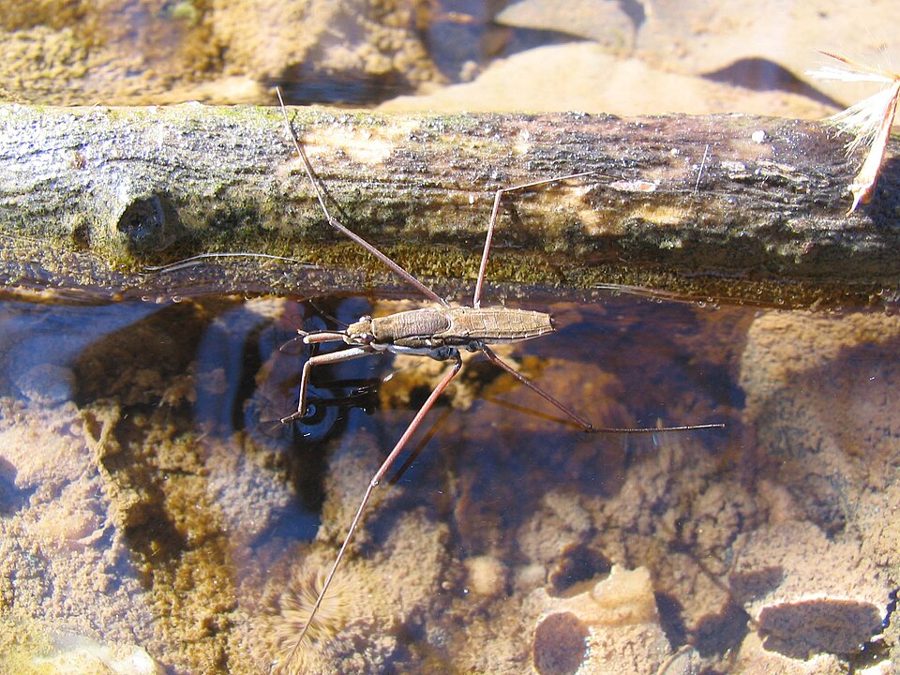
Effects: insects walk on water, a greased needle floats, and drops are spherical (the smallest surface for a given volume). Detergents and a rise in temperature reduce surface tension, which is why warm soapy water cleans better.
Cohesion, adhesion and angle of contact
Cohesion is the attraction between molecules of the same liquid. Adhesion is the attraction between liquid and solid molecules. The angle of contact $\theta$ is measured inside the liquid, between the solid surface and the tangent to the liquid surface.
- Adhesion greater than cohesion (water on clean glass): $\theta < 90^\circ$ (about $0^\circ$). The liquid wets the glass and the meniscus is concave.
- Cohesion greater than adhesion (mercury on glass): $\theta > 90^\circ$ (about $140^\circ$). The meniscus is convex.
Excess pressure inside curved surfaces
A curved surface needs a higher pressure on its concave side:
| Case | Excess pressure |
|---|---|
| liquid drop, or air bubble inside a liquid (one surface) | $\Delta P = \dfrac{2T}{r}$ |
| soap bubble in air (two surfaces) | $\Delta P = \dfrac{4T}{r}$ |
The smaller the bubble, the greater its excess pressure. Two soap bubbles joined by a tube do not even out. Air flows from the small bubble into the large one until the small one collapses into a cap with the same radius of curvature as the large bubble. (A 2023 Paper I question.)
Example: Blowing a soap bubble from radius $r$ to $2r$ at constant temperature: the excess pressure halves, the volume rises by $8$ times, and the surface energy ($T \times 2 \times 4\pi r^2$) rises by $4$ times. (A 2024 Paper I question.)
Capillarity
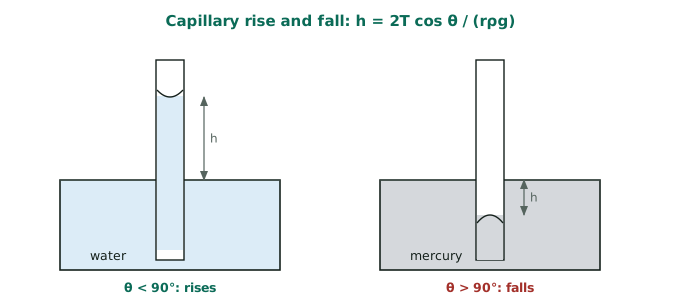
In a narrow tube of radius $r$, the upward pull of surface tension round the circumference balances the weight of the raised column: $$2\pi rT\cos\theta = \pi r^2h\rho g \quad\Rightarrow\quad h = \frac{2T\cos\theta}{r\rho g}$$
- The narrower the tube, the higher the rise ($h \propto \dfrac{1}{r}$).
- Mercury ($\theta > 90^\circ$) is depressed.
- If the tube is shorter than $h$, the liquid does not overflow. The meniscus flattens (its radius of curvature increases) until $\dfrac{2T}{R}$ balances the shorter column.
Capillarity draws oil up a lamp wick, moves water through soil and paper, and helps water rise in plants.
Photo credits: Water strider - surface tension.jpg by Tim McCormack, CC BY-SA 3.0.
