Stationary waves: strings, pipes, resonance and beats
Unit 3 · Oscillations and Waves
How stationary waves form, nodes and antinodes, harmonics of strings and of open and closed pipes, the resonance tube with end correction, the sonometer and beats.
Forming a stationary wave
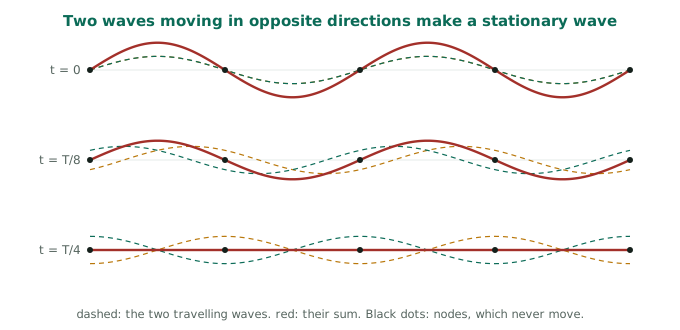
When two progressive waves of the same frequency and amplitude travel in opposite directions, they superpose to form a stationary (standing) wave. This happens, for example, with a wave and its reflection.
- Nodes (N): points of zero amplitude, always.
- Antinodes (A): points of largest amplitude.
- Node to node is $\dfrac{\lambda}{2}$. Node to the next antinode is $\dfrac{\lambda}{4}$.
- All points between two neighbouring nodes vibrate in phase. Points on either side of a node are in antiphase.
- A stationary wave stores energy. It does not carry energy along the medium.
Strings
A string fixed at both ends has a node at each end, so $l = n\dfrac{\lambda}{2}$: $$f_n = \frac{n}{2l}\sqrt{\frac{T}{m}}, \qquad n = 1, 2, 3, \ldots$$ The fundamental ($n = 1$) has one loop. All harmonics are possible. A sonometer checks the laws: $f \propto \dfrac{1}{l}$ at fixed tension, and $f \propto \sqrt{T}$ at fixed length.
Air columns
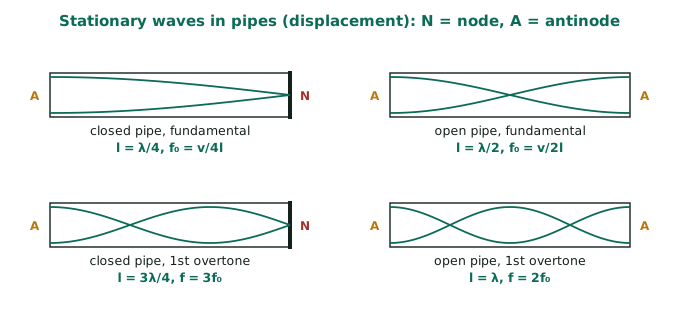
There is always a displacement antinode at an open end and a node at a closed end.
| Pipe | Fundamental | Harmonics present |
|---|---|---|
| closed at one end | $l = \dfrac{\lambda}{4}$, $f_0 = \dfrac{v}{4l}$ | odd only: $f_0, 3f_0, 5f_0, \ldots$ |
| open at both ends | $l = \dfrac{\lambda}{2}$, $f_0 = \dfrac{v}{2l}$ | all: $f_0, 2f_0, 3f_0, \ldots$ |
The antinode is actually a little beyond the open end. The end correction is $e \approx 0.3d$, where $d$ is the internal diameter. So for a closed pipe, $\dfrac{\lambda}{4} = l + e$.
Example: A pipe open at both ends resonates at $400\ \text{Hz}$. On a day when the speed of sound is $2%$ lower, the same pipe resonates at $f \propto v$, so $400 \times 0.98 = 392\ \text{Hz}$. (A 2023 Paper I question.)
The resonance tube experiment
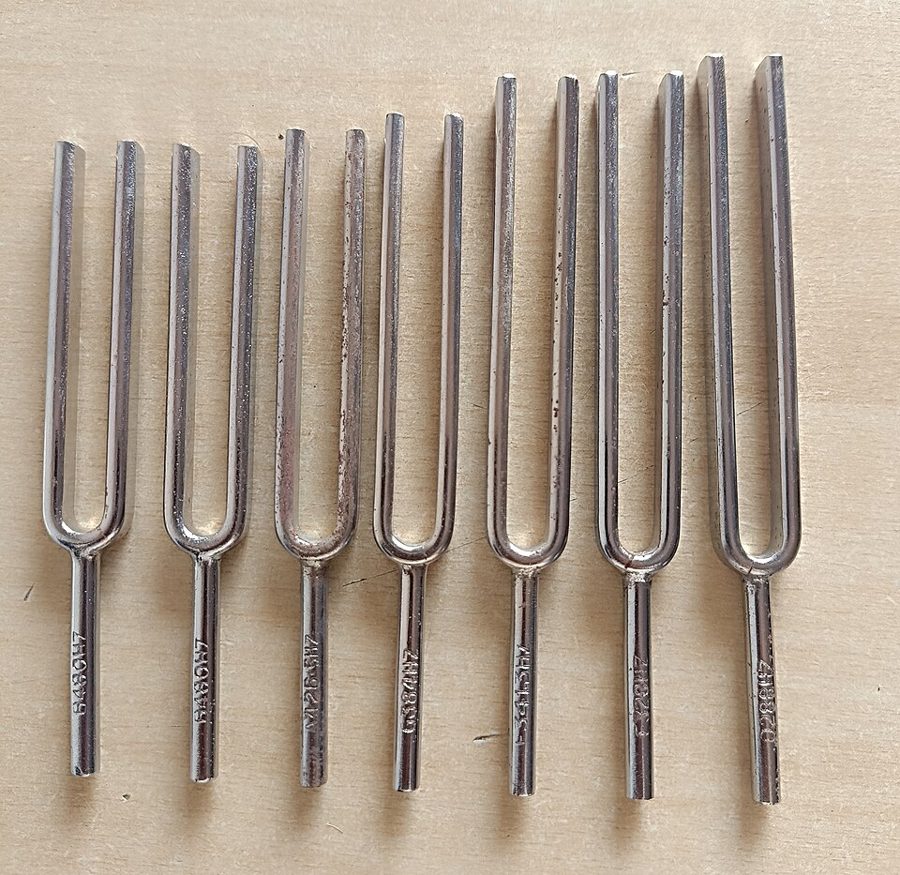
A tuning fork is held over a tube whose air column can be lengthened by lowering it in water. The first resonance is heard at length $l_1$, where $\dfrac{\lambda}{4} = l_1 + e$. The second is at $l_2$, where $\dfrac{3\lambda}{4} = l_2 + e$. Subtracting: $$l_2 - l_1 = \frac{\lambda}{2} \quad\Rightarrow\quad v = 2f(l_2 - l_1)$$ and the end correction drops out. With one length and several forks, plot $l$ against $\dfrac{1}{f}$: the gradient is $\dfrac{v}{4}$ and the intercept is $-e$.
Beats
Two notes of slightly different frequencies $f_1$ and $f_2$ sounded together give a loudness that rises and falls. These are beats, with $$f_{beat} = |f_1 - f_2|$$ To find which fork has the higher frequency, load one fork with a little wax. That lowers its frequency. If the beat frequency then rises, the loaded fork was already the lower one.
Exam tip: In a pipe question, first draw the pipe with N at the closed end and A at each open end. Then fit quarter-wavelengths into it. Do not try to recall formulas without the drawing.
Photo credits: Tuning forks - Various frequencies.jpg by K.Venkataramana, CC0.
