Rotational motion: torque, moment of inertia and angular momentum
Equations of uniform angular acceleration, torque and τ = Iα, moment of inertia, rotational kinetic energy, rolling and conservation of angular momentum.
Angular quantities and their equations
Rotation about a fixed axis has the same structure as motion in a straight line.
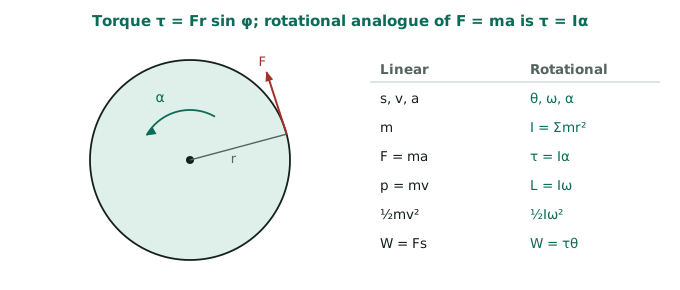
With constant angular acceleration $\alpha = \dfrac{d\omega}{dt}$ (unit $\text{rad s}^{-2}$): $$\omega = \omega_0 + \alpha t \qquad \theta = \omega_0 t + \tfrac{1}{2}\alpha t^2 \qquad \omega^2 = \omega_0^2 + 2\alpha\theta$$ A point at distance $r$ from the axis has tangential speed $v = r\omega$ and tangential acceleration $a = r\alpha$.
Torque and moment of inertia
The torque (moment) of a force $F$ about the axis is $\tau = Fr\sin\phi$, where $\phi$ is the angle between $F$ and the radius $r$. The rotational form of Newton's second law is $$\tau = I\alpha$$ where the moment of inertia $I = \sum m r^2$ measures how hard it is to change the body's rotation. It depends on the mass and on how far the mass is from the axis.
| Body (mass $M$) | Axis | $I$ |
|---|---|---|
| thin ring, radius $R$ | through centre, perpendicular to plane | $MR^2$ |
| uniform disc or cylinder, radius $R$ | through centre, along the axis | $\tfrac{1}{2}MR^2$ |
| solid sphere, radius $R$ | through centre | $\tfrac{2}{5}MR^2$ |
| thin rod, length $L$ | through centre, perpendicular | $\tfrac{1}{12}ML^2$ |
| thin rod, length $L$ | through one end, perpendicular | $\tfrac{1}{3}ML^2$ |
Example: A disc with $I = 8\ \text{kg m}^2$ slows from $40$ to $20\ \text{rad s}^{-1}$ in $10\ \text{s}$ under a constant torque. Then $\alpha = \dfrac{20 - 40}{10} = -2\ \text{rad s}^{-2}$ and $|\tau| = I|\alpha| = 16\ \text{N m}$. (A 2024 Paper I question.)
Rotational kinetic energy and rolling
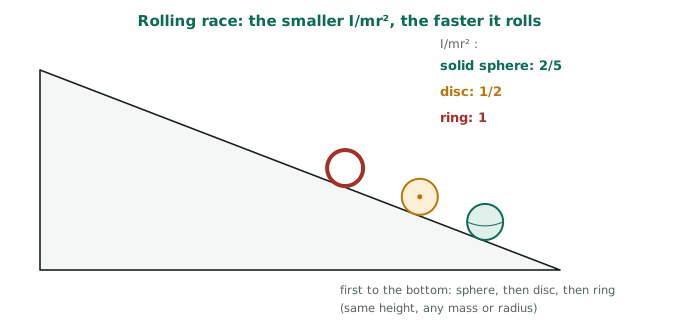
A rotating body has kinetic energy $\tfrac{1}{2}I\omega^2$. A body rolling without slipping both moves along and turns, with $v = r\omega$: $$E_k = \tfrac{1}{2}mv^2 + \tfrac{1}{2}I\omega^2$$ Rolling down a slope from height $h$: $mgh = \tfrac{1}{2}mv^2\left(1 + \dfrac{I}{mr^2}\right)$. So a solid sphere ($\tfrac{I}{mr^2} = \tfrac{2}{5}$) reaches the bottom before a disc ($\tfrac{1}{2}$), and the disc before a ring ($1$), whatever their masses and radii.
For a rolling wheel, the contact point is momentarily at rest. The centre moves at $v$ and the top of the rim moves at $2v$.
Angular momentum
Angular momentum $L = I\omega$ (unit $\text{kg m}^2\text{s}^{-1}$). The resultant torque equals its rate of change, $\tau = \dfrac{dL}{dt}$. With no external torque: $$I_1\omega_1 = I_2\omega_2$$ A skater who pulls in their arms makes $I$ smaller and spins faster. A diver tucks to turn quickly and opens out before entering the water. When a small mass drops onto a spinning turntable, $I$ increases and $\omega$ falls. Kinetic energy is lost in that process, but angular momentum is conserved.
Example: A bowling machine has two wheels that grip the ball on opposite sides, with rim speeds $v_1$ and $v_2$. The ball leaves with linear speed $\dfrac{v_1 + v_2}{2}$ and spin $\dfrac{v_1 - v_2}{2r}$. Equal wheel speeds give a fast ball with no spin. (The idea behind the 2023 Paper II essay question.)