Projectile motion
Treating horizontal and vertical motion separately: time of flight, maximum height, range and horizontal launches.
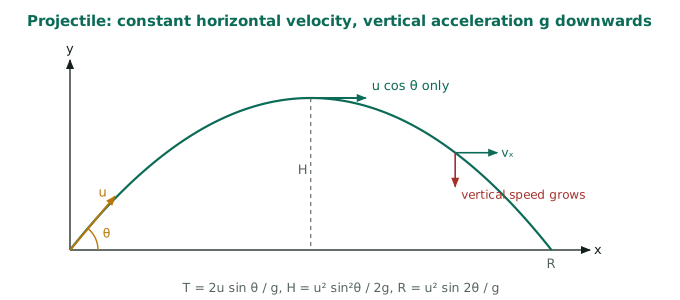
Two independent motions
A projectile moves under gravity alone (air resistance neglected). Resolve the launch velocity $u$ at angle $\theta$ above the horizontal:
| Horizontal | Vertical (up positive) | |
|---|---|---|
| initial velocity | $u\cos\theta$ | $u\sin\theta$ |
| acceleration | $0$ | $-g$ |
| velocity at time $t$ | $u\cos\theta$ (constant) | $u\sin\theta - gt$ |
| displacement at time $t$ | $x = (u\cos\theta)t$ | $y = (u\sin\theta)t - \tfrac{1}{2}gt^2$ |
The only link between the two columns is the time $t$.
Standard results on level ground
- At the top, the vertical velocity is zero: $t_{top} = \dfrac{u\sin\theta}{g}$.
- Time of flight $T = \dfrac{2u\sin\theta}{g}$.
- Maximum height $H = \dfrac{u^2\sin^2\theta}{2g}$.
- Range $R = (u\cos\theta),T = \dfrac{u^2\sin 2\theta}{g}$. It is greatest, $\dfrac{u^2}{g}$, at $\theta = 45^\circ$. The angles $30^\circ$ and $60^\circ$ give the same range.
- The path is a parabola: $y = x\tan\theta - \dfrac{g x^2}{2u^2\cos^2\theta}$.
Example: A ball is projected at $60^\circ$ to the horizontal with kinetic energy $K$. At the top only the horizontal component $u\cos 60^\circ = \tfrac{u}{2}$ remains. So the kinetic energy there is $\tfrac{1}{2}m\left(\tfrac{u}{2}\right)^2 = \tfrac{K}{4}$. (A 2023 Paper I question.)
Horizontal launch
A body thrown horizontally at speed $u$ from height $h$ starts with zero vertical velocity: $$t = \sqrt{\frac{2h}{g}}, \qquad \text{horizontal distance} = u\sqrt{\frac{2h}{g}}$$ A ball dropped and a ball thrown horizontally from the same height land at the same time.
Example: A bowler releases a cricket ball horizontally at $35.0\ \text{m s}^{-1}$ from $2.0\ \text{m}$ above the ground. It reaches the bat $17.5\ \text{m}$ away after $t = \dfrac{17.5}{35} = 0.50\ \text{s}$. In that time it falls $\tfrac{1}{2}(10)(0.5)^2 = 1.25\ \text{m}$, so it meets the bat $0.75\ \text{m}$ above the ground. Its vertical velocity is then $5.0\ \text{m s}^{-1}$, so its speed is $\sqrt{35^2 + 5^2} \approx 35.4\ \text{m s}^{-1}$. (From the 2023 Paper II essay.)
Exam tip: Always write the two columns, horizontal and vertical, before you calculate. Most lost marks come from mixing $u$ with $u\cos\theta$ or $u\sin\theta$.