Newton's laws, momentum and impulse
The three laws of motion, free-body diagrams, connected bodies, impulse, conservation of linear momentum and collisions.
The three laws
- First law. A body stays at rest, or moves with constant velocity, unless a resultant external force acts on it. The tendency to keep its state of motion is inertia, and mass measures it.
- Second law. The rate of change of momentum is proportional to the resultant force and in its direction: $F = \dfrac{d(mv)}{dt}$. With SI units and constant mass, $F = ma$. This defines the newton: the force that gives $1\ \text{kg}$ an acceleration of $1\ \text{m s}^{-2}$.
- Third law. If A pushes B, then B pushes A with an equal and opposite force. The two forces act on different bodies, so they never cancel each other.
Example: When a bull pulls a cart forward, what moves the bull forward is the force of the ground on the bull (friction on its hooves). The cart pulls the bull backwards, and the bull pushes the ground backwards. (A 2023 Paper I question.)
Careful: Weight $mg$ and the normal reaction $R$ on a book on a table are equal and opposite, but they are not an action–reaction pair. Both act on the book. The reaction to the book's weight is the book's pull on the Earth.
Free-body diagrams and connected bodies
Draw each body on its own with every force on it. Then write $F_{resultant} = ma$ for each body along its direction of motion.
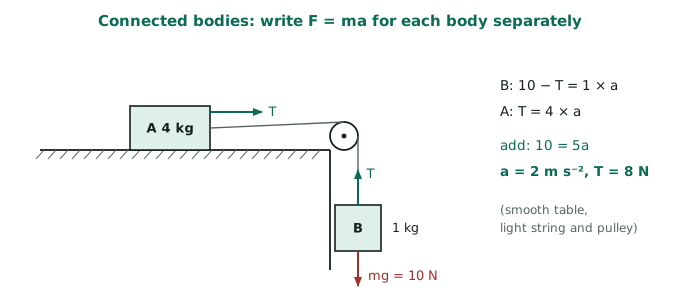
- In a light inextensible string over a smooth light pulley, the tension is the same throughout and both bodies have the same size of acceleration.
- In a lift accelerating upwards at $a$, the scale reading (normal reaction) is $R = m(g + a)$. Downwards, $R = m(g - a)$. In free fall, $R = 0$ ("weightless").
Example: Two blocks hang from a ceiling, A above B, joined by a light spring, and A hangs by a string. Just after the string is cut, the spring still pulls B up with $mg$ and A down with $mg$. So A accelerates at $\dfrac{mg + mg}{m} = 2g$, while B is momentarily still in equilibrium. (A 2023 Paper I question.)
Momentum and impulse
Linear momentum $p = mv$ (vector, unit $\text{kg m s}^{-1}$ = $\text{N s}$). Impulse $= F\Delta t = \Delta p$. For a varying force, the impulse is the area under the force–time graph.
Air bags, crumple zones, sand pits and bending the knees on landing all make $\Delta t$ longer. For the same $\Delta p$, the force is then smaller.
Example: A $0.16\ \text{kg}$ ball reaches a bat at $35\ \text{m s}^{-1}$ and returns along the same line at $35\ \text{m s}^{-1}$. The change in momentum is $0.16 \times (35 - (-35)) = 11.2\ \text{N s}$. If contact lasts $0.2\ \text{s}$, the average force is $\dfrac{11.2}{0.2} = 56\ \text{N}$.
Conservation of linear momentum
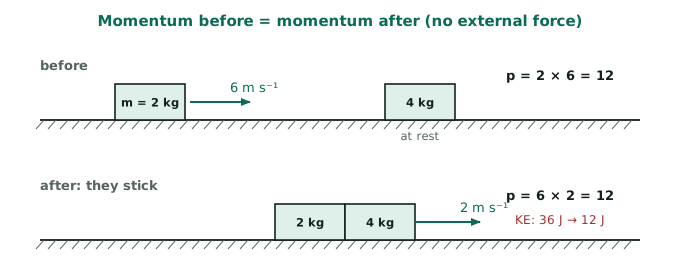
If no resultant external force acts on a system, its total momentum stays constant: $$m_1u_1 + m_2u_2 = m_1v_1 + m_2v_2$$ This is true for every collision and explosion. It follows from the second and third laws.
| Type | Momentum | Kinetic energy |
|---|---|---|
| elastic | conserved | conserved |
| inelastic | conserved | some lost (to heat, sound, deformation) |
| perfectly inelastic (bodies stick) | conserved | maximum loss |
| explosion (from rest) | conserved: total stays zero | increases (from chemical or stored energy) |
A bullet that embeds in a block on a smooth surface is a perfectly inelastic collision. Momentum is conserved, but most of the bullet's kinetic energy becomes heat. Total energy is still conserved.
Example: Trolley X (mass $m$, speed $2u$) catches trolley Y (mass $M$, speed $u$) and they move off together. Y's speed rises by $20%$ to $1.2u$. Then $m(2u) + Mu = (m + M)(1.2u)$, which gives $0.8m = 0.2M$, so $\dfrac{M}{m} = 4$. (A 2023 Paper I question.)
For an explosion from rest, the pieces fly apart with equal and opposite momenta. The lighter piece gets the larger speed and the larger share of the kinetic energy: $\dfrac{E_1}{E_2} = \dfrac{m_2}{m_1}$.