Motion in a straight line and motion graphs
Displacement, velocity and acceleration, the equations of uniformly accelerated motion, free fall and reading s–t and v–t graphs.
Describing motion
- Displacement $s$: distance in a stated direction (vector). Distance has no direction.
- Velocity $v = \dfrac{ds}{dt}$: rate of change of displacement. Speed is its magnitude.
- Acceleration $a = \dfrac{dv}{dt}$: rate of change of velocity, unit $\text{m s}^{-2}$.
A body moving round a circle at constant speed is accelerating, because the direction of its velocity changes.
Equations of uniformly accelerated motion
For motion in a straight line with constant acceleration $a$, initial velocity $u$, final velocity $v$, time $t$ and displacement $s$: $$v = u + at \qquad s = ut + \tfrac{1}{2}at^2 \qquad v^2 = u^2 + 2as \qquad s = \tfrac{1}{2}(u + v)t$$ Each equation leaves out one of the five quantities. Pick the one that leaves out the quantity you neither know nor want.
Example: A stone is thrown vertically up at $20\ \text{m s}^{-1}$ from the edge of a cliff $25\ \text{m}$ high. Take up as positive: $u = 20$, $a = -10$, $s = -25$. From $s = ut + \tfrac{1}{2}at^2$: $-25 = 20t - 5t^2$, so $t^2 - 4t - 5 = 0$ and $t = 5\ \text{s}$ (the negative root is not physical). Its speed on landing: $v^2 = 400 + 2(-10)(-25) = 900$, so $v = 30\ \text{m s}^{-1}$ downwards.
Careful: At the top of its flight a ball thrown upwards has $v = 0$ but its acceleration is still $g$ downwards. "Momentarily at rest" does not mean "no acceleration".
Motion graphs
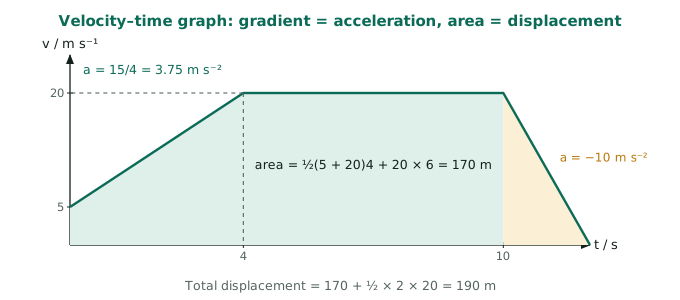
| Graph | Gradient gives | Area under it gives |
|---|---|---|
| displacement–time ($s$–$t$) | velocity | (nothing useful) |
| velocity–time ($v$–$t$) | acceleration | displacement |
| acceleration–time ($a$–$t$) | (rate of change of $a$) | change in velocity |
- A straight $s$–$t$ line means constant velocity. A curve that gets steeper means the body is speeding up.
- A horizontal $v$–$t$ line means constant velocity. A sloping straight line means constant acceleration.
- For a ball thrown up and caught, the $v$–$t$ graph is one straight line of gradient $-g$, crossing the time axis at the top of the flight.
- A ball bouncing on the floor gives a "saw-tooth" $v$–$t$ graph: straight lines of the same gradient $-g$, with a sudden jump in velocity at each bounce.
Exam tip: In Paper I graph questions, check three things in turn: the sign of the gradient, whether the gradient changes, and where the graph crosses the axis. These usually eliminate four options.
Relative velocity
The velocity of A relative to B is $\vec{v}_{AB} = \vec{v}_A - \vec{v}_B$. Two cars going the same way at $25$ and $20\ \text{m s}^{-1}$ approach each other at $5\ \text{m s}^{-1}$. Going in opposite directions, they approach at $45\ \text{m s}^{-1}$. For a boat crossing a river, add the boat's velocity relative to the water to the water's velocity as vectors.