Pressure in fluids, Archimedes' principle and flotation
Pressure at a depth, Pascal's principle and the hydraulic press, manometers and barometers, upthrust, flotation and relative density.
Pressure in a liquid
Pressure is the normal force per unit area, $P = \dfrac{F}{A}$, unit the pascal ($\text{Pa} = \text{N m}^{-2}$). In a liquid of density $\rho$ at rest: $$P = P_0 + h\rho g$$ where $P_0$ is the pressure at the surface, usually atmospheric, about $1.0 \times 10^5\ \text{Pa}$. The term $h\rho g$ on its own is the gauge pressure.
- Pressure at a point acts equally in all directions.
- All points at the same horizontal level in the same connected liquid at rest have the same pressure. This is the key step in every U-tube problem.
- Pressure does not depend on the shape or width of the container.
Manometer: a U-tube of liquid. A gas pressure $P$ connected to one arm makes a level difference $h$, and $P = P_0 + h\rho g$. Mercury barometer: atmospheric pressure holds up a column of mercury about $760\ \text{mm}$ high: $P_0 = h\rho_{Hg}g$.
Example: A pressure of $10\ \text{mmHg}$ in pascals is $0.010 \times 1.36 \times 10^4 \times 10 = 1.36 \times 10^3\ \text{Pa}$.
Pascal's principle
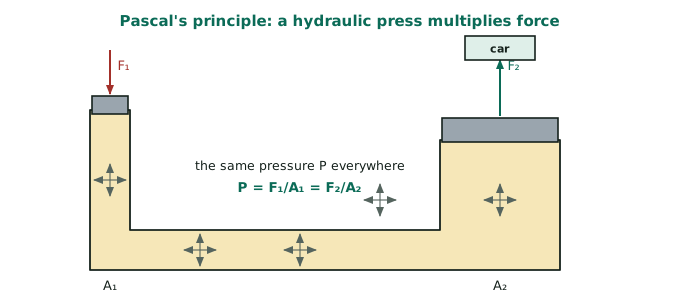
A pressure applied to an enclosed liquid is transmitted undiminished to every part of the liquid and to the walls. In a hydraulic press or car brake, a small force $F_1$ on a small piston $A_1$ produces $$F_2 = F_1\frac{A_2}{A_1}$$ on a large piston. Energy is still conserved: the large piston moves a smaller distance.
Archimedes' principle
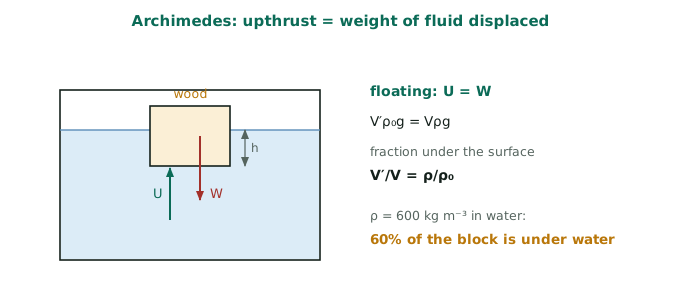
A body wholly or partly immersed in a fluid feels an upthrust equal to the weight of the fluid it displaces: $$U = V_{displaced},\rho_{fluid},g$$ The upthrust arises because the pressure on the bottom of the body is greater than on the top.
Flotation
A floating body is in equilibrium, so upthrust = its weight. It displaces its own weight of fluid. The fraction under the surface is $$\frac{V_{sub}}{V} = \frac{\rho_{body}}{\rho_{fluid}}$$ A ship floats higher in sea water than in fresh water. A hydrometer sinks less in a denser liquid.
A body denser than the fluid sinks. Its apparent weight is $W - U$. Weighing in air and then in water gives the relative density: $$\text{relative density of the solid} = \frac{W_{air}}{W_{air} - W_{water}}$$
Example: A sphere of density $\beta$ is fully immersed in a liquid of density $\rho$ and hangs from a rod. The rod's tension is $W - U = V(\beta - \rho)g$. This is the force that stretches the rod in a 2023 Paper I question.
Exam tip: Draw the forces on the body (weight, upthrust, tension or the reaction from the bottom) and write the equilibrium equation. Do not treat upthrust as a separate "law". It is one force in $\sum F = 0$.