Friction, moments and equilibrium
Static and kinetic friction, resolving forces, the triangle of forces, moments, couples and centre of gravity.
Friction
Friction acts along the surfaces in contact and opposes relative motion, or the tendency to it.
- Static friction grows to match the applied force, up to a maximum, the limiting friction $F_{max} = \mu_s R$.
- Once sliding, the kinetic (dynamic) friction is $F = \mu_k R$. It is roughly constant, with $\mu_k < \mu_s$.
- Friction is (nearly) independent of the area of contact and of the sliding speed.
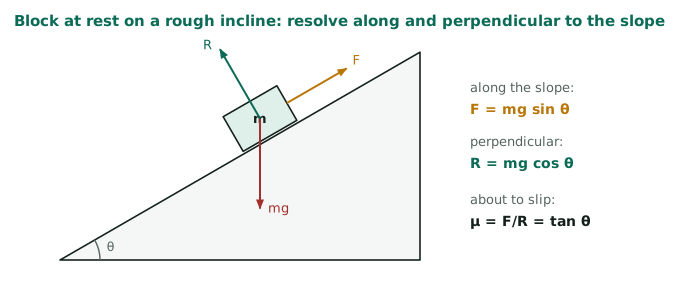
On an incline of angle $\theta$, resolve parallel and perpendicular to the slope: $R = mg\cos\theta$, and the friction needed is $mg\sin\theta$. The block is on the point of slipping when $mg\sin\theta = \mu_s mg\cos\theta$, that is when $\tan\theta = \mu_s$. If it slides down at constant velocity, then $\mu_k = \tan\theta$.
Example: Box A ($10\ \text{kg}$, $\mu_k = 0.5$) pushes box B ($5\ \text{kg}$) along a rough floor with a $100\ \text{N}$ horizontal force, and the force between the boxes is $40\ \text{N}$. For A: $100 - 40 - 0.5(100) = 10a$, so $a = 1\ \text{m s}^{-2}$. For B: $40 - \mu_B(50) = 5 \times 1$, so $\mu_B = 0.7$. (A 2024 Paper I question.)
Equilibrium of forces
A particle is in equilibrium when the vector sum of the forces on it is zero. For forces in a plane: $\sum F_x = 0$ and $\sum F_y = 0$.
Three forces in equilibrium can be drawn head to tail as a closed triangle. By Lami's theorem, $$\frac{F_1}{\sin\alpha} = \frac{F_2}{\sin\beta} = \frac{F_3}{\sin\gamma}$$ where each angle is the one between the other two forces.
Moments
The moment of a force about a point is the force times the perpendicular distance from the point to its line of action: $M = Fd$ (unit $\text{N m}$).
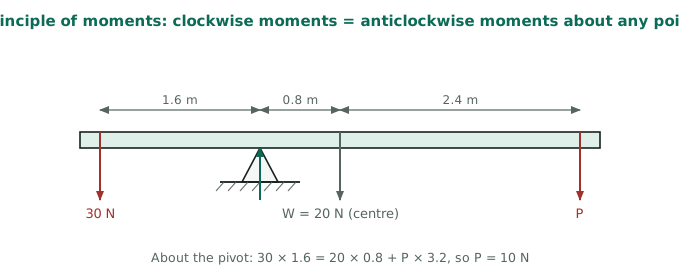
For a rigid body in equilibrium:
- the resultant force is zero, and
- the sum of clockwise moments equals the sum of anticlockwise moments about any point.
Taking moments about the point where an unknown force acts removes that force from the equation.
A couple is a pair of equal, opposite, parallel forces whose lines of action are apart. It has no resultant force but has a torque $Fd$ (where $d$ is the distance between the lines), the same about every point. A couple can turn a body but cannot move it along.
Centre of gravity
The centre of gravity is the point through which the whole weight acts. For a uniform rod it is at the middle. For a uniform triangular sheet it is where the medians meet. For a uniform semicircular sheet of radius $r$ it is on the axis of symmetry, $\dfrac{4r}{3\pi} \approx 0.42r$ from the straight edge.
A body hung from a point comes to rest with its centre of gravity vertically below that point. It is stable while the vertical line through its centre of gravity stays inside its base. A low centre of gravity and a wide base make a body harder to topple.
Exam tip: In a ladder problem, take moments about the foot of the ladder. The friction and the normal reaction from the floor both act there, so they drop out.