Fluid flow: continuity and Bernoulli's equation
Streamline and turbulent flow, the equation of continuity, Bernoulli's equation and its uses: Venturi meter, aerofoils, Pitot tube and speed of efflux.
Kinds of flow
In streamline (laminar) flow each particle follows a smooth path, a streamline, and the velocity at any fixed point does not change with time. Streamlines never cross. At high speeds or past obstacles the flow becomes turbulent, with eddies and irregular motion.
Bernoulli's equation applies to an ideal fluid: incompressible, non-viscous, in steady streamline flow.
Equation of continuity
In steady flow the same volume of fluid passes every cross-section each second: $$A_1v_1 = A_2v_2 = \text{volume flow rate } Q\ (\text{m}^3,\text{s}^{-1})$$ A narrower section means a faster flow. If the radius is halved, the area falls to a quarter, so the speed becomes four times as large. This is why water squirts out faster when you partly cover the end of a hose.
Bernoulli's equation
Along a streamline of an ideal fluid: $$P + \tfrac{1}{2}\rho v^2 + h\rho g = \text{constant}$$ Each term is an energy per unit volume: pressure energy, kinetic energy and gravitational potential energy. In a horizontal tube, where the speed is higher the pressure is lower.
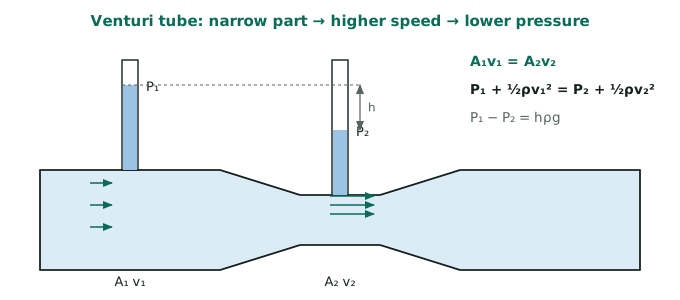
Example: An ideal fluid of density $\rho$ flows at speed $v_0$ and pressure $P_0$ in a horizontal pipe of radius $r$. It then enters a section of radius $\tfrac{r}{2}$. Continuity gives $v = 4v_0$. Bernoulli gives $P = P_0 + \tfrac{1}{2}\rho v_0^2 - \tfrac{1}{2}\rho(16v_0^2) = P_0 - \tfrac{15}{2}\rho v_0^2$. (A 2023 Paper I question.)
Applications
- Venturi meter: measures flow rate from the pressure drop $P_1 - P_2 = h\rho g$ between the wide and narrow parts.
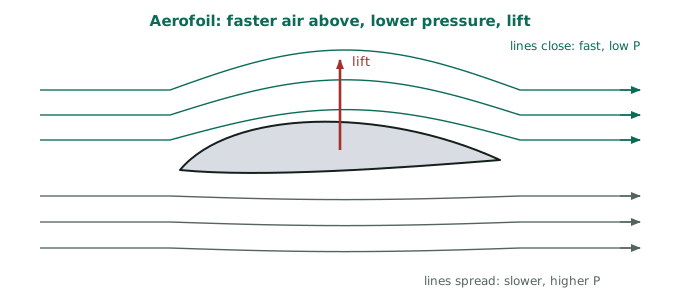
- Aerofoil (aircraft wing): air flows faster over the curved upper surface, so the pressure there is lower and there is a lift force.
- Spinning ball (Magnus effect): the spin speeds up the air on one side, so the ball curves towards that low-pressure side.
- Filter pump, scent spray, Bunsen burner: a fast jet creates low pressure that draws in air or liquid.
- Two ships side by side are pushed together, because the water between them flows faster and its pressure is lower.
Speed of efflux (Torricelli)
For a small hole a depth $h$ below the surface of a large open tank, the pressure at the surface and at the hole is atmospheric and the surface hardly moves. Bernoulli gives $$v = \sqrt{2gh}$$ which is the speed the liquid would gain by falling freely through $h$.
Careful: Bernoulli's equation needs streamline flow and no viscosity. For flow through a narrow tube where viscosity matters, use Poiseuille's equation (Unit 10).