Circular motion
Angular velocity, centripetal acceleration and force, the conical pendulum, banked roads, and motion in a vertical circle.
Describing circular motion
For a body moving round a circle of radius $r$:
- angular displacement $\theta$ in radians ($2\pi$ radians in a full turn)
- angular velocity $\omega = \dfrac{d\theta}{dt}$, unit $\text{rad s}^{-1}$. For uniform motion, $\omega = \dfrac{2\pi}{T} = 2\pi f$.
- linear speed $v = r\omega$. Its direction is along the tangent.
Example: A wheel turns at $600\ \text{rpm}$ (revolutions per minute). Then $f = 10\ \text{Hz}$ and $\omega = 2\pi \times 10 = 20\pi\ \text{rad s}^{-1}$.
Centripetal acceleration and force
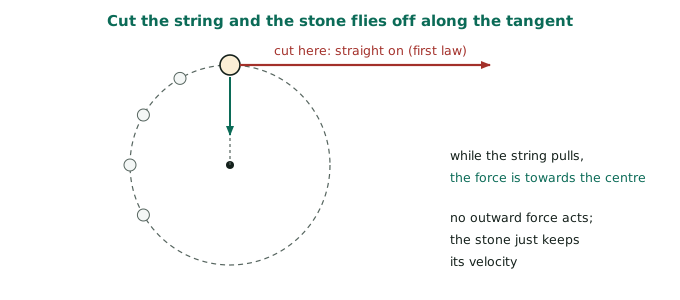
Even at constant speed the velocity keeps changing direction. So there is an acceleration towards the centre: $$a = \frac{v^2}{r} = r\omega^2$$ By Newton's second law, the resultant force on the body must point to the centre: $$F = \frac{mv^2}{r} = mr\omega^2$$ This centripetal force is supplied by real forces:
| Situation | What provides $\dfrac{mv^2}{r}$ |
|---|---|
| stone whirled on a string (horizontal circle on a smooth table) | tension |
| car turning on a level road | friction between tyres and road |
| satellite in orbit | gravitational attraction |
| electron in a magnetic field | magnetic force $Bqv$ |
| object on a turntable | static friction |
If the force is removed, the body moves off along the tangent, not outwards.
Conical pendulum and banked tracks
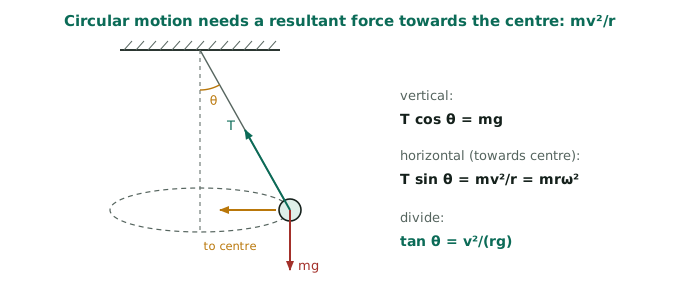
For a bob on a string of length $l$ making angle $\theta$ with the vertical: vertically $T\cos\theta = mg$, horizontally $T\sin\theta = \dfrac{mv^2}{r}$. Dividing gives $\tan\theta = \dfrac{v^2}{rg}$. The period is $2\pi\sqrt{\dfrac{l\cos\theta}{g}}$.
A road banked at angle $\theta$ needs no friction at the design speed $v = \sqrt{rg\tan\theta}$. The horizontal component of the normal reaction gives the centripetal force. The same equation explains why a cyclist leans into a bend.
Motion in a vertical circle
For a mass on a string swung in a vertical circle, the speed changes because gravity does work.
- At the top: $T + mg = \dfrac{mv_{top}^2}{r}$. The string stays taut only if $v_{top} \ge \sqrt{gr}$.
- At the bottom: $T - mg = \dfrac{mv_{bottom}^2}{r}$, so the tension is greatest here.
- Energy links the two: $v_{bottom}^2 = v_{top}^2 + 4gr$. So the least speed at the bottom is $\sqrt{5gr}$.
Careful: There is no outward "centrifugal force" in the free-body diagram of a body seen from the ground. Draw only the real forces. Their resultant towards the centre equals $\dfrac{mv^2}{r}$.