Wants, Resources and Factors of Production
Unit 1 · Basic economic problems and economic systems
Needs and wants, types of goods and resources, the four factors of production and what raises productivity.
Needs and wants
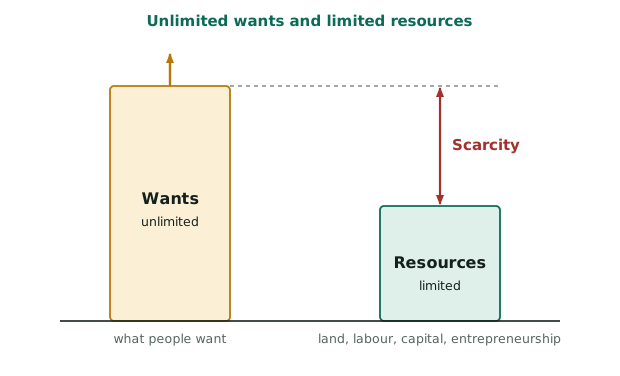
Needs (අවශ්යතා) are the things we must have to survive and live decently: food, clothing, shelter, basic health care and education. Wants (වුවමනා) are the things we would like to have beyond that: a smartphone, a car, holidays. Needs are limited, but wants are practically unlimited: when one want is met, new ones appear. What counts as a need also changes with time and place.
Goods and services
Goods (භාණ්ඩ) are physical items; services (සේවා) are intangible activities such as teaching, banking and transport.
- Economic goods (ආර්ථික භාණ්ඩ) are scarce: producing them uses resources, so they have a price. Rice, books, bus rides.
- Non-economic goods (ආර්ථික නොවන භාණ්ඩ), or free goods, are available in such quantity that no one has to pay and they use no scarce resources. Sunlight and, in most places, sea air. A good can change category: clean drinking water is free at a mountain spring but an economic good in a city.
Resources
Resources (සම්පත්) are the inputs used to produce goods and services.
- Economic resources are scarce and have an opportunity cost (a paddy field, a skilled worker). Non-economic resources exist in abundance (air for breathing).
- Renewable resources (පුනර්ජනනීය සම්පත්) can be replaced naturally if used wisely: forests, fish stocks, solar energy. Non-renewable resources cannot be replaced within a human time-scale: coal, petroleum, gemstones, mineral sands.
- Conservation means using natural resources wisely so that they last: replanting forests, preventing over-fishing, recycling, using energy efficiently. It protects the needs of future generations.
Factors of production
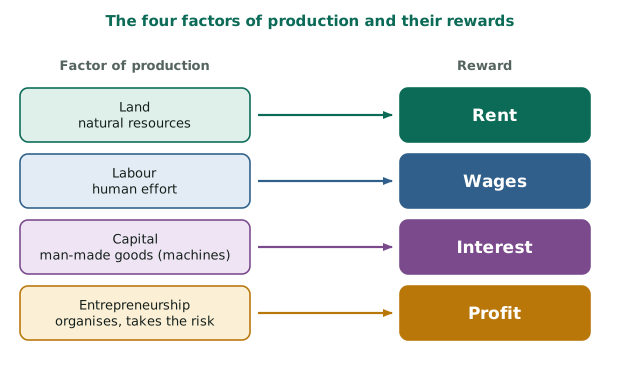
| Factor | Meaning | Characteristics | Reward |
|---|---|---|---|
| Land (භූමිය) | All natural resources: soil, water, forests, minerals | Fixed in supply; not made by people | Rent |
| Labour (ශ්රමය) | Human physical and mental effort | Inseparable from the worker | Wages |
| Capital (ප්රාග්ධනය) | Man-made goods used to produce other goods: machines, buildings, tools | Man-made; wears out (depreciates) with use | Interest |
| Entrepreneurship (ව්යවසායකත්වය) | Organising the other factors, taking risks, innovating | Bears the risk of the business | Profit |
Note that "capital" here means real capital goods, not money.
Productivity
Productivity (ඵලදායිතාව) is the amount of output produced per unit of input used.
Labour productivity = total output ÷ number of workers (or labour hours).
Example: a factory produces 1,800 shirts in a day using 30 workers. Labour productivity = 1,800 ÷ 30 = 60 shirts per worker per day.
Determinants of productivity (තීරක):
- Technology (තාක්ෂණය): better machines and methods produce more with the same inputs.
- Human capital (මානව ප්රාග්ධනය): the education, skills, training and health of workers.
- Management (කළමනාකරණය): good planning, organisation and motivation.
- Division of labour (ශ්රම විභජනය): splitting production into separate tasks, each done by different workers.
- Specialisation (විශේෂීකරණය): workers, firms or regions concentrating on what they do best.
Division of labour raises output because workers become more skilled at one task, less time is lost changing tasks, and machines can be used for simple tasks. It can also make work boring and leave workers dependent on one another.
Mind map
Remember:
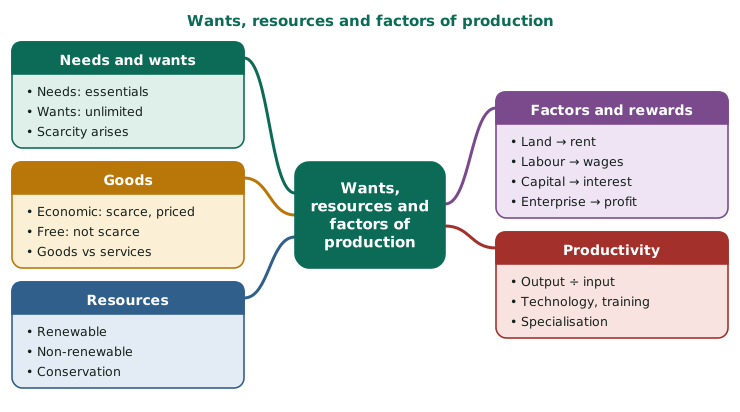
- Land → rent, labour → wages, capital → interest, entrepreneurship → profit
- Needs are limited, wants are unlimited
- Capital means machines and tools, not money
- The entrepreneur takes the risk, so profit is the entrepreneur's reward
- Productivity = output ÷ input
- Renewable: forests, fish; non-renewable: coal, petroleum.