Supply and the Law of Supply
Unit 2 · Demand, supply, elasticity and market equilibrium
Firm and market supply, the determinants of supply, the law of supply and its explanation through increasing opportunity cost, and the difference between a change in quantity supplied and a change in supply.
What is supply?
Supply is the quantity of a good or service that producers are willing and able to offer for sale at each possible price in a given period, ceteris paribus.
- Firm supply is the supply of a single producer.
- Market supply is the sum of all firms' supplies at each price (a horizontal sum).
Supply function, schedule, curve and equation
The supply function is Qs = f(P, C, T, Po, Tx, E, N, W): the quantity supplied depends on the good's own price (P), costs of production (C), technology (T), prices of other goods (Po), taxes and subsidies (Tx), expectations (E), number of sellers (N) and weather and other natural conditions (W).
Holding everything except P constant gives the supply equation, for example Qs = 4P - 20.
| Price (Rs. per kg) | Qs = 4P - 20 (kg per week) |
|---|---|
| 10 | 20 |
| 20 | 60 |
| 30 | 100 |
| 40 | 140 |
This is the supply schedule; plotting it gives the supply curve, which slopes upward (slope of P against Q = 1/4). Note that supply is zero at P = Rs. 5: below this price no one will supply.
Market supply from firms. Firm A: Qs = 2P. Firm B: Qs = 3P - 10 (for P at least 3.33). At P = 10, A supplies 20 and B supplies 20, so market supply is 40.
The law of supply and why it holds
The law of supply states that, ceteris paribus, the higher the price, the greater the quantity supplied. The main explanation is the law of increasing opportunity cost (rising marginal cost): to produce more of a good, a firm must use resources that are less suited to it, or bring in less fertile land, overtime labour and so on. The cost of each extra unit rises, so the firm will only produce more if the price rises to cover the higher marginal cost. A higher price also makes production more profitable and attracts new sellers.
Determinants of supply
| Determinant | Effect on supply |
|---|---|
| Costs of production (wages, fertiliser, fuel, raw materials) | Higher costs reduce supply; lower costs increase it |
| Technology | Better technology lowers costs and increases supply |
| Prices of other goods | If rubber becomes more profitable than tea, producers switch land to rubber and tea supply falls |
| Taxes and subsidies | A tax reduces supply; a subsidy (such as a fertiliser subsidy) increases it |
| Expectations | Expecting higher prices later, producers may hold back stock now |
| Number of sellers | More firms entering raise market supply |
| Weather and natural events | Drought or floods cut agricultural supply |
Change in quantity supplied vs change in supply
| Change in quantity supplied | Change in supply | |
|---|---|---|
| Cause | Change in the good's own price only | Change in any other determinant |
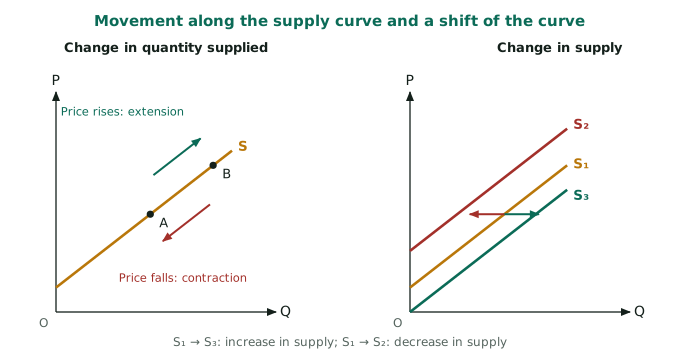
| On the graph | Movement along the same supply curve | Shift of the whole curve |
| Words | Extension (price rises) or contraction (price falls) | Increase (rightward / downward shift) or decrease (leftward / upward shift) |
Example. If the price of coconuts rises, farmers supply more: an extension along the curve. If a drought cuts yields, the supply curve for coconuts shifts left: a decrease in supply.
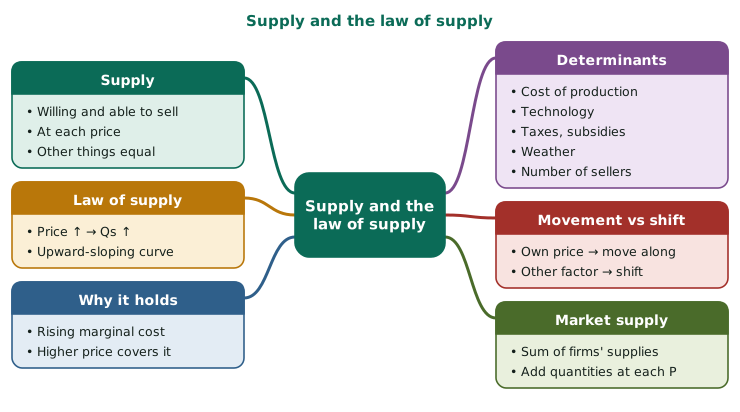
Mind map
Remember:
- Law of supply: price up, quantity supplied up (a direct link)
- Price change → movement along the curve; any other determinant → shift of the curve
- Marginal cost rises as output rises, so a higher price is needed to supply more
- Cost up / tax up → supply shifts left; technology up / subsidy → shifts right
- Determinants: costs, technology, other prices, taxes and subsidies, expectations, sellers, weather
- Market supply = horizontal sum of the firms' supplies