Scarcity, Choice and the Basic Economic Problems
Unit 1 · Basic economic problems and economic systems
The central problem of economics, opportunity cost, and the three basic questions every economy must answer.
Scarcity
Human wants are unlimited, but the resources (land, labour, capital, entrepreneurship) available to satisfy them are limited. This gap is called scarcity (හිඟකම) and it is the central problem of economics. Scarcity does not mean poverty or a temporary shortage: even the richest country faces it, because it cannot produce everything that everyone wants. A shortage of rice in the shops is a temporary event; scarcity of resources is permanent.
Choice and opportunity cost
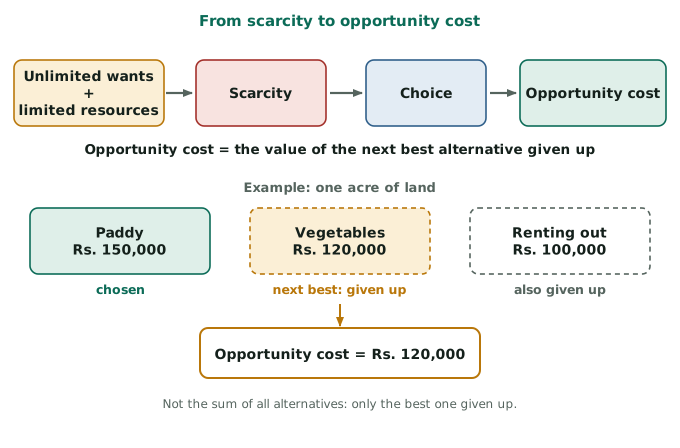
Because of scarcity we cannot have everything, so we must choose (තෝරා ගැනීම). Choosing one thing means giving up others. The opportunity cost (ආවස්ථික පිරිවැය) of a choice is the value of the next best alternative that is given up.
Example: a farmer has one acre. Growing paddy earns Rs. 150,000, growing vegetables earns Rs. 120,000, and renting the land out earns Rs. 100,000. If the farmer chooses paddy, the opportunity cost is Rs. 120,000, the best alternative given up, not the sum of all alternatives.
Opportunity cost is not always money. For a government, building a new highway means fewer funds for hospitals; for a student, an evening of cricket means an evening not studying.
Zero opportunity cost: if a resource has no alternative use (for example, an unemployed worker in a village where there is no other work, or free sunlight), using it gives up nothing, so its opportunity cost is zero.
The basic economic problems
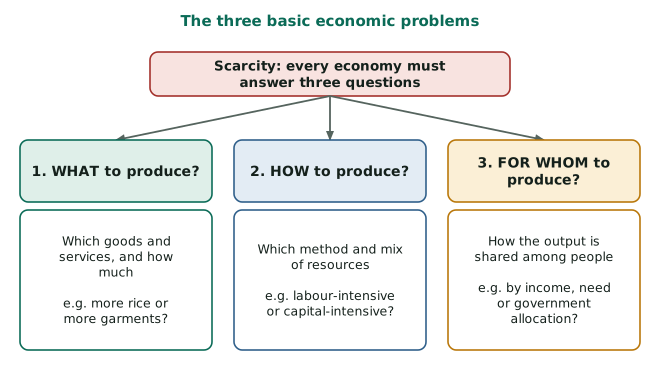
Because resources are scarce and have alternative uses, every society has to answer three questions:
- What and how much to produce? Which goods and services, and in what quantities: more rice or more garments, more schools or more roads?
- How to produce? Which production methods and what combination of resources: labour-intensive (many workers, few machines) or capital-intensive (few workers, many machines)?
- For whom to produce? How to distribute output among people: who gets how much, depending on income, need or government allocation?
These are the basic economic problems (මූලික ආර්ථික ප්රශ්න). They arise in every economy, whether poor or rich, large or small. Different economic systems answer them in different ways, which is the subject of the next lesson.
Mind map
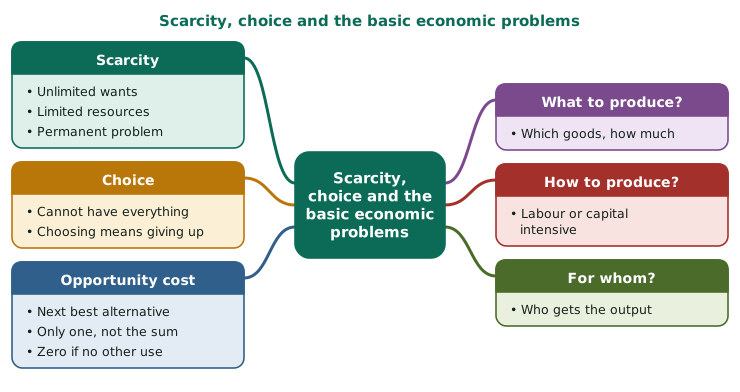
Remember:
- What? How? For whom? are the three basic questions
- Scarcity → choice → opportunity cost
- Opportunity cost = the next best alternative given up (just one, not the sum of all)
- A shortage is temporary, scarcity is permanent
- No alternative use means zero opportunity cost.