Price Elasticity of Supply
Unit 2 · Demand, supply, elasticity and market equilibrium
Measuring how responsive quantity supplied is to a price change: point and arc calculation, the types of supply, what determines it and why it matters.
Measuring responsiveness of supply
Price elasticity of supply (PES) measures how responsive the quantity supplied is to a change in the good's own price.
PES = % change in quantity supplied / % change in price
Because the law of supply gives a positive relationship, PES is normally positive.
Example. The price of vegetables rises by 10% and quantity supplied rises by 5%. PES = 5/10 = 0.5 (inelastic).
Types of PES
| PES | Name | Meaning |
|---|---|---|
| 0 | Perfectly inelastic | Quantity supplied does not change (vertical curve): e.g. a famous painting, a fixed supply of seats in a stadium |
| 0 to 1 | Inelastic | % change in Q is less than % change in P |
| 1 | Unitary elastic | % change in Q equals % change in P |
| More than 1 | Elastic | % change in Q is more than % change in P |
| Infinity | Perfectly elastic | Producers supply any amount at one price (horizontal curve) |
Point and arc elasticity of supply
Point PES uses the equation: PES = (ΔQ/ΔP) x (P/Q), where ΔQ/ΔP is the change in Q per Rs. 1 change in P, which is the coefficient of P in Qs = a + bP, namely b.
Example. Qs = 4P - 20. At P = 20: Q = 60, PES = 4 x 20/60 = 1.33 (elastic). At P = 40: Q = 140, PES = 4 x 40/140 = 1.14 (elastic, falling towards 1).
Arc PES uses average values. Price rises from Rs. 10 to Rs. 14, so Q rises from 20 to 36 on the same equation. Change in Q = 16; average Q = 28; so 16/28 = 57.1%. Change in P = 4; average P = 12; so 4/12 = 33.3%. Arc PES = 57.1 / 33.3 = 1.71.
Slope and elasticity: the intercept rule
For a straight-line supply curve Qs = a + bP:
- If a = 0 (the line passes through the origin) PES = 1 at every point.
- If a is negative (the line cuts the price axis) PES is above 1 at every point: elastic.
- If a is positive (the line cuts the quantity axis) PES is below 1 at every point: inelastic.
Two curves with the same slope can therefore have different elasticities at the same price. Elasticity compares percentage changes; slope compares absolute changes.
Determinants of PES
- Spare capacity and stocks: with idle machines or stocks of finished goods, firms can raise output quickly: elastic.
- Time period: supply is more elastic in the long run. A tea bush takes years to mature, so supply of tea is inelastic in the short run.
- Mobility and availability of factors: if labour, land and materials can move easily into the industry, supply is more elastic.
- Nature of the good: manufactured goods are more elastic than agricultural products. Perishable goods such as fresh fish cannot be stored, which makes supply inelastic over short periods.
- Ease of expansion: industries with low entry barriers and flexible technology can respond faster.
Importance of PES
- Farm prices: inelastic supply of crops in the short run means that a change in demand causes large price swings.
- Policy: governments need to know how far a guaranteed price or subsidy will raise output, and how long it takes.
- Taxes: the more inelastic supply is, the larger the share of a tax that producers bear.
- Business planning: firms with elastic supply can respond quickly to higher demand.
Mind map
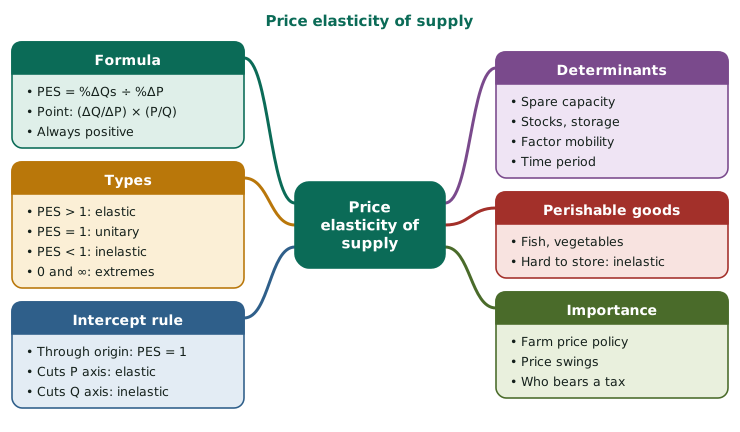
Remember:
- PES = %ΔQs ÷ %ΔP, and it is always positive
- PES > 1 elastic; = 1 unitary; < 1 inelastic
- Intercept rule: line from the origin → PES = 1; cuts the price axis → elastic; cuts the quantity axis → inelastic
- Spare capacity, stocks and time make supply more elastic
- Perishable fish and vegetables cannot be stored: inelastic in the short run