Price Control and Price Stabilisation
Unit 3 · Government intervention in the market
Maximum and minimum prices, shortages and surpluses, black markets, rationing, guaranteed prices, deficiency payments and buffer stocks.
Maximum price (ceiling)
A maximum price is the highest price that sellers may legally charge. Governments use it to keep essential goods affordable, for example rice, bread, gas or medicines.
- If the ceiling is above the equilibrium price, it has no effect (it is not effective).
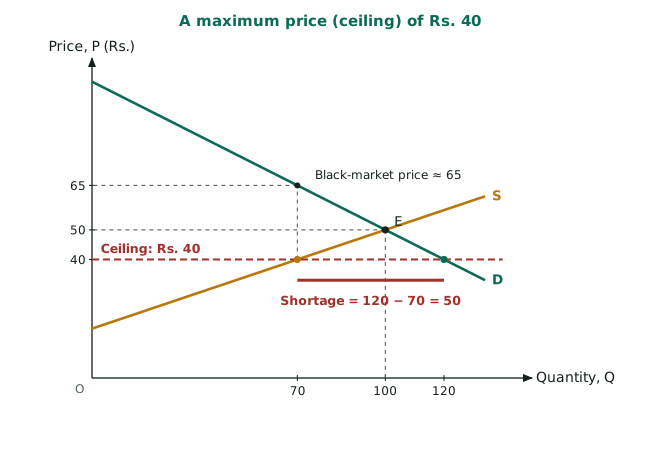
- If it is below equilibrium, it is an effective maximum price. Quantity demanded is then greater than quantity supplied, which creates a shortage (excess demand). Only the quantity supplied is traded, since no one can be forced to sell more.
Worked example
Rice: Qd = 200 - 2P, Qs = 3P - 50. Equilibrium: P = Rs. 50, Q = 100.
Ceiling at Rs. 40: Qd = 200 - 80 = 120, Qs = 120 - 50 = 70. Shortage = 50; only 70 units are traded.
Consequences
- Queues and rationing, and sellers deciding who to serve.
- Black markets: buyers are willing to pay more than the ceiling for the scarce units. The 70th unit is valued at 200 - 2P = 70, that is P = Rs. 65, so an illegal price near Rs. 65 can appear.
- Lower quality and less incentive for producers to invest.
- Producers lose and some consumers gain (those who get the goods), but total welfare falls.
Making it work
The government may use rationing (coupons, a fixed quota per household), buy supplies itself (imports or stocks) and sell them at the controlled price, or restrict demand, and enforce the price with inspections and fines.
Minimum price (floor)
A minimum price is the lowest price that may legally be paid. Examples are the guaranteed price for paddy and the minimum wage (a price for labour).
- A floor below equilibrium has no effect.
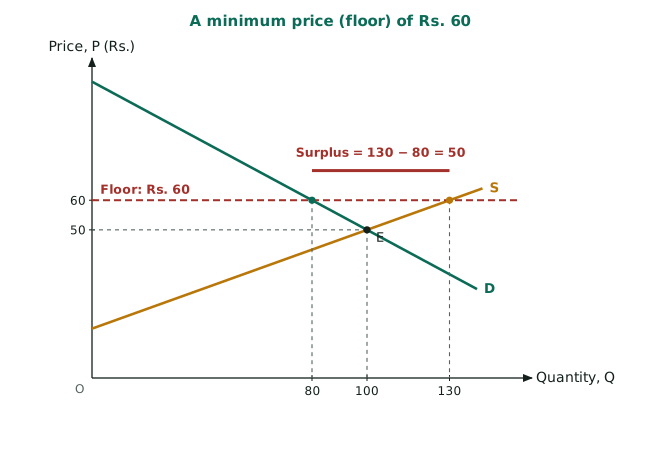
- A floor above equilibrium is effective: Qs is greater than Qd, giving a surplus (excess supply). Only the quantity demanded is sold unless someone buys the rest.
Worked example
Same market with a floor at Rs. 60: Qd = 200 - 120 = 80, Qs = 180 - 50 = 130. Surplus = 50.
Keeping a guaranteed price
1. The government buys the surplus. It buys 50 units at Rs. 60 = Rs. 3 000 and stores or exports them. Producers sell 130 units at Rs. 60.
2. Deficiency payment. The market clears on its own and the government pays producers the difference between the guaranteed price and the market price. Producers supply 130, and buyers will take 130 only at 200 - 2P = 130, so P = Rs. 35. The deficiency payment is 60 - 35 = Rs. 25 per unit x 130 = Rs. 3 250.
Buying the surplus keeps the market price high for consumers and creates stocks; a deficiency payment lowers the price to consumers and costs more here, but needs no storage. In both cases producers receive Rs. 60 per unit and the government uses taxpayers' money.
Price stabilisation
Farm prices swing because supply depends on the weather. Price stabilisation uses a buffer stock: in a bumper harvest the government (or an agency) buys the extra output to stop the price falling below a target; in a poor harvest it sells from the stock to stop the price rising above it. If the target is near the long-run average price, the scheme costs little over time. If the target is set too high, stocks pile up and cost the taxpayer.
Evaluating price controls
- Maximum prices help consumers in the short run but cause shortages, black markets and reduced supply over time.
- Minimum prices help producers but waste resources through surpluses and make consumers pay more.
- The result depends on elasticity: the more elastic the demand and supply, the larger the shortage or surplus.
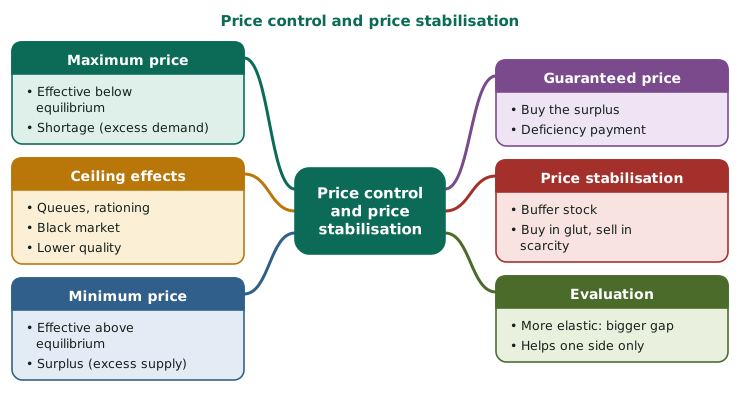
Mind map
Remember:
- Maximum price → effective only BELOW equilibrium; causes a shortage
- Minimum price → effective only ABOVE equilibrium; causes a surplus
- Black market price → read the demand curve at the quantity supplied (Qs)
- Buy the surplus → cost = guaranteed price × surplus
- Deficiency payment = (guaranteed price − market price) × quantity supplied
- Buffer stock → buy in a glut, sell in scarcity