The Production Possibility Frontier
Unit 1 · Basic economic problems and economic systems
Using the PPF to show scarcity, opportunity cost, efficiency, recession and economic growth.
What is the PPF?
The production possibility frontier (නිෂ්පාදන හැකියා මායිම් වක්රය, PPF), also called the production possibility curve, shows the maximum combinations of two goods (or two types of goods) that an economy can produce in a given period, using all its resources fully and efficiently with the available technology.
Assumptions (උපකල්පන):
- only two goods are produced;
- resources are fixed in quantity and quality during the period;
- technology is unchanged;
- resources are fully employed and used efficiently;
- resources can be moved from one good to another, though not always equally well.
A PPF from a table
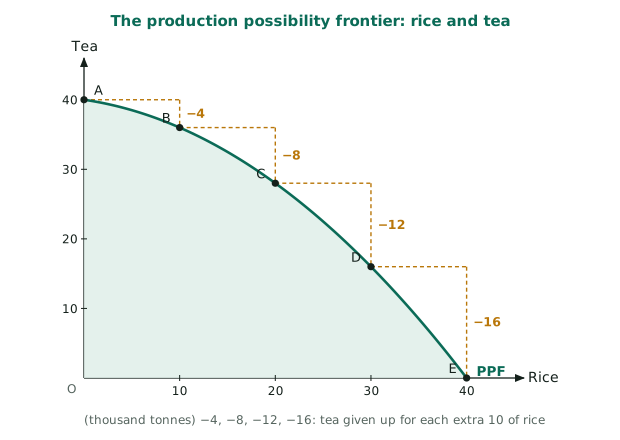
Suppose an economy can produce rice (thousand tonnes) and tea (thousand tonnes):
| Combination | Rice | Tea | Opportunity cost of 10 more rice |
|---|---|---|---|
| A | 0 | 40 | |
| B | 10 | 36 | 4 tea |
| C | 20 | 28 | 8 tea |
| D | 30 | 16 | 12 tea |
| E | 40 | 0 | 16 tea |
Plotting the combinations (rice on the horizontal axis, tea on the vertical axis) and joining them gives the PPF. Moving along the PPF, producing more of one good means producing less of the other. This is opportunity cost shown visually.
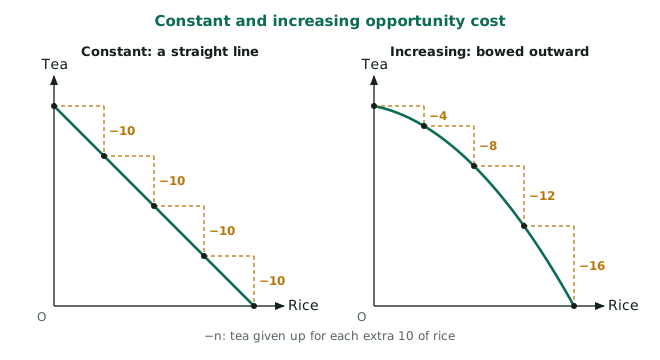
Constant and increasing opportunity cost
In the table, the opportunity cost of each extra 10 units of rice rises: 4, 8, 12, 16 tea. This is increasing opportunity cost (වැඩෙන ආවස්ථික පිරිවැය). The PPF is bowed outward (concave to the origin). It happens because resources are not equally suited to both goods: as rice output rises, resources better suited to tea must be moved to rice, so each extra 10 rice costs more tea.
If resources were equally good at making both goods, the opportunity cost would be constant (නියත ආවස්ථික පිරිවැය) and the PPF would be a straight line.
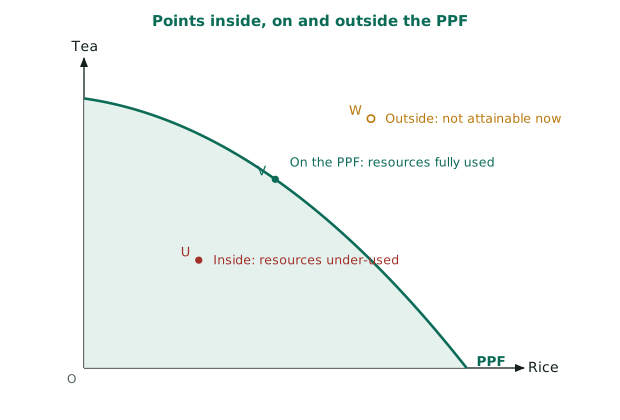
Points relative to the PPF
- On the PPF: resources fully used; productive efficiency (නිෂ්පාදන කාර්යක්ෂමතාව): more of one good is impossible without less of the other.
- Inside the PPF: under-utilisation (ඌන උපයෝජනය) of resources: unemployment or inefficiency. The economy could produce more of both goods. A recession (ආර්ථික පසුබැසීම) moves the economy inside the PPF.
- Outside the PPF: unattainable with present resources and technology.
- Allocative efficiency (සම්පත් බෙදාහැරීමේ කාර්යක්ෂමතාව): among the points on the PPF, the one that gives the mix of goods that society values most. Productive efficiency is necessary, but not sufficient.
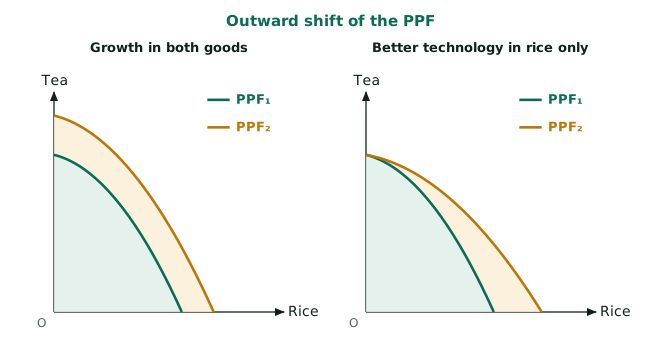
Change in production capacity
Production capacity (නිෂ්පාදන ධාරිතාව) changes when the PPF moves:
- Outward shift (economic growth, ආර්ථික වෘද්ධිය): more resources (more labour, new capital, discovery of natural resources), better technology, higher productivity from education and training.
- Inward shift (economic decline): war, natural disaster (such as the 2004 tsunami), loss of resources, migration of skilled workers.
- Pivot: if productivity improves in only one good, the PPF swings outward only along that good's axis.
Present and future consumption
Resources used to make more capital goods (machines, roads) today mean fewer consumer goods now. But capital goods raise productive capacity, so the PPF shifts further out in the future, allowing more consumption later. A country that invests heavily gives up present consumption (the opportunity cost) for faster growth.
Mind map
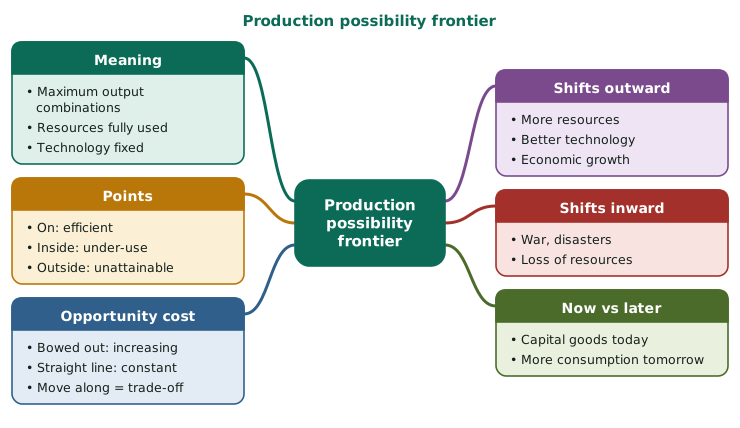
Remember:
- On the PPF = fully used; inside = under-utilisation; outside = unattainable
- Bowed outward = increasing opportunity cost; straight line = constant
- Outward shift = economic growth (more resources, better technology)
- Inward shift = war, disaster
- Better technology in one good only = the PPF pivots
- Capital goods today = more consumption tomorrow.