Money: Characteristics, Functions and Types
Unit 7 · Money, prices and banking
What money is, what makes a good money, the four functions of money, and the types of money used in Sri Lanka: currency, bank money, near money, money substitutes and e-money.
What is money?
Money is anything that is generally accepted by people as a medium of exchange and for the settlement of debts. In Sri Lanka today a Rs. 1,000 note, the balance in your savings account and a payment made with a QR code are all used as money, although they look very different.
Before money, people used barter: goods were swapped for goods. Barter works badly because it needs a double coincidence of wants. A paddy farmer who wants a pair of shoes must find a shoemaker who happens to want paddy at that moment, and they must also agree how much paddy equals one pair. Money removes this problem: the farmer sells paddy for money and uses the money to buy shoes from anyone.
Characteristics of a good money
| Characteristic | Meaning |
|---|---|
| General acceptability | Everyone is willing to take it in payment |
| Durability | It lasts through repeated use (this is why notes are printed on strong paper or polymer) |
| Portability | It is easy to carry and move |
| Divisibility | It can be divided into small units to buy cheap and costly things |
| Homogeneity (uniformity) | Units of the same value are identical, so one Rs. 100 note equals any other |
| Limited supply (scarcity) | If it were unlimited it would lose value |
| Stability of value | Its purchasing power does not change violently |
| Recognisability | It is easy to identify and hard to forge |
Functions of money
- Medium of exchange - money is used to buy and sell, so trade does not need a double coincidence of wants.
- Unit of account (measure of value) - the prices of all goods are stated in rupees, which makes prices easy to compare. A kilo of rice at Rs. 220 and a litre of coconut oil at Rs. 600 can be compared at once.
- Store of value - money lets people keep purchasing power from today to a later date. Money is the most liquid store of value, but inflation reduces its value over time.
- Standard of deferred payment - loans, rents and wages are agreed in money and paid later, for example a housing loan repaid over 15 years or a monthly salary paid at the month end.
Some books add the fifth function of a means of transferring value: money can be sent from one place to another, for example a remittance sent from abroad to a family in Matara.
Types of money
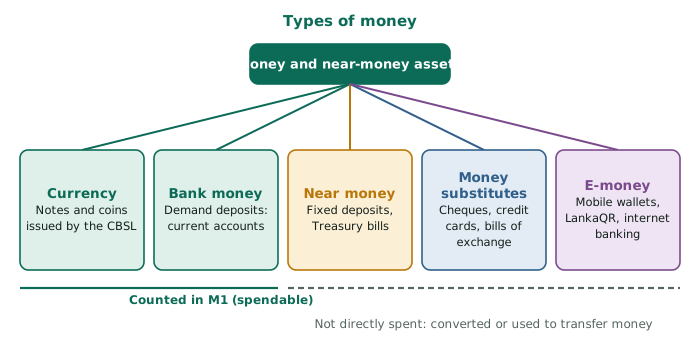
- Currency (cash) - notes and coins issued by the Central Bank of Sri Lanka (CBSL), which alone has the right to issue them. Notes and coins are legal tender, which means the law requires creditors to accept them for settling debts, within the limits set for coins. The currency held by the public is the most liquid money.
- Bank money - the demand deposits (current-account balances) that can be paid out on demand by cheque, or used by debit card or transfer, without first being turned into cash. Savings deposits are not counted here; they are included in M2 as time and savings deposits. The balance is created by banks and is the largest part of money in modern economies.
- Near money (quasi money) - assets that are not directly accepted in payment but can be turned into money quickly and with little loss of value. Examples: fixed deposits, savings deposits with notice, Treasury bills. Near money is a good store of value but not a medium of exchange until it is converted.
- Money substitutes - instruments that stand in for money in a payment but are not money themselves, for example cheques, credit cards, bills of exchange and promissory notes. A cheque is only an order to the bank to pay; the money is the bank deposit behind it. A credit card is a way of borrowing: the buyer pays the bank later.
- E-money (electronic money) - money stored and moved electronically: mobile wallets, internet and mobile banking, LankaQR payments, prepaid cards and CEFTS fund transfers. E-money is not a new kind of money; it is a faster way of spending bank money and stored value, and it reduces the need for cash.
Liquidity is how quickly and cheaply an asset can be turned into a means of payment without loss of value. The order from the most to the least liquid is: currency, demand deposits, savings and fixed deposits, Treasury bills, other assets such as shares and land.
Mind map
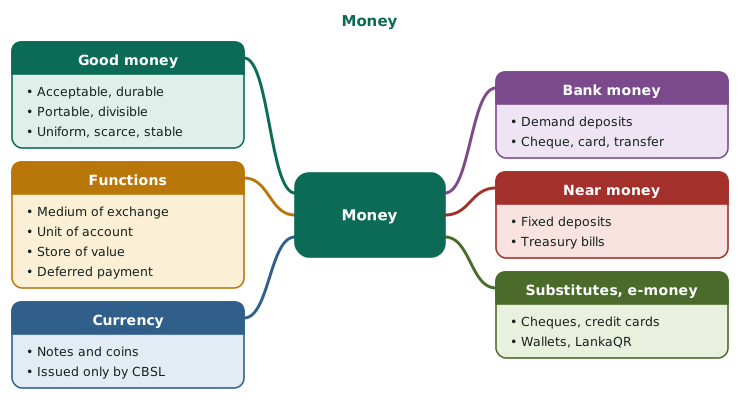
Remember:
- Barter problem: double coincidence of wants - money solves it
- Functions (MUSD): Medium of exchange, Unit of account, Store of value, Deferred payment standard
- Good money (DAPHS): Durable, Acceptable, Portable, Homogeneous, Scarce (also divisible and stable)
- Currency is issued only by the CBSL; bank money is created by commercial banks
- Near money = easily converted but not spent directly; money substitutes = cheque, credit card, which only transfer money
- Liquidity: cash is perfectly liquid; the more quickly an asset becomes cash without loss, the more liquid it is