The Market and Market Equilibrium
Unit 2 · Demand, supply, elasticity and market equilibrium
What a market is, goods and services versus factor markets, how equilibrium price and quantity are found from schedules, curves and equations, excess demand and supply, and consumer, producer and economic surplus.
The market
A market is any arrangement through which buyers and sellers come into contact to exchange goods, services or resources. It need not be a place: the Pettah market, a mobile phone app for vegetables and the stock exchange are all markets.
Functions of a market: it brings buyers and sellers together; it sets prices (the price signal); it allocates resources according to what consumers want; it provides information; it rewards efficient producers.
| Goods and services market | Factor market | |
|---|---|---|
| What is traded | Final goods and services (rice, mobile phones, haircuts) | Factors of production (land, labour, capital, entrepreneurship) |
| Buyers | Households | Firms (and government) |
| Sellers | Firms | Households (owners of the factors) |
| Price | Product price | Rent, wage, interest, profit |
Market equilibrium
The market is in equilibrium when the quantity demanded equals the quantity supplied (Qd = Qs). At the equilibrium price (P*) every buyer who is willing to pay P* can buy, and every seller who is willing to sell at P* can sell. There is no pressure for the price to change.
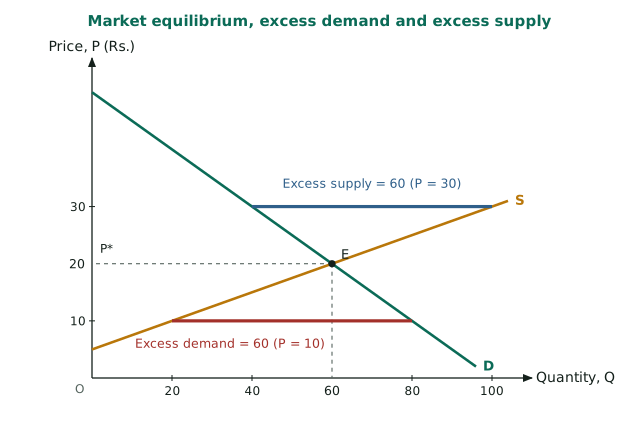
By schedule. From the schedules for Qd = 100 - 2P and Qs = 4P - 20:
| Price (Rs.) | Qd | Qs | Result |
|---|---|---|---|
| 10 | 80 | 20 | Excess demand of 60 |
| 15 | 70 | 40 | Excess demand of 30 |
| 20 | 60 | 60 | Equilibrium |
| 25 | 50 | 80 | Excess supply of 30 |
| 30 | 40 | 100 | Excess supply of 60 |
By equation. Set Qd = Qs: 100 - 2P = 4P - 20, so 120 = 6P, giving P = Rs. 20*. Substitute back: Q* = 100 - 40 = 60 (check: 4 x 20 - 20 = 60). The equilibrium is the intersection of the demand and supply curves.
Excess demand and excess supply
- Excess demand (shortage): at a price below equilibrium, Qd is greater than Qs. Buyers compete and bid the price up, and the quantity supplied rises and quantity demanded falls until equilibrium is restored.
- Excess supply (surplus): at a price above equilibrium, Qs is greater than Qd. Unsold stocks build up, sellers cut prices, and the market moves back to equilibrium.
The self-correcting process is the work of the price mechanism, sometimes called the invisible hand.
Excess demand price and excess supply price. For any quantity, the demand price is the highest price buyers will pay for the last unit, read from the demand curve; the supply price is the lowest price sellers need to supply that unit, read from the supply curve.
- At a quantity below equilibrium, demand price is higher than supply price. The gap is the excess demand price: buyers value the unit more than it costs to supply, so output should expand.
- At a quantity above equilibrium, supply price is higher than demand price. The gap is the excess supply price: the unit costs more to supply than buyers value it, so output should contract.
At equilibrium both gaps are zero.
Consumer, producer and economic surplus
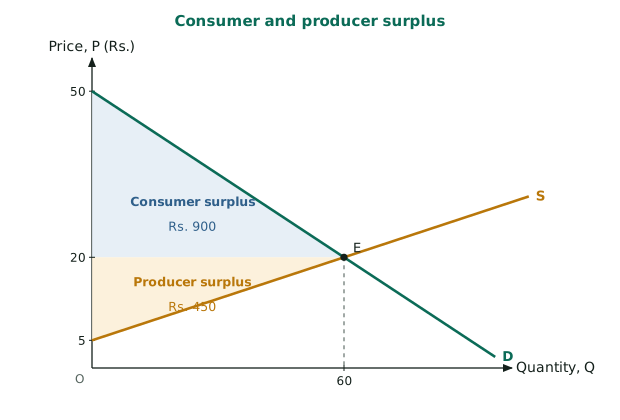
- Consumer surplus (CS): the difference between what consumers are willing to pay and the price they actually pay. On a graph, the area under the demand curve and above the price.
- Producer surplus (PS): the difference between the price producers receive and the minimum price they would accept. On a graph, the area above the supply curve and below the price.
- Economic (total) surplus = CS + PS.
Example. For Qd = 100 - 2P and Qs = 4P - 20, with P* = 20 and Q* = 60:
- The demand curve meets the price axis at P = 50 (Qd = 0), so CS = 1/2 x (50 - 20) x 60 = Rs. 900.
- The supply curve meets the price axis at P = 5 (Qs = 0), so PS = 1/2 x (20 - 5) x 60 = Rs. 450.
- Economic surplus = 900 + 450 = Rs. 1,350.
The competitive equilibrium gives the largest possible economic surplus. A quantity above or below Q* reduces it (a deadweight loss).
Mind map
Remember:
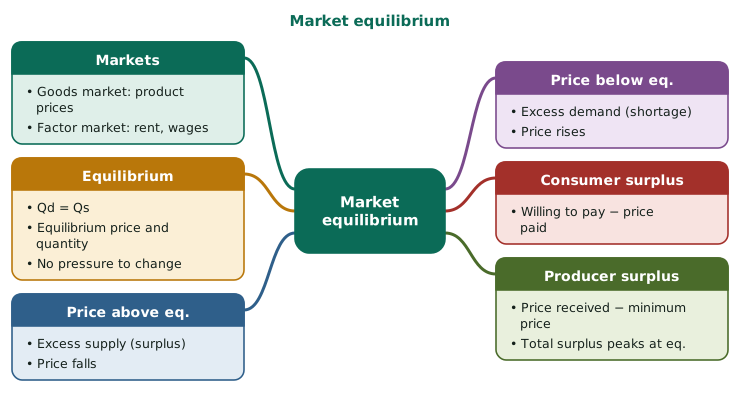
- Equilibrium: Qd = Qs
- Price above equilibrium: excess supply, price falls
- Price below equilibrium: excess demand, price rises
- Excess supply → stocks left over → price ↓; excess demand → shortage → price ↑
- Consumer surplus + producer surplus = total (economic) surplus
- Total surplus is greatest at equilibrium