Macroeconomic Equilibrium and Disequilibrium
Unit 6 · Macroeconomic equilibrium
When the whole economy is at rest, what happens when it is not, and the three ways of showing macroeconomic equilibrium (Y = E, W = J and AD = AS).
Macroeconomic equilibrium
In a single market, equilibrium is the price at which quantity demanded equals quantity supplied. Macroeconomic equilibrium is the same idea for the whole economy. It is the level of national output (and so national income) at which the total amount that households, firms, the government and foreigners plan to spend equals the total amount the economy produces.
At that level:
- planned aggregate expenditure (E or AE) = aggregate output (Y), which also equals aggregate income;
- firms sell exactly what they expected to sell, so their stocks (inventories) do not change in a way they did not plan;
- nobody has a reason to change output, employment or spending, so the level of output stays where it is unless something changes.
The word planned matters. Actual expenditure always equals output after the event, because any goods that were produced but not sold are counted as stocks that firms have "bought" from themselves. Equilibrium requires that the stock change was planned, not forced on firms.
Disequilibrium and macroeconomic instability
If planned expenditure and output differ, the economy is in disequilibrium, and firms find out through their stocks.
| Situation | What happens to stocks | What firms do | Result |
|---|---|---|---|
| Planned expenditure > output | Stocks fall below the planned level (unplanned fall) | Raise production, hire more workers | Output and income rise toward equilibrium |
| Planned expenditure < output | Unsold goods pile up (unplanned rise) | Cut production, lay off workers | Output and income fall toward equilibrium |
| Planned expenditure = output | As planned | No change | Equilibrium |
Worked example. Output is Rs. 1,200 billion but households, firms, the government and exporters together plan to spend only Rs. 1,100 billion. Rs. 100 billion of output is not sold, so stocks rise by Rs. 100 billion against the plan. Firms cut production, incomes fall, spending falls with them, and the gap closes as output moves down toward the equilibrium level.
Macroeconomic instability means that output, employment, prices and the external accounts keep moving sharply away from a stable path. Sri Lanka in 2022 is a clear case. Real GDP contracted by about 7.3% in 2022 and about 2% in 2023 as imports, fuel and spending were squeezed by the foreign exchange crisis; consumer price inflation peaked at about 70% (CCPI, September 2022); the economy then recovered, growing by about 5% in 2024 (CBSL, DCS). Policies are needed to push the economy back toward a stable, high-employment equilibrium.
Three approaches to show equilibrium
The same equilibrium can be found in three ways. They always give the same level of output.
| Approach | Equilibrium condition | Idea |
|---|---|---|
| Aggregate income = aggregate expenditure | Y = E | Output is just enough to meet planned spending |
| Withdrawals = injections | W = J, i.e. S + T + M = I + G + X | Money leaving the circular flow is replaced by money entering it |
| Aggregate demand = aggregate supply | AD = AS | Total demand at a price level equals total output supplied |
The first two are developed with schedules, graphs and equations in the lesson on equilibrium income. They come from the circular flow you met in Unit 5: saving (S), taxes (T) and imports (M) are leakages (withdrawals) from the flow, and investment (I), government purchases (G) and exports (X) are injections.
The AD-AS approach
Aggregate demand (AD) is the total planned expenditure on the country's output at each price level: AD = C + I + G + (X - M). Aggregate supply (AS) is the total output firms are willing to produce at each price level.
- The AD curve slopes downward: when the price level falls, the real value of wealth and money balances rises, interest rates tend to fall, and Sri Lankan goods become cheaper compared with foreign goods, so more is demanded.
- The short-run aggregate supply (SRAS) curve slopes upward: in the short run, wages and other input prices are slow to adjust, so a higher price level raises profit and encourages more output.
- The long-run aggregate supply (LRAS) curve is vertical at the potential (full-employment) output Yf, because in the long run output depends on resources and technology, not on the price level.
Macroeconomic equilibrium in this approach is the point where AD meets AS. It fixes the equilibrium price level (P₀) and equilibrium real output (Y₀).
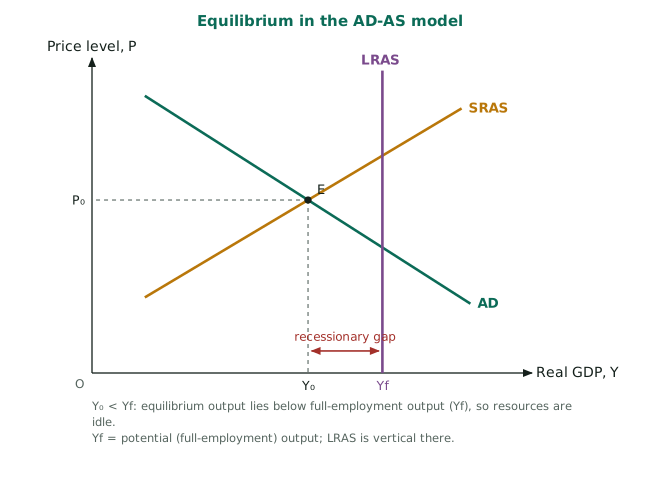
In the diagram, equilibrium output Y₀ lies to the left of Yf. Resources are idle, so there is a recessionary gap. If equilibrium were to the right of Yf, resources would be over-stretched and prices would rise strongly (an inflationary gap). So equilibrium does not guarantee full employment: the economy can settle at a high-unemployment equilibrium, which is why governments use fiscal and monetary policy.
A link between the approaches: in the simple income-expenditure model prices are taken as fixed, so AS is just the output Y that firms supply to meet demand, and AD = AS becomes E = Y.
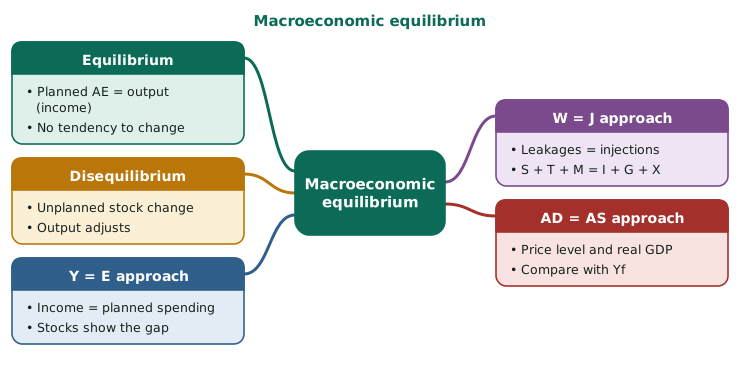
Mind map
Remember:
- Equilibrium = planned expenditure equals output; no unplanned stock change
- Stocks are the signal: unplanned fall means output rises; unplanned rise means output falls
- Instability = big swings in output, jobs, prices, external balance (Sri Lanka 2022)
- Three approaches, one answer: Y = E, W = J (S + T + M = I + G + X), AD = AS
- AD slopes down, SRAS up, LRAS vertical at potential output Yf
- Equilibrium is not full employment: Y₀ can be below or above Yf