Government Intervention and the Unit Tax
Unit 3 · Government intervention in the market
Why and how governments intervene in markets, and what a unit tax does to price, quantity, surpluses, revenue and total welfare.
Why governments intervene
A free market usually works well, but it can give results that a society does not accept: prices that poor households cannot afford, farmers who earn too little, harmful goods that are over-consumed, or too little revenue to build roads and schools. In a mixed economy such as Sri Lanka the government therefore intervenes in markets.
The main ways of intervening are:
- Taxes: for example VAT, excise duty on liquor and cigarettes, and the fuel tax. They raise revenue and discourage consumption of harmful goods.
- Subsidies: for example the fertiliser subsidy for paddy farmers. They lower costs or prices to encourage production and consumption.
- Price control: a legal maximum price (ceiling), such as the controlled price of a medicine, or a legal minimum price (floor), such as a guaranteed price for paddy.
- Price stabilisation: buying in a good season and selling in a bad one to keep prices steady (covered in the last lesson of this unit).
Unit tax and ad valorem tax
- A unit (specific) tax is a fixed amount per unit sold, for example Rs. 10 per litre. The same rupee amount is added whether the price is high or low.
- An ad valorem (proportional) tax is a percentage of the price, for example 18% VAT. The rupee amount grows with the price.
A tax can be imposed on suppliers (the seller must pay the government) or on buyers (the buyer must pay). Who the law makes pay does not decide who really bears the burden; that is the subject of the next lesson.
Effect on the curves
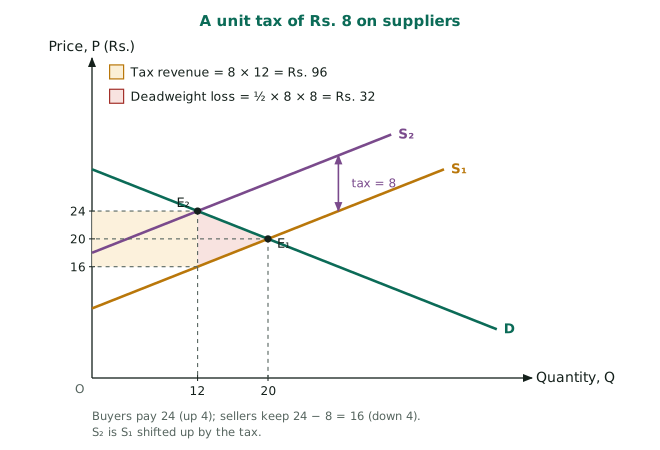
A unit tax of Rs. t on suppliers raises the cost of selling each unit by t. At any price buyers pay, sellers now keep only P minus t. So the supply curve shifts up (left) by exactly t. The demand curve does not move.
In equation form, if the original supply is Qs = f(P), the new supply is Qs = f(P - t).
If the tax is on buyers, buyers will pay only P minus t to sellers, so the demand curve shifts down (left) by t and supply stays. In equation form, if the original demand is Qd = f(P), the new demand is Qd = f(P + t), where P is now the price the sellers receive and the buyers pay P + t.
Schedule view. Take the rice market of the example below (Qd = 60 - 2P, Qs = -20 + 2P) with a tax of Rs. 8 on suppliers. Each new quantity supplied is the old quantity at a price Rs. 8 lower:
| Price buyers pay (Rs.) | 20 | 24 | 28 |
|---|---|---|---|
| Qd | 20 | 12 | 4 |
| Qs before the tax | 20 | 28 | 36 |
| Qs after the tax = old Qs at (P - 8) | 4 | 12 | 20 |
Demand and the new supply are equal (12) at Rs. 24. If the Rs. 8 tax were on buyers instead, the new demand would be Qd = 60 - 2(P + 8) = 44 - 2P, where P is the price sellers receive; it equals Qs at P = 16 (Q = 12), so buyers still pay 16 + 8 = Rs. 24.
For an ad valorem tax the vertical gap between the old and new supply curves grows as the price rises, so the new curve is steeper and not parallel to the old one.
Worked example
Rice market: Qd = 60 - 2P and Qs = -20 + 2P (P in Rs. per kg, Q in thousands of kg).
Before the tax: 60 - 2P = -20 + 2P gives P = Rs. 20 and Q = 20.
A unit tax of Rs. 8 on suppliers: new supply Qs = -20 + 2(P - 8) = -36 + 2P.
60 - 2P = -36 + 2P gives P = Rs. 24, Q = 12.
- Buyers now pay Rs. 24 (up Rs. 4).
- Sellers receive 24 - 8 = Rs. 16 (down Rs. 4).
- Tax revenue = 8 × 12 = Rs. 96.
Welfare effects
The demand curve cuts the price axis at P = 30 (Qd = 0) and the supply curve at P = 10 (Qs = 0).
| Before | After | Change | |
|---|---|---|---|
| Consumer surplus | ½ × (30 - 20) × 20 = 100 | ½ × (30 - 24) × 12 = 36 | -64 |
| Producer surplus | ½ × (20 - 10) × 20 = 100 | ½ × (16 - 10) × 12 = 36 | -64 |
| Government revenue | 0 | 8 × 12 = 96 | +96 |
| Total welfare | 200 | 168 | -32 |
The loss of 32 is the deadweight loss: trades worth doing (buyers value them above the sellers' cost) that no longer happen because of the tax. It is the triangle ½ × tax × fall in quantity = ½ × 8 × (20 - 12) = 32.
Exam tip: the buyer's price and the seller's price always differ by exactly the tax; revenue is the tax times the new quantity; the deadweight loss uses the fall in quantity.
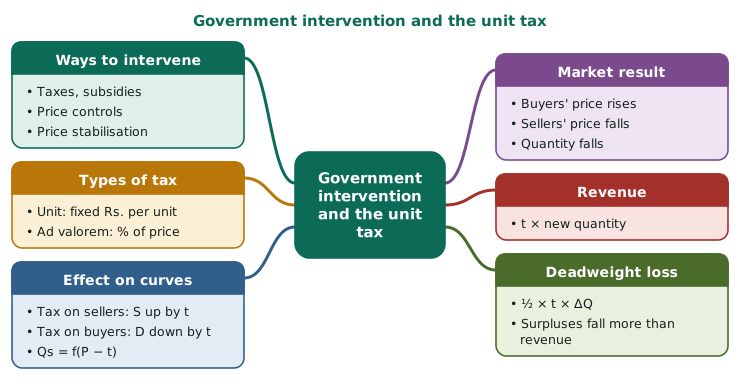
Mind map
Remember:
- Unit tax → supply curve up (left) by t: Qs = f(P − t)
- Tax on buyers → demand curve down (left) by t: Qd = f(P + t)
- Price gap → price buyers pay − price sellers keep = t, always
- Tax revenue = t × the NEW quantity
- Deadweight loss = ½ × t × FALL in quantity
- Ad valorem tax → percentage of price; the new supply curve is steeper, not parallel