The Foundation of Economics
Unit 1 · Basic economic problems and economic systems
What economics studies, micro and macro economics, and positive and normative statements.
Economic behaviour and the meaning of economics
Every day people make economic decisions. A family decides how much of its monthly income to spend on rice, school books and transport. A tea estate decides how many pluckers to employ. The government decides whether to build a road or a hospital first. All of these are examples of economic behaviour (ආර්ථික හැසිරීම): choosing how to use limited means to meet wants.
Economics is the social science that studies how individuals, firms and governments choose to use limited resources to satisfy unlimited human wants. It is a social science because it studies human behaviour in society, and it uses the scientific method: observe, form a theory, test it against data. Unlike physics, however, economists cannot run most experiments, so they rely on data and models.
Why study economics?
- It helps us understand everyday problems such as rising prices, unemployment and shortages of fuel.
- It helps households and firms make better choices with their limited money and resources.
- It helps governments design policies on taxes, spending, trade and the exchange rate, and judge their results.
- It trains logical, evidence-based thinking about trade-offs.
Microeconomics and macroeconomics
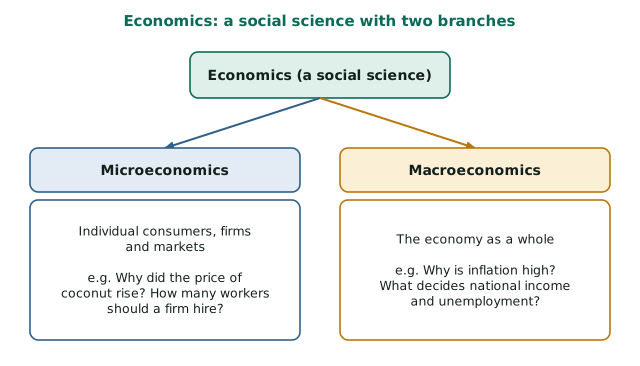
| Microeconomics (සූක්ෂ්ම ආර්ථික විද්යාව) | Macroeconomics (සාර්ව ආර්ථික විද්යාව) | |
|---|---|---|
| Focus | Individual consumers, firms and markets | The whole economy |
| Typical questions | Why did the price of coconut rise? How many workers should a firm hire? | Why is inflation high? What determines national income and unemployment? |
| Variables | Price of a good, output of a firm, a household's demand | GDP, general price level, total employment |
The two are linked: the national economy is the sum of millions of individual decisions, but what is true for one household need not be true for the whole economy.
Positive and normative statements
A positive statement (යථානුරූපී ප්රකාශය) is about facts. It can be checked against evidence and shown to be true or false. "The price of a kilogram of red onions rose by 20% last month." is positive. A positive statement can be wrong and still be positive.
A normative statement (අභිමතානුරූපී ප්රකාශය) contains a value judgement about what ought to be done. It cannot be proved true or false by facts alone. "The government should lower the price of onions." is normative. Words such as should, ought, fair and unjust are clues.
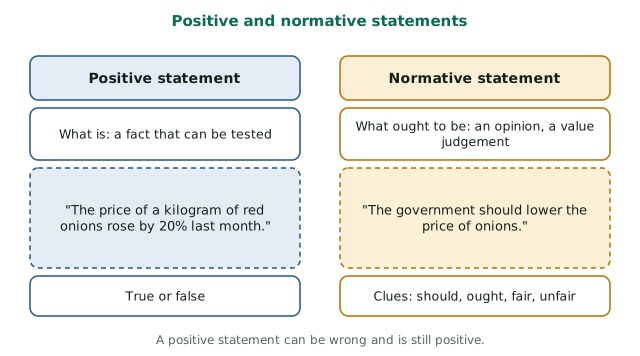
Economists use positive analysis to find out what would happen, and normative reasoning to decide what is desirable. Good policy needs both.
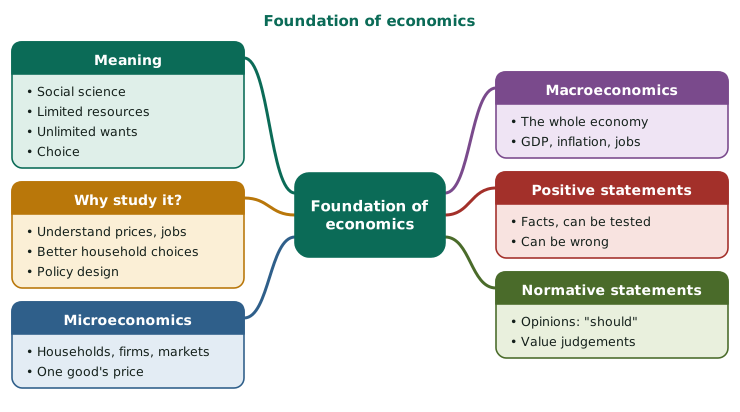
Mind map
Remember:
- Economics = limited resources, unlimited wants
- Micro = individual units (a household, a firm); Macro = the whole economy
- Positive = facts you can test; normative = opinions, so look for "should"
- A positive statement can be wrong and is still positive.