The Foreign Exchange Market and the Exchange Rate
Unit 10 · Balance of payments and exchange rates
What the exchange rate is, how it is quoted, and how the demand for and supply of foreign exchange determine it in a free market.
The foreign exchange market
When a Sri Lankan importer buys goods from Japan, she must pay in foreign currency, so rupees are exchanged for yen or dollars. The foreign exchange market is the market in which national currencies are bought and sold against each other. In Sri Lanka it consists of the commercial banks, licensed money changers, exporters, importers, remitters, tourists and the Central Bank (which may buy or sell dollars). It is mostly a telephone and computer network of banks rather than a single place. Foreign exchange is also called "forex" or FX.
The foreign exchange rate (exchange rate) is the price of one currency in terms of another currency.
Quoting the exchange rate
| Method | Meaning | Example |
|---|---|---|
| Direct quotation (price quotation) | Units of home currency per one unit (or 100 units) of foreign currency | Rs. 300 = US$ 1 (the way Sri Lanka quotes) |
| Indirect quotation (quantity quotation) | Units of foreign currency per one unit of home currency | 1 / 300 = US$ 0.00333 for Rs. 1 (or US$ 0.33 for Rs. 100) |
In direct quotation, a higher number means the dollar has become more expensive, so the rupee has become weaker.
Worked example. At Rs. 300 per US$, a car imported at US$ 10,000 costs Rs. 3,000,000. If the rate becomes Rs. 330 per US$, the same car costs Rs. 3,300,000.
Demand for and supply of foreign exchange
Demand for foreign exchange (US dollars) arises when residents need to pay abroad:
- Imports of goods and services (fuel, wheat, vehicles)
- Interest and debt repayments, profits sent abroad
- Foreign travel and education abroad
- Outward investment by residents; capital flight
- Speculation that the dollar will rise
Supply of foreign exchange arises from foreign receipts:
- Exports of goods (apparel, tea)
- Tourism earnings
- Worker remittances
- Foreign direct and portfolio investment inflows, foreign loans
- Sales of dollars by the CBSL, speculation that the dollar will fall
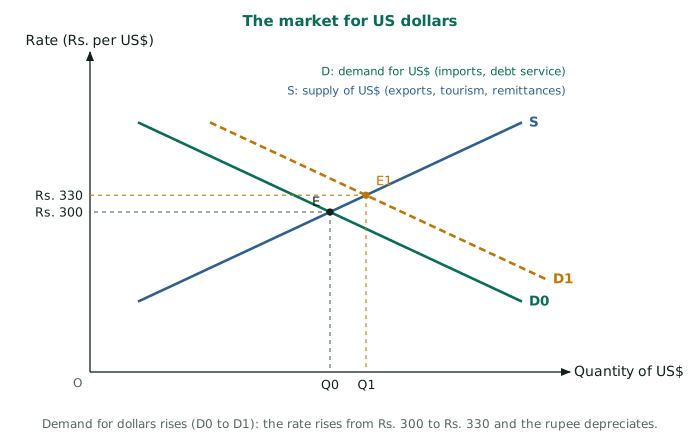
In the graph the vertical axis is the exchange rate (Rs. per US$), the price of a dollar. The demand curve for dollars slopes downward: a lower rupee price of the dollar makes imports cheaper, so more dollars are demanded. The supply curve slopes upward: a higher rupee price of the dollar makes Sri Lankan exports cheaper for foreigners and more profitable for exporters, so more dollars are supplied. The equilibrium exchange rate is where demand equals supply (E, Rs. 300).
Changes in the exchange rate
- Increase in the demand for dollars (a surge in imports, debt payments, capital outflow): D shifts right, and the rate rises from Rs. 300 to Rs. 330 per US$. The rupee depreciates.
- Increase in the supply of dollars (higher tourism, remittances, exports, inflows): S shifts right, and the rate falls (the rupee appreciates).
Calculating the change. From Rs. 300 to Rs. 330, the dollar's price in rupees rose by (330 - 300) / 300 = 10%. But the rupee's value in dollars changed from 1/300 to 1/330, a fall of (300 / 330 - 1) = -9.1%. The two percentages are not the same; the exam normally asks for the change in the rupee price of the dollar.
Factors that shift demand and supply
- Relative inflation: higher inflation in Sri Lanka makes imports relatively attractive and exports dear, so the rupee weakens over time.
- Relative interest rates: higher rates in Sri Lanka attract foreign funds, strengthening the rupee; higher rates abroad do the reverse.
- Incomes and tastes: rising incomes raise demand for imports.
- Expectations and confidence: if people expect the rupee to fall they buy dollars now, and it falls.
- Seasonal flows: tourist seasons, remittances at Avurudu and in December, and tea and apparel shipments.
- Government and CBSL policy: trade restrictions, interest rates and intervention in the market.
Mind map
Remember:
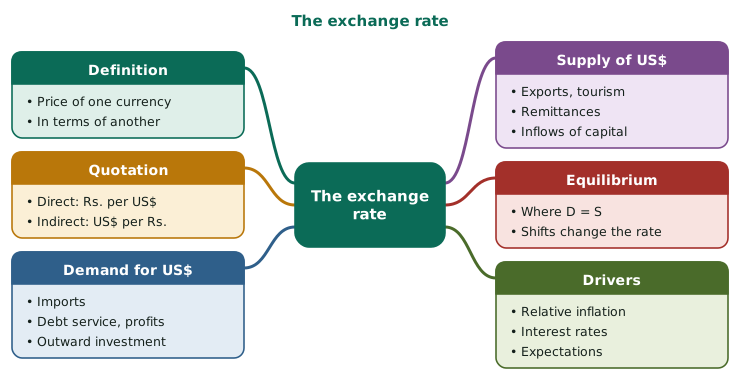
- Exchange rate = price of one currency in another; Sri Lanka quotes Rs. per US$ (direct)
- Higher Rs. per US$ = weaker rupee (depreciation); lower = appreciation
- Demand for dollars: imports, debt service, outward investment. Supply: exports, tourism, remittances, inflows
- Equilibrium where D = S; shifts in D or S move the rate
- Drivers: relative inflation, interest rates, expectations, income