Economic Systems
Unit 1 · Basic economic problems and economic systems
How societies organise to solve the basic problems: market, command and mixed economies, and how to judge them.
What is an economic system?
An economic system (ආර්ථික පද්ධතිය) is the set of institutions, rules and decision makers through which a society answers the basic economic problems. Its elements are:
- Decision makers (economic actors): households, firms and the government (and, in an open economy, the rest of the world).
- Resources and their ownership: private or state.
- Institutions and rules: property rights, laws, markets, planning bodies.
- A coordination mechanism: the price mechanism, or government instructions.
Criteria for classification
Economic systems are classified by:
- Ownership of resources: private, state, or both.
- Who takes economic decisions: individuals and firms, or the state.
- The mechanism of coordination: prices and markets, or central planning.
- The motive for production: private profit, or the plan's social targets.
Market economy
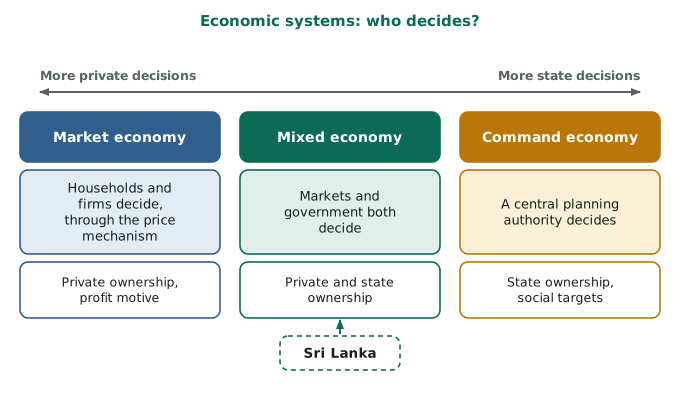
In a market economy (වෙළෙඳපොළ ආර්ථික පද්ධතිය) resources are mainly privately owned and decisions are made by households and firms interacting in markets through the price mechanism.
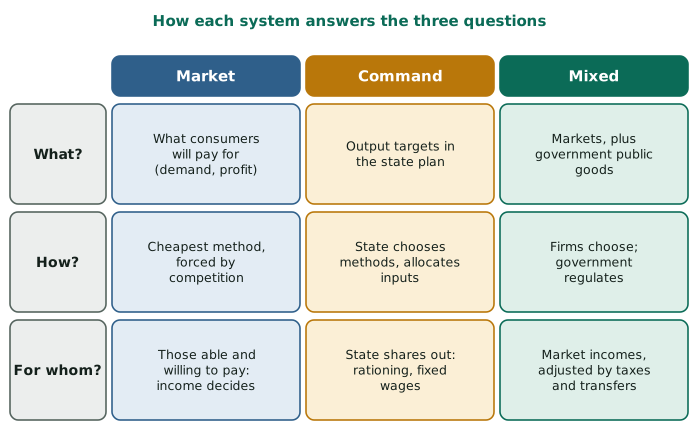
- What to produce: goods that consumers are willing to pay for; firms follow demand and profit.
- How to produce: firms choose the cheapest method, because competition forces them to cut costs.
- For whom: goods go to those with the ability and willingness to pay, so income determines who gets what.
Strengths: efficiency, variety, innovation, consumer choice. Weaknesses: inequality, under-provision of public goods (and merit goods), neglect of those without income, instability, harm to the environment.
Command economy
In a command economy (විධාන ආර්ථික පද්ධතිය) resources are owned by the state and a central planning authority decides.
- What: the plan sets output targets.
- How: the state decides the methods and allocates inputs.
- For whom: the state distributes goods, often by rationing or fixed wages, usually aiming at greater equality.
Strengths: can focus resources on national priorities, can reduce inequality. Weaknesses: lack of incentives, inefficiency, shortages and surpluses because planners lack information, little consumer choice.
Traditional economy
In a traditional economy (සාම්ප්රදායික ආර්ථික පද්ධතිය), found in some subsistence farming and fishing communities, custom and inheritance answer the three questions: people produce what their ancestors produced, by the same methods, and share the output by family or village rules.
Mixed economy
A mixed economy (මිශ්ර ආර්ථික පද්ධතිය) combines private and public decision making. Private firms and the market operate in most sectors, while the government provides public goods (such as roads and defence), regulates markets, provides some services (such as free education and health care) and redistributes income through taxes and transfers. Almost all real economies, including Sri Lanka's, are mixed: they differ in the degree of state involvement. In Sri Lanka, state enterprises (such as the Ceylon Electricity Board and the Sri Lanka Transport Board) operate alongside many private firms and farmers who respond to market prices.
Judging performance
Economists use several criteria to judge how well a system works:
- Efficiency: are scarce resources used to produce the goods people value, with little waste?
- Equity: is income distributed fairly?
- Economic growth: is output rising over time?
- Stability: are prices stable and are people employed?
- Freedom of choice for consumers, workers and firms.
No system is best on every criterion, so societies trade off between them.
New trends
Since the 1980s many command economies (for example China, Vietnam and the former Soviet bloc) have introduced market reforms, and many market economies have expanded the role of the state in welfare and regulation. Economies are therefore converging towards mixed systems, with debate about the right balance.
Mind map
Remember:
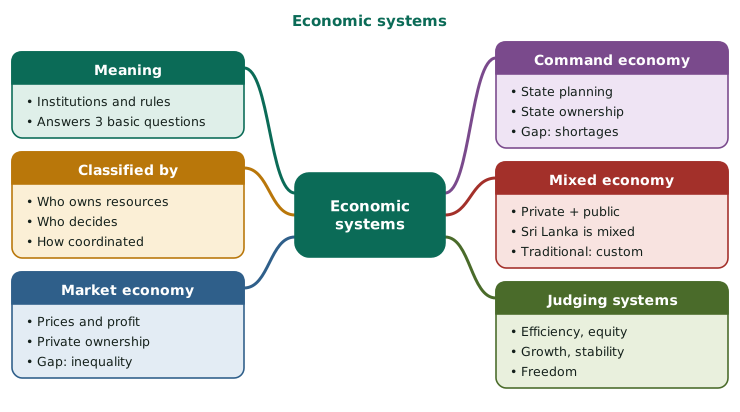
- For the three questions: market = price, command = plan, mixed = both
- Sri Lanka is mixed: CEB and SLTB alongside private firms
- Traditional: custom and inheritance
- Judge a system by efficiency, equity, growth, stability, freedom.