Demand and the Law of Demand
Unit 2 · Demand, supply, elasticity and market equilibrium
Individual and market demand, the determinants of demand, the law of demand and its exceptions, and the difference between a change in quantity demanded and a change in demand.
What is demand?
In economics, demand is not simply "wanting" something. It is the quantity of a good or service that consumers are both willing and able to buy at each possible price during a given period, ceteris paribus (other things remaining equal). A student may want a motorcycle, but if she cannot afford it, it is not part of her demand.
- Individual demand is the demand of one consumer or household.
- Market demand is the demand of all consumers in the market together. We obtain it by adding the individual quantities demanded at each price (a horizontal sum).
The demand function, schedule, curve and equation
The demand function shows how quantity demanded depends on its determinants:
Qd = f(P, Y, Pr, T, E, N)
where P is the good's own price, Y income, Pr prices of related goods, T tastes, E expectations and N the number of buyers.
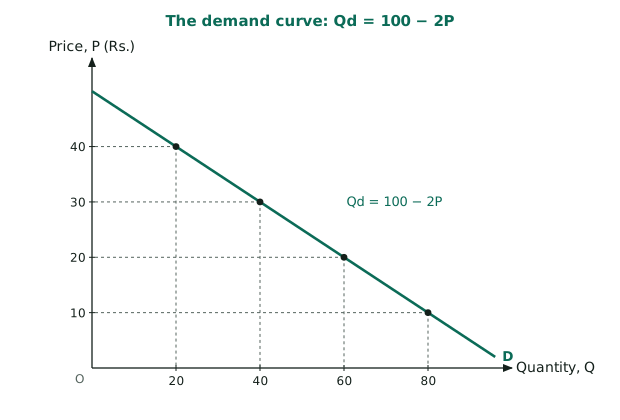
When we hold everything except P constant, we get the demand equation, for example Qd = 100 - 2P. It can be shown as a demand schedule (a table) or a demand curve (a graph with P on the vertical axis and Q on the horizontal axis).
| Price (Rs.) | Qd = 100 - 2P (kg per week) |
|---|---|
| 10 | 80 |
| 20 | 60 |
| 30 | 40 |
| 40 | 20 |
The curve slopes downward: the slope of this equation is -1/2 (as P rises by Rs. 1, Q falls by 2 units).
The law of demand and why it holds
The law of demand states that, ceteris paribus, there is an inverse relationship between the price of a good and the quantity demanded. Three reasons explain it:
- Substitution effect: when the price of rice rises, other foods such as bread or noodles become relatively cheaper, so consumers switch away from rice.
- Income effect: a higher price reduces the real purchasing power of a given money income, so consumers can buy less.
- Diminishing marginal utility: each extra unit gives less satisfaction, so consumers are willing to pay less for each additional unit.
Price effects together (substitution plus income effect) are what make the demand curve slope downward.
Determinants of demand
| Determinant | Effect on demand |
|---|---|
| Consumer income | Rises for normal goods when income rises; falls for inferior goods |
| Prices of substitutes | If the price of tea rises, demand for coffee rises |
| Prices of complements | If the price of petrol rises, demand for cars falls |
| Tastes and preferences | Fashion, advertising, health awareness |
| Expectations | Expecting a price rise tomorrow raises demand today |
| Number of buyers | Population growth, tourist arrivals |
Change in quantity demanded vs change in demand
| Change in quantity demanded | Change in demand | |
|---|---|---|
| Cause | Change in the good's own price only | Change in any other determinant |
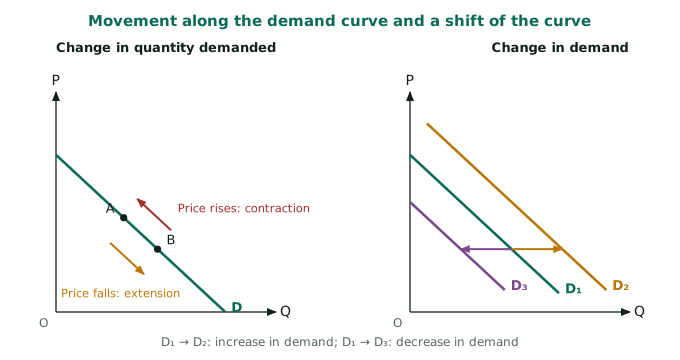
| On the graph | Movement along the same curve | Shift of the whole curve |
| Words used | Extension (price falls) or contraction (price rises) | Increase (rightward shift) or decrease (leftward shift) |
Example (Sri Lanka). If the price of coconuts rises from Rs. 80 to Rs. 120, households buy fewer coconuts: a contraction in quantity demanded. If a health campaign makes people prefer coconut oil, demand for coconut oil rises at every price: an increase in demand.
Exceptions to the law of demand
- Giffen goods: a rare inferior good that takes a large part of a poor household's budget. When its price rises, the household cannot afford better foods and buys even more of the staple. Quantity demanded rises with price.
- Demonstrative (ostentatious) goods: goods bought to show status, such as luxury jewellery. A higher price raises their prestige, so quantity demanded may rise as price rises.
- Also, buying more because consumers expect still higher prices tomorrow.
Mind map
Remember:
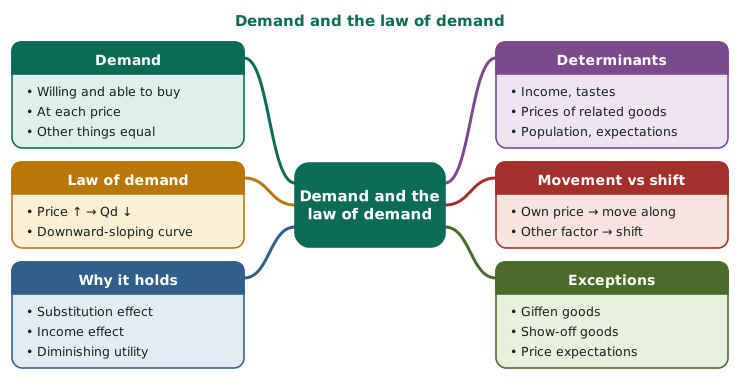
- Law of demand: price up, quantity demanded down (an inverse link)
- Price change → movement along the curve; any other determinant → shift of the curve
- Three reasons: substitution effect, income effect, diminishing marginal utility
- Exceptions: Giffen goods and show-off (conspicuous) goods
- Determinants: income, tastes, related prices, population, expectations
- Quantity demanded changes with price; demand changes with everything else