A point or a line and a circle
Unit 27 · The Circle: Geometric Properties
Decide whether a point is inside, on or outside a circle, and whether a line cuts, touches or misses it; find the intersection points, the chord length and the midpoint of a chord.
Is a point inside, on or outside?
Take the circle $S \equiv x^2 + y^2 + 2gx + 2fy + c = 0$ with centre $C$ and radius $r$, and a point $P(x_1, y_1)$. The point is inside, on or outside depending on whether $CP$ is less than, equal to or greater than $r$. Since $$CP^2 - r^2 = (x_1 + g)^2 + (y_1 + f)^2 - (g^2 + f^2 - c) = x_1^2 + y_1^2 + 2gx_1 + 2fy_1 + c,$$ the quantity $S_1$ (the left-hand side of the equation with $(x_1, y_1)$ put in) has the same sign as $CP - r$:
- $S_1 < 0$: inside; $S_1 = 0$: on the circle; $S_1 > 0$: outside.
The circle must be written with $x^2$ and $y^2$ coefficient $1$ and everything on one side before you substitute.
Example: Where are $A(3, 1)$, $B(5, -1)$ and $D(4, 3)$ relative to $x^2 + y^2 - 4x + 2y - 4 = 0$? $A$: $9 + 1 - 12 + 2 - 4 = -4 < 0$, inside. $B$: $25 + 1 - 20 - 2 - 4 = 0$, on the circle. $D$: $16 + 9 - 16 + 6 - 4 = 11 > 0$, outside.
A line and a circle
There are three possibilities. Let $d$ be the perpendicular distance from the centre to the line.
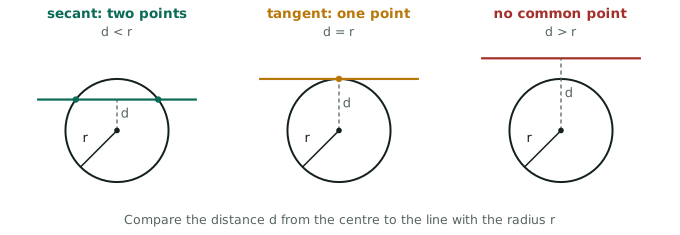
- $d < r$: the line is a secant, meeting the circle at two points.
- $d = r$: the line is a tangent, meeting it at one point.
- $d > r$: the line does not meet the circle.
The distance is found from $d = \dfrac{|px_0 + qy_0 + s|}{\sqrt{p^2 + q^2}}$ for the line $px + qy + s = 0$ and centre $(x_0, y_0)$. The other method is to substitute the line into the circle: you get a quadratic in one variable, and its discriminant is positive, zero or negative in the three cases. Use this method when you also need the intersection points.
Example: For which values of $k$ is the line $y = x + k$ a tangent to $x^2 + y^2 = 8$? Write the line as $x - y + k = 0$ and the centre is $(0, 0)$, $r = 2\sqrt{2}$. $d = \dfrac{|k|}{\sqrt{2}} = 2\sqrt{2}$ gives $|k| = 4$, so $k = 4$ or $k = -4$. For $-4 < k < 4$ the line cuts the circle; for $|k| > 4$ it misses.
For the circle $x^2 + y^2 = a^2$ and the line $y = mx + c$: substituting gives $(1+m^2)x^2 + 2mcx + c^2 - a^2 = 0$, and the discriminant is zero when $c^2 = a^2(1 + m^2)$. This is the tangent condition and is used again in the next lesson.
The chord cut off by a line
Let the line meet the circle at $P$ and $Q$. The perpendicular from the centre $C$ to the line meets it at $M$; this foot $M$ is the midpoint of the chord $PQ$ (the perpendicular from the centre bisects a chord). In the right-angled triangle $CMP$, $CM = d$ and $CP = r$, so $$PQ = 2\sqrt{r^2 - d^2}.$$
Example: Find the length of the chord cut from $x^2 + y^2 = 25$ by the line $3x + 4y = 5$. The distance from the centre is $d = \dfrac{|-5|}{\sqrt{9 + 16}} = 1$. Then $PQ = 2\sqrt{25 - 1} = 2\sqrt{24} = 4\sqrt{6}$.
Example: Find the midpoint of the chord cut from $x^2 + y^2 = 10$ by $x + y = 4$. Substituting $y = 4 - x$: $x^2 + (4-x)^2 = 10$, so $x^2 - 4x + 3 = 0$ and $x = 1$ or $3$. The points are $(1, 3)$ and $(3, 1)$ and the midpoint is $(2, 2)$. As a check, the foot of the perpendicular from the origin to $x + y = 4$ is $(2, 2)$.
Exam tip: In Sri Lankan A/L papers a line and a circle usually appear together with a tangent or a chord: "show that the line meets the circle at two points, and find the length of the chord", or "find $k$ so that the line is a tangent". Using $d = r$ is faster than the discriminant when no intersection points are needed; use the discriminant when they are. If a question asks for the greatest or least distance from a point $P$ to a circle, use $CP + r$ and $CP - r$ (for $P$ outside the circle).