Parallel forces and couples
Unit 29 · Coplanar Force Systems
Find the resultant of like and unlike parallel forces, define a couple and its moment, and combine coplanar couples.
Two parallel forces
Two forces acting on a rigid body along parallel lines of action have a resultant, except in one special case. Let $P$ act at $A$ and $Q$ at $B$, both perpendicular to $AB$ (this is no restriction, we can always take $AB$ perpendicular to the forces). Put the origin at $A$, with $B$ at a distance $d = AB$.
Like parallel forces (same direction). The resultant is $R = P + Q$, in the same direction. Let it act at $C$ on $AB$. By the principle of moments about $A$: $R \cdot AC = Q \cdot AB$, so $$AC = \frac{Q}{P + Q},AB, \qquad P \cdot AC = Q \cdot CB.$$ $C$ lies between $A$ and $B$, nearer the larger force.
Unlike parallel forces (opposite directions, $P > Q$). The resultant is $R = P - Q$, in the direction of the larger force $P$. Take moments about $A$: the moment of $P$ is $0$, the moment of $Q$ is $-Q \cdot AB$ (taking $P$ upwards as positive), so $R$ acts at a point $C$ on the side of $A$ away from $B$, with $(P - Q),AC = Q \cdot AB$, that is $$CA = \frac{Q}{P - Q},AB, \qquad P \cdot CA = Q \cdot CB.$$ $C$ lies outside $AB$ on the side of the larger force.
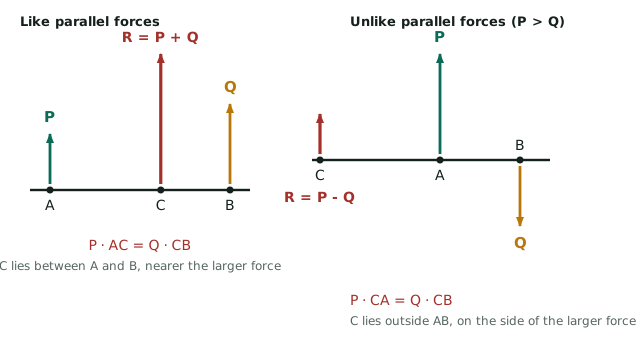
Example: Parallel forces of $6\ \text{N}$ at $A$ and $9\ \text{N}$ at $B$ act in the same direction, with $AB = 1.5\ \text{m}$. Find the resultant. $R = 6 + 9 = 15\ \text{N}$. Moments about $A$: $15 \times AC = 9 \times 1.5$, so $AC = \dfrac{13.5}{15} = 0.9\ \text{m}$. The resultant of $15\ \text{N}$ acts at $0.9\ \text{m}$ from $A$ (and $0.6\ \text{m}$ from $B$).
Example: Parallel forces of $10\ \text{N}$ upwards at $A$ and $4\ \text{N}$ downwards at $B$, with $AB = 3\ \text{m}$. Find the resultant. $R = 10 - 4 = 6\ \text{N}$ upwards. Let $C$ be on the extension of $BA$ beyond $A$ with $CA = x$, so $CB = x + 3$. Then $P \cdot CA = Q \cdot CB$ gives $10x = 4(x + 3)$, so $x = 2$. The resultant is $6\ \text{N}$ upwards, $2\ \text{m}$ from $A$ on the side away from $B$.
Equal and unlike: the couple
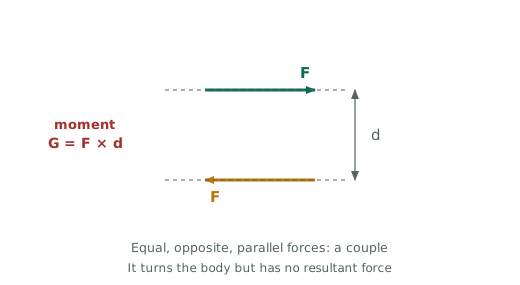
If $P = Q$ in the unlike case, $R = P - Q = 0$ and $CA = \dfrac{Q}{P - Q}AB$ is infinite: there is no single resultant force. Such a pair of forces, equal in magnitude, opposite in direction, parallel but not in the same line, is a couple. (Two equal and opposite forces in the same line are simply in equilibrium.) A couple has no resultant force, but it turns the body.
The moment of a couple is $G = F \times d$, where $F$ is the magnitude of each force and $d$ is the perpendicular distance between the two lines of action (the arm of the couple). To see that this is the moment about any point, take a point at distance $x$ from one of the forces. If the point is outside the two lines, the moments are $F(x + d)$ and $-Fx$; if it lies between them, they are $F(d - x)$ and $Fx$ (both in the same sense). In each case the total is $Fd$, independent of $x$.
Consequences:
- The moment of a couple is the same about every point in its plane. It acts as a pure turning effect: the "sense" (anticlockwise or clockwise) and the number $Fd$ describe it completely.
- Two couples of the same sense and the same moment are equivalent, whatever their forces and arms. Changing $F$ and $d$ while keeping $Fd$ the same, or rotating the couple in its plane, does not change its effect.
- A couple cannot be replaced by a single force, and a single force cannot balance a couple; a couple is balanced only by another couple of equal moment and opposite sense.
Combining couples
Coplanar couples combine into one couple whose moment is the algebraic sum of their moments (anticlockwise $+$, clockwise $-$). Coplanar couples are in equilibrium when this sum is zero.
Example: A couple is formed by two $12\ \text{N}$ forces $0.5\ \text{m}$ apart, anticlockwise, and a second couple by two $5\ \text{N}$ forces $2\ \text{m}$ apart, clockwise. Find the single couple equivalent to both. $G_1 = +12 \times 0.5 = +6$ and $G_2 = -5 \times 2 = -10$, so $G = 6 - 10 = -4$: a couple of moment $4\ \text{N m}$ clockwise.
Exam tip: A very common slip is to call the sum of two parallel forces "the resultant" without finding where it acts. Always give the magnitude and the position (a distance from a named point, on a named side), and check with the relation $P \cdot AC = Q \cdot CB$ (or $P \cdot CA = Q \cdot CB$ for unlike forces). For couples, state the moment with its sense, and remember that "the moment of a couple" needs no reference point.