Number systems: N, Z, Q and R
Natural numbers, integers, rational and irrational numbers, the real number line, and how decimals show which family a number belongs to.
The families of numbers
Mathematics builds numbers in steps, each step fixing something the last one cannot do.
- Natural numbers $\mathbb{N} = {1, 2, 3, \dots}$ are the counting numbers. (Some books include 0. In this course $\mathbb{N}$ starts at 1, and we say "non-negative integers" when we want 0 too.)
- Integers $\mathbb{Z} = {\dots, -3, -2, -1, 0, 1, 2, 3, \dots}$ add zero and the negatives, so that $a - b$ always exists.
- Rational numbers $\mathbb{Q} = \left{\dfrac{p}{q} : p, q \in \mathbb{Z},\ q \neq 0\right}$ add fractions, so that $a \div b$ exists for $b \neq 0$. Every integer is rational, because $n = \dfrac{n}{1}$.
- Irrational numbers cannot be written as $\dfrac{p}{q}$ with integers $p, q$. Examples: $\sqrt{2}$, $\sqrt{3}$, $\sqrt{5}$, $\pi$, $e$.
- Real numbers $\mathbb{R}$ are all the rational and irrational numbers together.
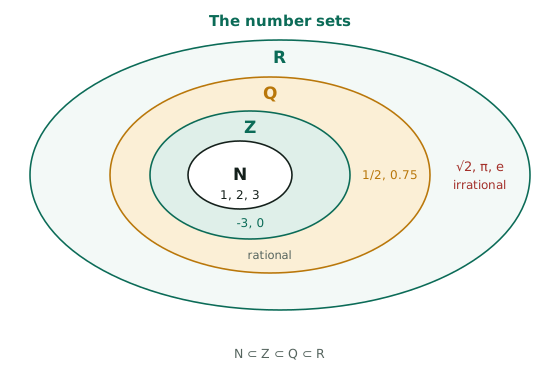
So $\mathbb{N} \subset \mathbb{Z} \subset \mathbb{Q} \subset \mathbb{R}$, and a real number is either rational or irrational, never both.
The real number line
Choose a point $O$ for $0$ and a point for $1$. Every real number then matches exactly one point of the line, and every point matches exactly one real number. Larger numbers lie to the right. This is why $\mathbb{R}$ is called a "continuum": there are no gaps. The rational numbers alone do leave gaps. The point at distance $\sqrt{2}$ from $O$ (the diagonal of a unit square) is on the line, but it is not a fraction.
Decimals tell the family
Divide $p$ by $q$ with long division. The remainders are less than $q$, so they either reach $0$ (the decimal terminates) or repeat (the decimal recurs). So:
- Rational $\iff$ the decimal terminates or recurs: $\dfrac{3}{8} = 0.375$, $\dfrac{1}{3} = 0.\dot{3}$, $\dfrac{5}{7} = 0.\dot{7}1428\dot{5}$.
- Irrational $\iff$ the decimal neither terminates nor recurs: $\sqrt{2} = 1.41421356\dots$, $\pi = 3.14159265\dots$, and the pattern $0.101001000100001\dots$ (the zeros grow, so it never repeats).
A calculator shows only a finite part of a decimal. $3.14159$ is a rational approximation to $\pi$, not $\pi$ itself, and $\dfrac{22}{7}$ is another.
Recurring decimal to fraction
Let $x$ be the decimal. Multiply by $10^n$, where $n$ is the length of the repeating block, and subtract to cancel the tail.
Example: Write $0.2\dot{7} = 0.27777\dots$ as a fraction. Let $x = 0.27777\dots$. Then $10x = 2.7777\dots$ and $100x = 27.7777\dots$. Subtracting, $100x - 10x = 27.7777\dots - 2.7777\dots$, so $90x = 25$ and $x = \dfrac{25}{90} = \dfrac{5}{18}$. Check: $5 \div 18 = 0.2777\dots$.
Combining rational and irrational numbers
- Sum, difference, product and quotient (divisor $\neq 0$) of rationals are rational.
- A rational plus an irrational is irrational. A non-zero rational times an irrational is irrational. (Proofs are in the next lesson.)
- Two irrationals can give either kind: $\sqrt{2} + (-\sqrt{2}) = 0$ and $\sqrt{2} \cdot \sqrt{2} = 2$ are rational, while $\sqrt{2} + \sqrt{3}$ is irrational.
- $\sqrt{n}$ for a positive integer $n$ is rational only when $n$ is a perfect square ($\sqrt{16} = 4$), and irrational otherwise.
Example: Classify each number as natural, integer, rational or irrational (all that apply): (i) $\sqrt{\dfrac{49}{4}}$, (ii) $\dfrac{\sqrt{45}}{\sqrt{5}}$, (iii) $\sqrt{2} + \sqrt{8}$. (i) $\sqrt{\dfrac{49}{4}} = \dfrac{7}{2}$: rational, but not an integer. (ii) $\dfrac{\sqrt{45}}{\sqrt{5}} = \sqrt{\dfrac{45}{5}} = \sqrt{9} = 3$: a natural number, so also an integer and rational. (iii) $\sqrt{8} = 2\sqrt{2}$, so $\sqrt{2} + \sqrt{8} = 3\sqrt{2}$, a non-zero rational times an irrational: irrational.
Exam tip: When a question says "classify" or "show that this is rational", simplify first. Many numbers that look irrational (like $\dfrac{\sqrt{45}}{\sqrt{5}}$) collapse to integers. To show a number is rational, write it as $\dfrac{p}{q}$ and say what $p$ and $q$ are.