Modulus inequalities
Solving inequalities that contain a modulus: the interval rules, squaring, the method of cases and the graphical method.
The two basic rules
Think of $|x|$ as a distance from $0$. Then for $a > 0$:
- $|x| < a$: $x$ is closer to $0$ than $a$, so $-a < x < a$ (one connected interval).
- $|x| > a$: $x$ is farther from $0$ than $a$, so $x < -a$ or $x > a$ (two pieces).
For $|x| \le a$ and $|x| \ge a$ the end-points are included. If $a < 0$: $|x| < a$ has no solution and $|x| > a$ is true for every real $x$. These rules also apply to expressions: $|f(x)| < a \iff -a < f(x) < a$.
Example: Solve $|2x - 3| < 5$. $-5 < 2x - 3 < 5$. Add 3: $-2 < 2x < 8$. Divide by 2: $-1 < x < 4$. Answer: $x \in (-1, 4)$.
Example: Solve $|x - 1| \ge 3$. $x - 1 \ge 3$ or $x - 1 \le -3$, so $x \ge 4$ or $x \le -2$. Answer: $x \le -2$ or $x \ge 4$.
Comparing two moduli: square both sides
If both sides are non-negative, then $A < B \iff A^2 < B^2$. Since $|f|^2 = f^2$ and $|f| \ge 0$, squaring is allowed when comparing $|f|$ with $|g|$ (and the squares have no moduli left).
Example: Solve $|x - 1| < |x + 2|$. Square: $(x - 1)^2 < (x + 2)^2 \Rightarrow x^2 - 2x + 1 < x^2 + 4x + 4 \Rightarrow -3 < 6x \Rightarrow x > -\tfrac12$. Check $x = 0$: $1 < 2$. True. Check $x = -1$: $2 < 1$. False. Answer: $x > -\tfrac12$. (In words: $x$ is closer to $1$ than to $-2$, that is, it lies to the right of their midpoint $-\tfrac12$.)
The method of cases
For several moduli, find the critical points, split the number line, remove the moduli in each part, solve, and keep only the answers inside that part. Finally take the union of the parts.
Example: Solve $|x - 1| + |x + 2| < 5$. Critical points: $-2$ and $1$. $x < -2$: $(1 - x) + (-x - 2) = -2x - 1 < 5 \Rightarrow x > -3$. With $x < -2$: $-3 < x < -2$. $-2 \le x < 1$: $(1 - x) + (x + 2) = 3 < 5$: always true. So all of $-2 \le x < 1$. $x \ge 1$: $(x - 1) + (x + 2) = 2x + 1 < 5 \Rightarrow x < 2$. With $x \ge 1$: $1 \le x < 2$. Join the three parts, which meet end to end. Answer: $-3 < x < 2$.
The graphical method
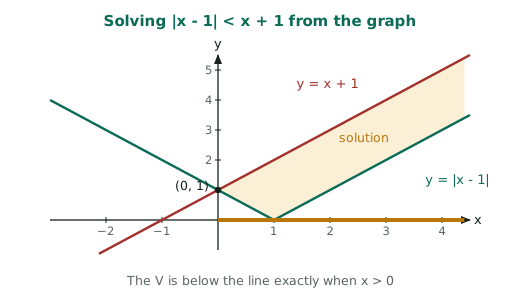
Sketch both sides as graphs and read the inequality: $|f(x)| < g(x)$ is true where the graph of $y = |f(x)|$ lies below the graph of $y = g(x)$. Find the intersection points algebraically (they are the end-points) and look at the picture for the rest.
Example: Solve $|x - 1| < x + 1$. Graphs: the V $y = |x - 1|$ with vertex $(1, 0)$ and the line $y = x + 1$. For $x \ge 1$ the V is $y = x - 1$, which is parallel to the line and always $2$ below it. For $x < 1$ the V is $y = 1 - x$; it meets the line when $1 - x = x + 1$, so $x = 0$. For $x > 0$ the V is below the line; for $x < 0$ it is above. Algebraic check: $-(x + 1) < x - 1 < x + 1$. The right inequality $-1 < 1$ is always true; the left gives $-x - 1 < x - 1$, so $0 < 2x$, $x > 0$. Answer: $x > 0$.
Another type of question has a modulus of a quadratic. Split it into two inequalities:
Example: Solve $|x^2 - 3| < 1$. $-1 < x^2 - 3 < 1 \Rightarrow 2 < x^2 < 4$. $x^2 < 4$ gives $-2 < x < 2$. $;x^2 > 2$ gives $x < -\sqrt2$ or $x > \sqrt2$. Both must hold. Answer: $-2 < x < -\sqrt2$ or $\sqrt2 < x < 2$.
Exam tip: The usual traps are (1) writing $|f| > g$ as a single interval, (2) squaring when one side may be negative, and (3) forgetting to combine the cases with "or". For $|f| < g$ you need $g > 0$ as well, which the double inequality $-g < f < g$ takes care of automatically. A/L questions often ask you to sketch two graphs and "hence" solve an inequality: use the picture first, then confirm algebraically.