The modulus and modulus equations
The modulus (absolute value) of a real number, its graph and properties, and solving equations containing moduli by cases, by squaring and from graphs.
The modulus (absolute value)
The modulus of a real number $x$, written $|x|$, is its size without regard to sign: $$|x| = \begin{cases} x, & x \ge 0 \ -x, & x < 0 \end{cases}$$ So $|5| = 5$, $|-5| = 5$, $|0| = 0$. Notice that $-x$ is positive when $x$ is negative. Geometrically $|x|$ is the distance from $x$ to $0$ on the number line, and more generally $|a - b|$ is the distance between $a$ and $b$. For example $|x - 3| = 2$ asks for the points exactly $2$ away from $3$, namely $1$ and $5$.
Properties
For real numbers $a, b$:
- $|a| \ge 0$, and $|a| = 0$ only when $a = 0$.
- $|a| = \sqrt{a^2}$ and $|a|^2 = a^2$. (So $\sqrt{a^2} = a$ is false for negative $a$.)
- $|ab| = |a||b|$ and $\left|\dfrac{a}{b}\right| = \dfrac{|a|}{|b|}$ for $b \ne 0$.
- $-|a| \le a \le |a|$.
- Triangle inequality: $|a + b| \le |a| + |b|$.
- $|a| = |b|$ if and only if $a = b$ or $a = -b$.
The graph
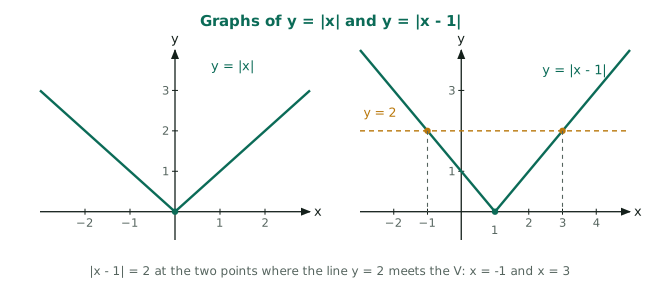
Plot $y = x$ for $x \ge 0$ and $y = -x$ for $x < 0$: two half-lines meeting at the origin form a V. The graph is symmetric about the $y$-axis. Shifting the argument moves the V: $y = |x - 1|$ has its vertex at $(1, 0)$, and its arms have gradients $+1$ and $-1$. In the same way $y = |x| + 2$ is the V lifted up by $2$, and $y = |2x - 3|$ has its vertex where $2x - 3 = 0$, at $x = \tfrac32$. To sketch any $y = |f(x)|$: draw $y = f(x)$ and reflect in the $x$-axis every part that lies below it.
Solving modulus equations
Type 1: $|f| = k$, $k$ a number. If $k > 0$ then $f = k$ or $f = -k$. If $k = 0$ then $f = 0$. If $k < 0$ there is no solution, because a modulus is never negative.
Example: Solve $|2x - 3| = 5$. $2x - 3 = 5$ gives $x = 4$. $;2x - 3 = -5$ gives $x = -1$. Answer: $x = 4$ or $x = -1$. (Check: $|8 - 3| = 5$ and $|-2 - 3| = 5$.)
Type 2: $|f| = |g|$. Then $f = g$ or $f = -g$ (or square both sides).
Example: Solve $|x + 1| = |2x - 3|$. $x + 1 = 2x - 3$ gives $x = 4$. $;x + 1 = -(2x - 3) = -2x + 3$ gives $3x = 2$, $x = \tfrac23$. Check $x = 4$: $5 = 5$. Check $x = \tfrac23$: $\tfrac53 = \left|\tfrac43 - 3\right| = \tfrac53$. Answer: $x = 4$ or $x = \tfrac23$.
Type 3: $|f| = g$, where $g$ is an expression. The right side must be $\ge 0$, so solve $f = g$ and $f = -g$, then reject any value that makes $g < 0$.
Example: Solve $|x - 1| = 2x$. We need $2x \ge 0$, that is $x \ge 0$. $x - 1 = 2x$ gives $x = -1$: rejected, since $x \ge 0$ fails. $x - 1 = -2x$ gives $3x = 1$, $x = \tfrac13$: accepted. Check: $\left|\tfrac13 - 1\right| = \tfrac23 = 2 \cdot \tfrac13$. Answer: $x = \tfrac13$ only.
Type 4: several moduli. Use cases. Find the values where each expression inside a modulus is $0$ (the critical points), split the number line there, and in each part remove the moduli with the correct signs. Keep only solutions that lie in their own part.
Example: Solve $|x - 1| + |x + 2| = 5$. The critical points are $x = 1$ and $x = -2$. Case $x < -2$: $|x - 1| = 1 - x$ and $|x + 2| = -x - 2$. The equation is $-2x - 1 = 5$, so $x = -3$. Since $-3 < -2$, accepted. Case $-2 \le x < 1$: $|x - 1| = 1 - x$, $|x + 2| = x + 2$. The equation is $3 = 5$: never true. No solution. Case $x \ge 1$: $(x - 1) + (x + 2) = 2x + 1 = 5$, so $x = 2$. Since $2 \ge 1$, accepted. Answer: $x = -3$ or $x = 2$.
The graphical method gives the same answer: the solutions of $|f(x)| = g(x)$ are the $x$-coordinates of the points where the graphs of $y = |f(x)|$ and $y = g(x)$ meet, as in the picture above where $y = |x - 1|$ meets $y = 2$ at $x = -1$ and $x = 3$.
Exam tip: A/L questions on the modulus usually say "solve the equation $|f(x)| = g(x)$" or "sketch the graphs of $y = |x - 1|$ and $y = 2x$ in the same diagram and hence solve ...". In the graph part, label the vertex, the intercepts and the intersection points; the algebraic solution must match what the picture shows. And always check the answers of a Type 3 equation: a wrong "extra" root is the usual lost mark.