Inverse functions
When a function has an inverse, how to find it algebraically, how its graph is a reflection in y = x, and the inverse of a composite.
The idea
A function $f$ sends $x$ to $y = f(x)$. The inverse function $f^{-1}$ undoes this and sends $y$ back to $x$. It exists only when each $y$ in the codomain comes from exactly one $x$: that is, only when $f$ is one-one and onto (a bijection). $$f^{-1}(f(x)) = x, \qquad f(f^{-1}(y)) = y.$$ The domain of $f^{-1}$ is the range of $f$, and the range of $f^{-1}$ is the domain of $f$.
Careful: $f^{-1}(x)$ is not $\dfrac{1}{f(x)}$. The $-1$ here means "inverse function".
Finding the inverse
- Check that $f$ is one-one (restrict the domain if needed).
- Write $y = f(x)$ and solve for $x$ in terms of $y$.
- Replace $y$ by $x$ to write $f^{-1}(x)$.
- State the domain of $f^{-1}$ (= the range of $f$).
Example: $f(x) = \dfrac{2x + 1}{x - 3}$ with domain $\mathbb{R} \setminus {3}$ and range $\mathbb{R} \setminus {2}$. Find $f^{-1}$.
From $y = \dfrac{2x+1}{x-3}$: $y(x - 3) = 2x + 1$, so $x(y - 2) = 3y + 1$, so $x = \dfrac{3y + 1}{y - 2}$. Rename $y$ as $x$.
Answer: $f^{-1}(x) = \dfrac{3x + 1}{x - 2}$ with domain $\mathbb{R} \setminus {2}$.
Example: $f(x) = x^2 - 4x + 7$ with domain $[2, \infty)$. Find $f^{-1}$ and its domain.
$f(x) = (x - 2)^2 + 3$. On $[2, \infty)$ the function is increasing, hence one-one, with range $[3, \infty)$. Put $y = (x - 2)^2 + 3$. Then $(x - 2)^2 = y - 3$. Since $x \ge 2$, $x - 2 \ge 0$, so $x - 2 = +\sqrt{y - 3}$ (the positive root only), giving $x = 2 + \sqrt{y - 3}$.
Answer: $f^{-1}(x) = 2 + \sqrt{x - 3}$, domain $[3, \infty)$.
Graph of the inverse
Because $(a, b)$ on the graph of $f$ means $(b, a)$ is on the graph of $f^{-1}$, the two graphs are mirror images in the line $y = x$.
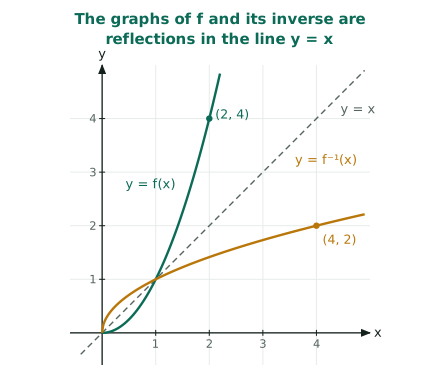
Here $f(x) = x^2$ for $x \ge 0$ and $f^{-1}(x) = \sqrt{x}$. The point $(2, 4)$ becomes $(4, 2)$. Any intersection of $f$ and $f^{-1}$ that is on $y = x$ satisfies $f(x) = x$. For an increasing function, solving $f(x) = f^{-1}(x)$ is the same as solving $f(x) = x$.
Inverse of a composite, self-inverse functions
$$(f \circ g)^{-1} = g^{-1} \circ f^{-1}.$$ Think of putting on socks and then shoes: to undo them you remove the shoes first. If $f \circ f(x) = x$ for all $x$, then $f^{-1} = f$, and $f$ is self-inverse; its graph is symmetric about $y = x$.
Exam tip: Typical questions: "Find $f^{-1}$ and state its domain", "Sketch $f$ and $f^{-1}$ on the same axes", and "Solve $f(x) = f^{-1}(x)$". Show the working $y = \dots \to x = \dots$ clearly. If the domain is restricted (such as $x \ge 2$), choose the root sign that matches it and say why.