Sets and intervals
Set notation, interval notation for subsets of the real line, union, intersection and complement, and writing the solution of an inequality as an interval.
Set notation
A set is a collection of distinct objects, called its elements. We write a set with braces: $A = {1, 2, 3}$.
| Symbol | Meaning |
|---|---|
| $x \in A$, $x \notin A$ | $x$ is, or is not, an element of $A$ |
| $A \subset B$ | every element of $A$ is in $B$ ($A$ is a subset of $B$) |
| $\emptyset$ | the empty set, with no elements |
| $A \cup B$ | union: in $A$ or in $B$ (or both) |
| $A \cap B$ | intersection: in both $A$ and $B$ |
| $A \setminus B$ | difference: in $A$ but not in $B$ |
| $A'$ | complement: in the universal set but not in $A$ |
Sets of numbers are usually described with set-builder notation: ${x \in \mathbb{R} : x^2 < 4}$ means "all real $x$ such that $x^2 < 4$". The colon is read "such that".
Intervals
An interval is a set of all real numbers between two end points. Its end points may or may not belong to it.
| Interval | Set-builder form | Name |
|---|---|---|
| $(a, b)$ | ${x : a < x < b}$ | open |
| $[a, b]$ | ${x : a \leq x \leq b}$ | closed |
| $[a, b)$ | ${x : a \leq x < b}$ | half-open |
| $(a, b]$ | ${x : a < x \leq b}$ | half-open |
| $(a, \infty)$ | ${x : x > a}$ | unbounded |
| $(-\infty, b]$ | ${x : x \leq b}$ | unbounded |
The symbols $\infty$ and $-\infty$ are not real numbers. They only say "no upper limit" or "no lower limit", so the bracket next to them is always round. $\mathbb{R} = (-\infty, \infty)$.
On the number line, an open circle means the end point is excluded and a filled circle means it is included.
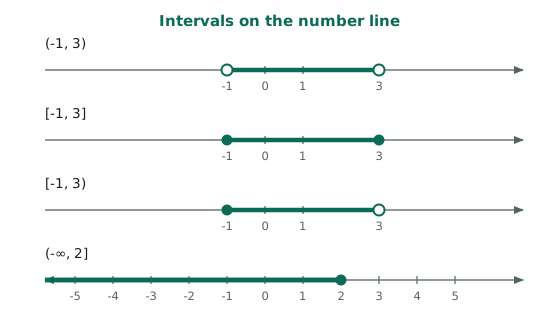
Because the real line has no gaps, an interval such as $(0, 1)$ contains infinitely many numbers and has no smallest and no largest element. In contrast, $(0, 1)$ contains no integers at all.
Combining intervals
Draw each interval on the same number line and read off the result.
Example: Let $A = [-2, 3)$ and $B = (0, 5]$. Find $A \cap B$, $A \cup B$, $A \setminus B$ and $B \setminus A$. On the number line, $A$ runs from $-2$ (included) to $3$ (excluded), and $B$ from $0$ (excluded) to $5$ (included). They overlap between $0$ and $3$. $A \cap B = (0, 3)$: $0$ is not in $B$ and $3$ is not in $A$. $A \cup B = [-2, 5]$: the two intervals overlap, so they join into one. $A \setminus B = [-2, 0]$: here $0 \in A$ and $0 \notin B$, so $0$ is kept. $B \setminus A = [3, 5]$: $3 \notin A$ and $3 \in B$, so $3$ is kept.
If $A \cap B = \emptyset$ the union is two separate pieces, written with $\cup$: $(-\infty, 1) \cup (4, \infty)$.
The complement of an interval inside $\mathbb{R}$ is what is left over: $[1, 4)' = (-\infty, 1) \cup [4, \infty)$. The end point switches side, so a round bracket becomes a square one.
From inequalities to intervals
Solve the inequality, then describe the solution set. Remember: multiplying or dividing by a negative number reverses the inequality.
Example: Find the set of real $x$ satisfying both $2x - 1 < 5$ and $3x + 2 \geq -4$. Write it as an interval. $2x - 1 < 5 \Rightarrow 2x < 6 \Rightarrow x < 3$. $3x + 2 \geq -4 \Rightarrow 3x \geq -6 \Rightarrow x \geq -2$. "Both" means the intersection $(-\infty, 3) \cap [-2, \infty) = [-2, 3)$. Answer: $[-2, 3)$, that is ${x \in \mathbb{R} : -2 \leq x < 3}$.
Exam tip: In Paper I, solution sets of inequalities and domains of functions (square roots, denominators, logarithms) are always asked as intervals. Write the answer in interval notation and check each end point separately: is it in or out? A sketch of the number line takes 10 seconds and prevents most bracket errors.