Even and odd functions, and piecewise functions
Testing symmetry with f(−x), and defining, evaluating and graphing functions given by different rules on different intervals, including the modulus function.
Even functions
A function $f$ is even if $$f(-x) = f(x) \quad \text{for every } x \text{ in the domain.}$$ Replacing $x$ by $-x$ changes nothing, so the graph is a mirror image of itself in the $y$-axis. Examples: $x^2$, $x^4 - 3x^2 + 2$, $|x|$, $\dfrac{1}{x^2 + 1}$. A polynomial with only even powers of $x$ (a constant counts) is even.
Odd functions
A function $f$ is odd if $$f(-x) = -f(x) \quad \text{for every } x \text{ in the domain.}$$ The graph is unchanged by a half-turn about the origin. Examples: $x$, $x^3$, $x^3 + x$, $\dfrac{1}{x}$. A polynomial with only odd powers of $x$ is odd. If $0$ is in the domain of an odd function, then $f(0) = -f(0)$, so $f(0) = 0$.
Testing a function
- Check that the domain is symmetric about $0$ (if $x$ is allowed, so is $-x$).
- Work out $f(-x)$ and simplify.
- Compare: equal to $f(x)$ means even; equal to $-f(x)$ means odd; otherwise neither. To prove "neither", give a single $x$ for which both fail.
Example: Classify (a) $f(x) = x^3 - x$, (b) $g(x) = x^2 + |x|$, (c) $h(x) = x^2 + x$.
(a) $f(-x) = (-x)^3 - (-x) = -x^3 + x = -(x^3 - x) = -f(x)$: odd.
(b) $g(-x) = (-x)^2 + |-x| = x^2 + |x| = g(x)$: even.
(c) $h(1) = 2$ and $h(-1) = 1 - 1 = 0$. Since $h(-1) \ne h(1)$ and $h(-1) \ne -h(1)$: neither.
Answer: (a) odd; (b) even; (c) neither.
Every function whose domain is symmetric about $0$ is the sum of an even and an odd function: $f(x) = \dfrac{f(x) + f(-x)}{2} + \dfrac{f(x) - f(-x)}{2}$. For $x^2 + x$ these parts are $x^2$ (even) and $x$ (odd). For a function known only for $x \ge 0$, evenness or oddness decides the rest of the graph.
Piecewise functions
A piecewise function (also called a function defined by cases) uses different rules on different parts of its domain, for example $$f(x) = \begin{cases} x + 1, & x < 0 \ x^2, & 0 \le x < 2 \ 6 - x, & x \ge 2. \end{cases}$$ To find $f(a)$, decide which condition $a$ satisfies and use only that rule. Here $f(-3) = -3 + 1 = -2$, $f(1) = 1$, and $f(2) = 6 - 2 = 4$ because $2 \ge 2$ belongs to the third piece. The graph is drawn piece by piece, with an open circle where an end point is excluded and a filled dot where it is included. The graph joins up (is continuous) at $x = c$ when the rules on both sides give the same value there. At $x = 2$ both rules give $4$, so there is no break. At $x = 0$ the first rule approaches $1$ while the second gives $0$, so there is a jump.
The modulus function
$$|x| = \begin{cases} x, & x \ge 0 \ -x, & x < 0. \end{cases}$$ Its value is the distance of $x$ from $0$, so it is never negative. In general, $|g(x)| = g(x)$ when $g(x) \ge 0$ and $-g(x)$ when $g(x) < 0$. To rewrite an expression with several moduli without them, split the number line at the points where each inside is zero, and in each interval decide the signs.
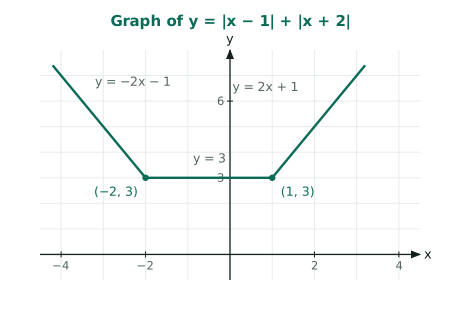
Example: Write $f(x) = |x - 1| + |x + 2|$ without moduli and find its range.
The inside values are zero at $x = 1$ and $x = -2$, giving three intervals.
- $x < -2$: both insides negative, $f = -(x - 1) - (x + 2) = -2x - 1$.
- $-2 \le x < 1$: $x - 1 < 0$ and $x + 2 \ge 0$, $f = -(x - 1) + (x + 2) = 3$.
- $x \ge 1$: both non-negative, $f = (x - 1) + (x + 2) = 2x + 1$.
The graph decreases to the value $3$ at $x = -2$, stays at $3$ up to $x = 1$, then increases. The smallest value is $3$ and there is no largest value.
Answer: $f(x) = -2x - 1$ for $x < -2$; $3$ for $-2 \le x < 1$; $2x + 1$ for $x \ge 1$. Range $[3, \infty)$.
Example: Solve $|2x - 4| = x$.
$|2x - 4| = 2x - 4$ for $x \ge 2$ and $4 - 2x$ for $x < 2$.
Case $x \ge 2$: $2x - 4 = x$ gives $x = 4$, and $4 \ge 2$ is valid.
Case $x < 2$: $4 - 2x = x$ gives $x = \tfrac{4}{3}$, and $\tfrac{4}{3} < 2$ is valid.
Answer: $x = \tfrac{4}{3}$ or $x = 4$.
Exam tip: In "solve the equation with moduli" questions, always split into cases and check each answer against the case's condition. Answers that fall outside their case are rejected. For piecewise graphs, mark open and filled end points exactly as the inequality signs say.