Shapes of molecules and ions (VSEPR theory)
Unit 2 · Structure and Bonding
Valence shell electron pair repulsion theory, electron pair geometry and molecular shape for two to six electron pairs, the effect of lone pairs and multiple bonds on bond angles, and shapes of common ions.
The VSEPR idea
The valence shell electron pair repulsion (VSEPR) theory predicts the shape of a molecule or ion from its Lewis structure:
- The regions of electron density around the central atom, bond pairs and lone pairs, all repel each other.
- They arrange themselves as far apart as possible, to make the repulsion least.
- A multiple bond counts as one region, because all its electrons lie between the same two atoms (although it repels a little more than a single bond).
The arrangement of all the electron pairs is the electron pair geometry. The shape of the molecule describes only where the atoms are, so it differs from the electron pair geometry whenever there are lone pairs.
Counting the electron pairs
Draw the Lewis structure and count around the central atom: (number of atoms bonded to it) + (number of lone pairs on it). For a quick check with halogens or H as the outer atoms: $$\text{pairs} = \frac{\text{valence electrons of central atom} + \text{number of monovalent atoms} - \text{charge}}{2}$$ (here "charge" is the ion's charge with its sign, so $-1$ adds an electron). Oxygen atoms bonded by double bonds contribute nothing to this count but still each occupy one position.
Example: ClF₃. Cl has 7 valence electrons; 3 F atoms add 3: $\frac{7 + 3}{2} = 5$ pairs. Three are bond pairs, so there are 2 lone pairs: trigonal bipyramidal geometry, T-shaped molecule.
Shapes with no lone pairs
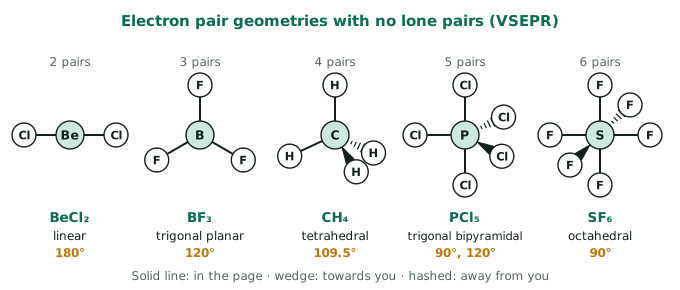
| Pairs | Electron pair geometry | Bond angle | Examples |
|---|---|---|---|
| 2 | linear | 180° | BeCl₂, CO₂, HCN |
| 3 | trigonal planar | 120° | BF₃, SO₃, CO₃²⁻, NO₃⁻ |
| 4 | tetrahedral | 109.5° | CH₄, CCl₄, NH₄⁺, SO₄²⁻ |
| 5 | trigonal bipyramidal | 90° (axial–equatorial), 120° (equatorial) | PCl₅ |
| 6 | octahedral | 90° | SF₆, [AlF₆]³⁻ |
In a trigonal bipyramid the positions are not all equivalent: the two axial positions are at 90° to three other pairs, while the three equatorial positions are at 90° to only two.
Shapes with lone pairs
A lone pair is held by only one nucleus, so it spreads out closer to the central atom and repels more strongly than a bond pair: $$\text{lone pair–lone pair} > \text{lone pair–bond pair} > \text{bond pair–bond pair}$$ Lone pairs therefore squeeze the bond angles. All three of CH₄, NH₃ and H₂O have four electron pairs and tetrahedral electron pair geometry, but:
- CH₄: 4 bond pairs, tetrahedral, $109.5°$;
- NH₃: 3 bond pairs + 1 lone pair, trigonal pyramidal, $107°$;
- H₂O: 2 bond pairs + 2 lone pairs, angular (V-shaped, bent), $104.5°$.
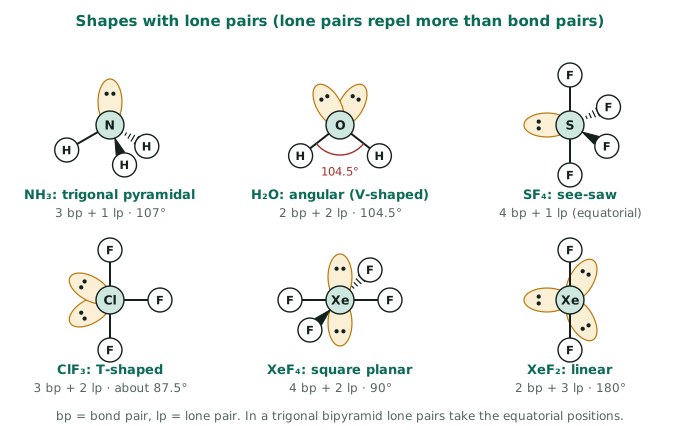
| Pairs | Bond pairs + lone pairs | Shape | Example |
|---|---|---|---|
| 3 | 2 + 1 | angular, just under 120° | SO₂ (119°), SnCl₂, NO₂⁻ |
| 4 | 3 + 1 | trigonal pyramidal | NH₃ (107°), PCl₃, H₃O⁺ |
| 4 | 2 + 2 | angular | H₂O (104.5°), H₂S, OF₂ |
| 5 | 4 + 1 | see-saw (distorted tetrahedron) | SF₄ |
| 5 | 3 + 2 | T-shaped | ClF₃ |
| 5 | 2 + 3 | linear | XeF₂, I₃⁻ |
| 6 | 5 + 1 | square pyramidal | BrF₅, IF₅ |
| 6 | 4 + 2 | square planar | XeF₄, ICl₄⁻ |
In a trigonal bipyramid, lone pairs always go into equatorial positions, where they have fewer close (90°) neighbours. In an octahedron a second lone pair goes opposite the first (180° apart), which is why XeF₄ is square planar.
Multiple bonds also take more room than single bonds. In methanal, H₂C=O, the H–C–H angle is about $116°$, less than $120°$, because the C=O double bond pushes the C–H bonds together.
Example: Predict the shape of the ammonium ion, NH₄⁺. N has 5 valence electrons, 4 H add 4, and the charge +1 removes one: $\frac{5 + 4 - 1}{2} = 4$ pairs, all bonding. NH₄⁺ is tetrahedral, $109.5°$, like CH₄ (they are isoelectronic).
Example: The nitrite ion, NO₂⁻. Lewis structure: N with one N=O, one N–O⁻ and one lone pair. Three regions of electron density on N, one of them a lone pair: trigonal planar electron pair geometry, angular ion, angle about $115°$ (less than $120°$ because of the lone pair).
Exam tip: Paper II questions ask separately for the electron pair geometry and the shape around a named atom. Give both, and use the exact names: "trigonal pyramidal", not "pyramid"; "angular" or "V-shaped", not "bent line". Remember that lone pairs on the outer atoms do not affect the shape around the central atom.