Quantum numbers, orbitals and electron configuration
The four quantum numbers, shells, subshells and orbitals, shapes of s, p and d orbitals, the Aufbau principle, Pauli exclusion principle and Hund's rule, configurations up to Z = 36 including Cr, Cu and ions.
The four quantum numbers
In the modern (quantum mechanical) model each electron in an atom is described by four quantum numbers.
| Quantum number | Symbol | Allowed values | What it tells us |
|---|---|---|---|
| principal | $n$ | $1, 2, 3, \dots$ | the shell: main energy and size |
| azimuthal (angular momentum) | $l$ | $0, 1, \dots, n - 1$ | the subshell and the shape of the orbital |
| magnetic | $m_l$ | $-l, \dots, 0, \dots, +l$ | the orientation of the orbital in space |
| spin | $m_s$ | $+\tfrac{1}{2}$ or $-\tfrac{1}{2}$ | the spin of the electron |
The value of $l$ is given a letter: $l = 0$ is s, $l = 1$ is p, $l = 2$ is d, $l = 3$ is f. A subshell with a given $l$ has $2l + 1$ orbitals (one s, three p, five d, seven f), each holding two electrons.
| Shell | Subshells | Orbitals ($n^2$) | Maximum electrons ($2n^2$) |
|---|---|---|---|
| $n = 1$ | 1s | 1 | 2 |
| $n = 2$ | 2s, 2p | 4 | 8 |
| $n = 3$ | 3s, 3p, 3d | 9 | 18 |
| $n = 4$ | 4s, 4p, 4d, 4f | 16 | 32 |
Example: Which of these sets is not allowed? (a) $n = 2, l = 1, m_l = -1, m_s = +\tfrac{1}{2}$; (b) $n = 3, l = 3, m_l = 0, m_s = -\tfrac{1}{2}$. Set (b) is impossible: $l$ can be at most $n - 1 = 2$. Set (a) describes a 2p electron.
Shapes of orbitals
An orbital is the region of space around the nucleus in which there is a high probability (about 90%) of finding an electron of a particular energy.
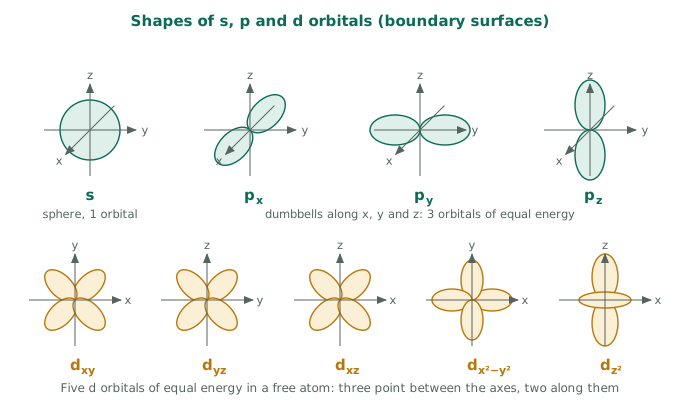
- s orbitals are spherical. A 2s orbital is larger than 1s and has higher energy.
- p orbitals are dumbbell-shaped with two lobes on opposite sides of the nucleus. The three, $p_x$, $p_y$ and $p_z$, lie along the three axes and have equal energy (they are degenerate).
- d orbitals: five, of equal energy in a free atom. $d_{xy}$, $d_{yz}$ and $d_{xz}$ point between the axes; $d_{x^2-y^2}$ and $d_{z^2}$ point along them.
The rules for filling orbitals
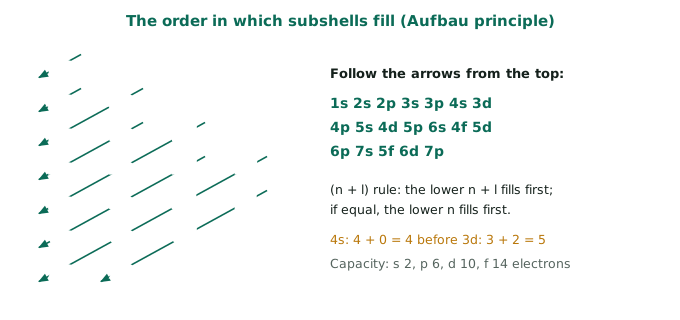
Aufbau (building-up) principle: electrons enter the available subshell of lowest energy first. In atoms with many electrons, subshells of the same shell no longer have equal energy (s < p < d < f), and 4s is filled before 3d. The order is given by the $(n + l)$ rule: the lower $n + l$ fills first, and if two are equal, the one with lower $n$ fills first.
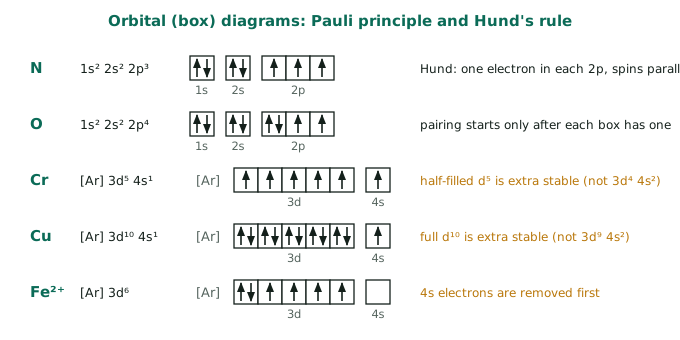
Pauli exclusion principle: no two electrons in the same atom can have the same set of four quantum numbers. So an orbital can hold at most two electrons, and they must have opposite spins ($\uparrow\downarrow$).
Hund's rule: when electrons fill orbitals of equal energy (such as the three 2p orbitals), they occupy them singly, with parallel spins, before any pairing begins. This keeps the electrons apart and lowers the repulsion between them.
Writing electron configurations
Write the subshells in order with the number of electrons as a superscript. A noble-gas core in square brackets shortens it.
| Element | Z | Configuration |
|---|---|---|
| N | 7 | $1s^2,2s^2,2p^3$ |
| Na | 11 | $1s^2,2s^2,2p^6,3s^1 = [\text{Ne}],3s^1$ |
| P | 15 | $[\text{Ne}],3s^2,3p^3$ |
| K | 19 | $[\text{Ar}],4s^1$ |
| Sc | 21 | $[\text{Ar}],3d^1,4s^2$ |
| Cr | 24 | $[\text{Ar}],3d^5,4s^1$ |
| Fe | 26 | $[\text{Ar}],3d^6,4s^2$ |
| Cu | 29 | $[\text{Ar}],3d^{10},4s^1$ |
| Zn | 30 | $[\text{Ar}],3d^{10},4s^2$ |
| Br | 35 | $[\text{Ar}],3d^{10},4s^2,4p^5$ |
Once 3d contains electrons it is lower in energy than 4s, so the configuration is usually written with 3d before 4s.
Chromium and copper are exceptions. A half-filled ($d^5$) or completely filled ($d^{10}$) d subshell is especially stable, so one 4s electron moves into 3d: Cr is $[\text{Ar}],3d^5,4s^1$, not $3d^4,4s^2$, and Cu is $[\text{Ar}],3d^{10},4s^1$, not $3d^9,4s^2$.
Configurations of ions
- Anions: add electrons to the next available orbital. $\text{Cl}^-$ is $[\text{Ne}],3s^2,3p^6 = [\text{Ar}]$; $\text{O}^{2-}$ is $1s^2,2s^2,2p^6$.
- Cations: remove electrons from the highest shell first. For the d-block this means the 4s electrons go before the 3d: $\text{Fe}^{2+}$ is $[\text{Ar}],3d^6$ and $\text{Fe}^{3+}$ is $[\text{Ar}],3d^5$; $\text{Cu}^{2+}$ is $[\text{Ar}],3d^9$; $\text{Zn}^{2+}$ is $[\text{Ar}],3d^{10}$.
Fe³⁺ ($3d^5$, half-filled) is more stable than Fe²⁺, which explains why iron(II) compounds are easily oxidised in air.
Example: How many unpaired electrons does $\text{Mn}^{2+}$ have? Mn ($Z = 25$) is $[\text{Ar}],3d^5,4s^2$; removing the two 4s electrons gives $[\text{Ar}],3d^5$. By Hund's rule the five d electrons occupy the five d orbitals singly: 5 unpaired electrons.
Exam tip: The most common mistakes are writing Cr as $3d^4,4s^2$, writing Fe²⁺ as $[\text{Ar}],3d^4,4s^2$ (removing 3d electrons instead of 4s), and drawing two electrons with the same spin in one box. Check the total number of electrons at the end.