Bond polarity and intermolecular forces
Unit 2 · Structure and Bonding
Polar bonds and dipole moments, polar and non-polar molecules, London dispersion forces, dipole–dipole and ion–dipole forces, hydrogen bonding, and how these forces control boiling points and solubility.
Polar covalent bonds
When the two atoms in a covalent bond have different electronegativities, the shared pair is pulled closer to the more electronegative atom. That atom gets a small negative charge, $\delta-$, and the other a small positive charge, $\delta+$: the bond is polar. In H–Cl, chlorine (3.16) is more electronegative than hydrogen (2.20): $\overset{\delta+}{\text{H}}\text{–}\overset{\delta-}{\text{Cl}}$.
- Equal electronegativities (H–H, Cl–Cl, C–C): non-polar covalent bond.
- A small or moderate difference (C–Cl, O–H, N–H): polar covalent bond.
- A large difference (Na and Cl, about 2.1): the electron is effectively transferred; the bond is mainly ionic.
There is no sharp boundary between these: bonds have a continuous range of ionic character.
Dipole moment
A pair of equal and opposite charges $q$ separated by a distance $d$ is a dipole. Its dipole moment is $$\mu = q \times d$$ measured in coulomb metres or in debye, D ($1\ \text{D} = 3.34 \times 10^{-30}\ \text{C m}$). It is a vector, drawn from $\delta+$ to $\delta-$ as an arrow with a cross at the positive end (+→).
| Molecule | HF | HCl | HBr | HI |
|---|---|---|---|---|
| electronegativity difference | 1.78 | 0.96 | 0.76 | 0.46 |
| dipole moment / D | 1.82 | 1.08 | 0.82 | 0.44 |
Polar and non-polar molecules
The dipole moment of a molecule is the vector sum of its bond dipoles, so it depends on the shape.
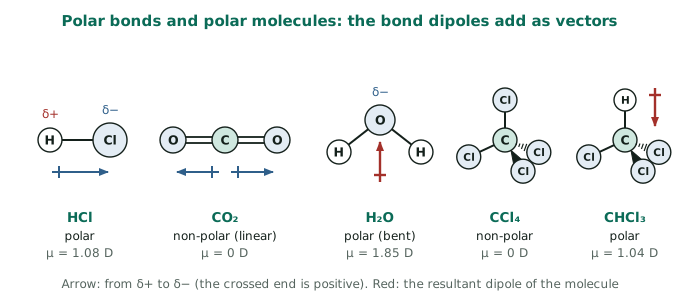
- CO₂ is linear: the two C=O dipoles are equal and opposite and cancel. $\mu = 0$, non-polar, although each bond is polar.
- BF₃ (trigonal planar) and CCl₄ (tetrahedral) are symmetrical: the bond dipoles cancel, $\mu = 0$.
- H₂O is angular: the two O–H dipoles add to give a resultant along the bisector, $\mu = 1.85\ \text{D}$. NH₃ (trigonal pyramidal) is also polar, $1.47\ \text{D}$.
- CHCl₃: replacing one Cl of CCl₄ by H breaks the symmetry, $\mu = 1.04\ \text{D}$.
A polar liquid is attracted towards a charged rod: a thin stream of water bends towards a charged plastic rod, but a stream of hexane does not.
Intermolecular forces
The forces between molecules are much weaker than the covalent bonds within them. They are often grouped together as van der Waals forces. When a molecular substance melts or boils, only these intermolecular forces are overcome; the molecules themselves stay intact.
London (dispersion) forces
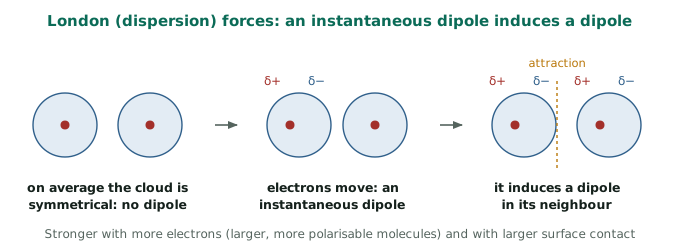
The electrons in any atom or molecule are constantly moving. At any instant their distribution may be uneven, giving an instantaneous dipole. This induces a dipole in a neighbouring molecule, and the two attract. The dipoles keep changing, but the attraction is always there. London forces act between all atoms and molecules, polar or not; they are the only forces between noble gas atoms and between non-polar molecules such as H₂, Cl₂, CH₄ and CCl₄.
London forces are stronger when:
- the molecule has more electrons (it is larger and more polarisable): the halogens go from gases to a solid as the molecules get bigger;
- the molecules have a larger area of contact: long, straight-chain molecules attract each other more than compact, branched ones.
| Substance | F₂ | Cl₂ | Br₂ | I₂ |
|---|---|---|---|---|
| electrons per molecule | 18 | 34 | 70 | 106 |
| boiling point / °C | −188 | −34 | 59 | 184 |
Pentane (straight chain) boils at $36\ ^\circ\text{C}$, but its isomer 2,2-dimethylpropane, which is nearly spherical, boils at $10\ ^\circ\text{C}$, although both are C₅H₁₂.
Dipole–dipole forces
Polar molecules have permanent dipoles. They line up so that the $\delta+$ end of one is near the $\delta-$ end of the next, and attract. This adds to the London forces. For molecules with about the same number of electrons, the polar one has the higher boiling point: propane, CH₃CH₂CH₃ (non-polar, $M_r = 44$), boils at $-42\ ^\circ\text{C}$, but ethanal, CH₃CHO (polar, $M_r = 44$), at $20\ ^\circ\text{C}$.
A permanent dipole can also induce a dipole in a non-polar molecule nearby (dipole–induced dipole forces), which helps explain why a little O₂ dissolves in water.
Ion–dipole forces
An ion attracts the oppositely charged end of polar molecules. In water, Na⁺ ions are surrounded by water molecules with their O ($\delta-$) ends towards the ion, and Cl⁻ ions by water molecules with their H ($\delta+$) ends inwards. These hydrated ions are why many ionic compounds dissolve in water; the energy released by hydration helps pay for breaking up the lattice.
Hydrogen bonding
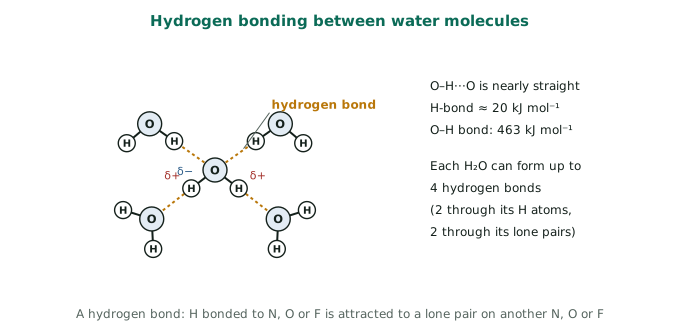
When hydrogen is bonded to a very electronegative, small atom, N, O or F, the bond is so polar that the H atom is left almost as a bare proton. This $\delta+$ H is strongly attracted to a lone pair on an N, O or F atom of a neighbouring molecule. The attraction, shown by a dotted line, X–H···Y, is a hydrogen bond. The three atoms X–H···Y are usually in a straight line.
Hydrogen bonds (about $10$–$40\ \text{kJ mol}^{-1}$) are the strongest intermolecular forces, but still about a tenth to a twentieth of the strength of a covalent bond.
Effects of hydrogen bonding:
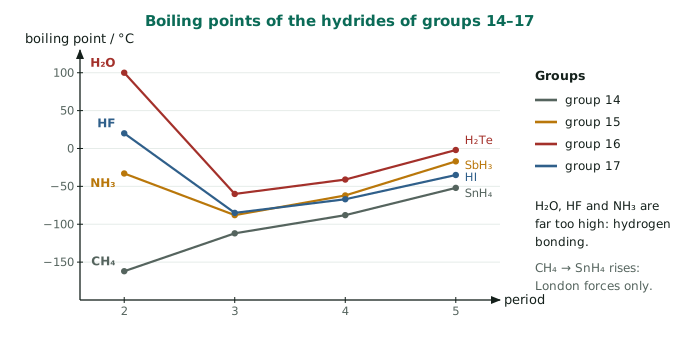
- Anomalously high boiling points of H₂O, HF and NH₃. Down group 14 the boiling points of the hydrides rise steadily (CH₄ $-162$, SiH₄ $-112$, GeH₄ $-88$, SnH₄ $-52\ ^\circ\text{C}$) as London forces grow. In groups 15–17 the first hydride breaks the pattern: H₂O boils at $100\ ^\circ\text{C}$ instead of the roughly $-80\ ^\circ\text{C}$ the trend predicts. Water boils highest because each molecule has two H atoms and two lone pairs, so it can form up to four hydrogen bonds; HF has three lone pairs but only one H, and N in NH₃ has only one lone pair.
- Ice is less dense than water. In ice each water molecule is hydrogen-bonded to four others in an open, tetrahedral network. On melting the network partly collapses and the molecules pack closer. Ice therefore floats, and lakes freeze from the top.
- Solubility: ethanol, ammonia and sugars dissolve readily in water because they form hydrogen bonds with water molecules.
- Dimers: ethanoic acid forms hydrogen-bonded dimers in non-polar solvents and in the vapour, so its measured relative molecular mass there is about 120 instead of 60.
- Biology: hydrogen bonds hold the two strands of DNA together and fix the shapes of proteins.
Comparing the forces
| Force | Typical strength / kJ mol⁻¹ | Acts between |
|---|---|---|
| covalent bond | 150–950 | atoms within a molecule or network |
| ionic bond (lattice) | 600–4000 | ions in a lattice |
| hydrogen bond | 10–40 | H on N, O, F and a lone pair on N, O, F |
| dipole–dipole | 5–25 | polar molecules |
| London | 0.1–40 (grows with size) | all molecules |
London forces in a large molecule can be stronger than the dipole–dipole forces in a small one: HI (small dipole, 54 electrons) boils at $-35\ ^\circ\text{C}$, higher than HCl ($-85\ ^\circ\text{C}$), because its London forces are much larger.
"Like dissolves like": polar and hydrogen-bonded substances dissolve in polar solvents such as water; non-polar substances such as iodine, oils and waxes dissolve in non-polar solvents such as hexane or CCl₄.
Exam tip: In "explain the difference in boiling points" questions, (1) name the forces present in each substance, (2) say which is stronger and why (number of electrons, polarity, hydrogen bonding), and (3) say that more energy is needed to overcome them. Never say that covalent bonds break when a molecular substance boils.