The periodic table and atomic and ionic radii
The modern periodic law, periods, groups and the s, p, d and f blocks, effective nuclear charge and shielding, covalent, metallic and van der Waals radii, ionic radii and isoelectronic ions.
From Mendeleev to the modern periodic table
In 1869 Dmitri Mendeleev arranged the 63 known elements in order of atomic mass, putting elements with similar properties in the same vertical column. He left gaps for undiscovered elements and predicted their properties; "eka-silicon" was found in 1886 as germanium, with almost exactly the predicted properties. A few pairs (such as Ar and K, Te and I) were out of order by mass. In 1913 Henry Moseley showed from X-ray spectra that the true order is by atomic number. This gives the modern periodic law: the physical and chemical properties of the elements are a periodic function of their atomic numbers.
The structure of the periodic table
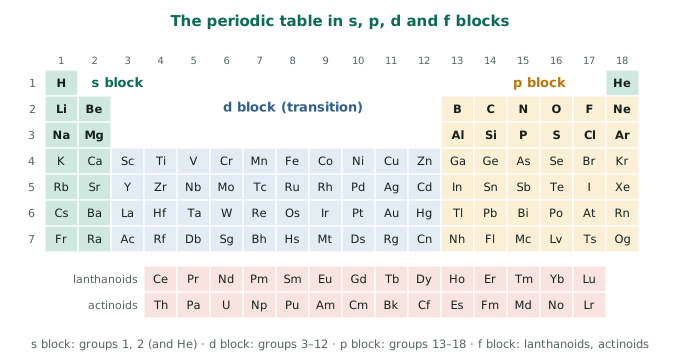
- Periods (horizontal rows, 1 to 7): the period number is the number of the outermost occupied shell. Period 1 has 2 elements, periods 2 and 3 have 8, periods 4 and 5 have 18 and period 6 has 32.
- Groups (vertical columns, 1 to 18): elements in a group have the same outer electron configuration and therefore similar chemical properties.
- Blocks: named after the subshell that receives the last electron. The s block is groups 1 and 2 (and helium), the p block is groups 13 to 18, the d block (transition elements) is groups 3 to 12, and the f block is the lanthanoids and actinoids.
For the s and p blocks the group follows directly from the outer configuration: $ns^1$ is group 1, $ns^2$ group 2, and $ns^2,np^x$ is group $10 + 2 + x = 12 + x$, that is group $(10 + \text{number of outer electrons})$.
Example: An element has the configuration $1s^2,2s^2,2p^6,3s^2,3p^4$. Highest shell $n = 3$, so period 3; last electron in a p subshell, so p block; outer electrons $3s^2,3p^4$ = 6, so group 16. It is sulfur.
Metallic character decreases across a period and increases down a group: the elements on the left and at the bottom are metals, those at the top right are non-metals, and between them lie the metalloids (B, Si, Ge, As, Sb, Te).
Shielding and effective nuclear charge
An outer electron is attracted by the nucleus but repelled by the electrons between it and the nucleus. These inner electrons shield (screen) it, so it feels only part of the nuclear charge, the effective nuclear charge: $$Z_{eff} \approx Z - S$$ where $S$ measures the shielding. Electrons in inner shells shield well; electrons in the same shell shield poorly. Across a period, each step adds one proton and one electron to the same shell, so $Z_{eff}$ on the outer electrons rises steadily (for Na it is roughly $+1$, for Cl roughly $+7$). Down a group, the extra protons are almost cancelled by an extra shell of shielding electrons, so $Z_{eff}$ stays about the same but the outer electrons are further away.
Atomic radius
An atom has no sharp edge, so its radius is defined from the distance between nuclei:
- covalent radius: half the distance between the nuclei of two identical atoms joined by a single covalent bond (Cl–Cl is $198\ \text{pm}$, so $r_{cov}(\text{Cl}) = 99\ \text{pm}$);
- metallic radius: half the distance between neighbouring nuclei in a metal crystal;
- van der Waals radius: half the distance between the nuclei of neighbouring atoms that are not bonded, as in solid noble gases. It is always larger than the covalent radius, so noble gases are left out when comparing covalent radii.
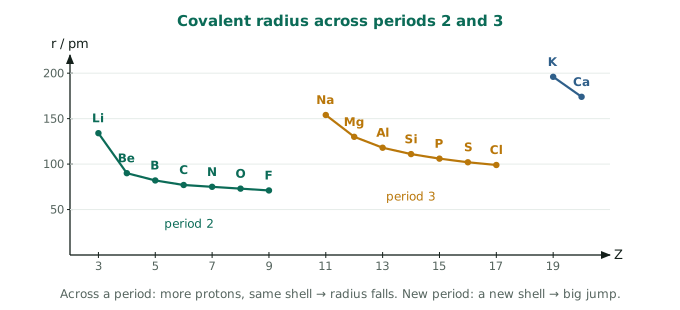
Across a period the atomic radius decreases: the rising effective nuclear charge pulls the same outer shell closer. Down a group it increases: each element has one more occupied shell. Across a transition series the radius changes only a little, because the electrons are added to an inner (3d) subshell that shields the 4s electrons fairly well.
Ionic radius
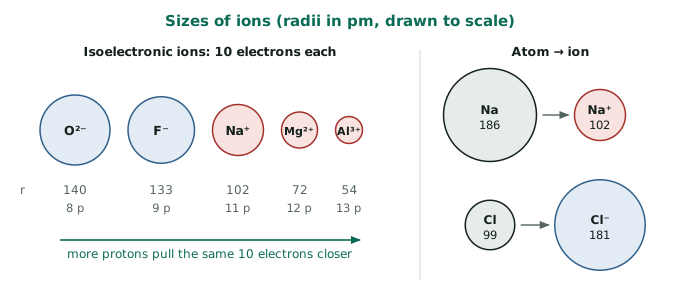
- A cation is smaller than its atom. Na ($186\ \text{pm}$) loses its whole third shell to form Na⁺ ($102\ \text{pm}$), and the 11 protons now hold only 10 electrons.
- An anion is larger than its atom. Cl ($99\ \text{pm}$) gains an electron to give Cl⁻ ($181\ \text{pm}$): there is more electron–electron repulsion and the same nuclear charge.
- Isoelectronic species have the same number of electrons. In the series $\text{O}^{2-}, \text{F}^-, \text{Na}^+, \text{Mg}^{2+}, \text{Al}^{3+}$ (10 electrons each) the radius falls steadily as the nuclear charge rises from 8 to 13.
Example: Arrange $\text{K}^+$, $\text{S}^{2-}$, $\text{Ca}^{2+}$ and $\text{Cl}^-$ in order of increasing radius. All have 18 electrons (isoelectronic with Ar). More protons, smaller ion: $\text{Ca}^{2+}\ (20\ p) < \text{K}^+\ (19) < \text{Cl}^-\ (17) < \text{S}^{2-}\ (16)$.
Exam tip: To compare the sizes of any two species, first count the occupied shells (more shells, larger). If the shells are the same, compare the nuclear charges for the same number of electrons (more protons, smaller). Only then think about electron repulsion. Never compare a van der Waals radius with a covalent radius.