Organic compounds, formulae and functional groups
Unit 7 · Basic Concepts of Organic Chemistry
Why carbon forms so many compounds, hybridisation of carbon, ways of writing formulae, functional groups, homologous series and primary, secondary and tertiary carbon atoms.
What organic chemistry is about
Organic chemistry is the chemistry of carbon compounds (except simple ones such as CO, CO₂, carbonates and cyanides, which are treated as inorganic). Millions of organic compounds are known, far more than the compounds of all the other elements together. Fuels, plastics, medicines, dyes, soaps, food and every molecule of a living cell are organic.
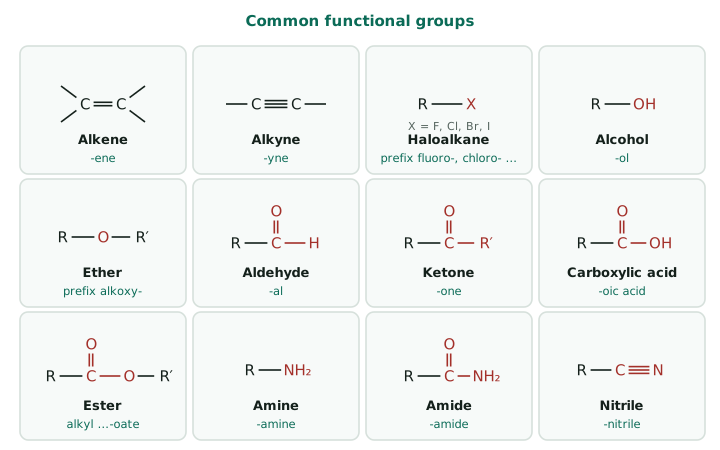
Carbon forms so many compounds because:
- it is tetravalent: with the configuration $1s^2,2s^2,2p^2$ it forms four covalent bonds;
- C–C bonds are strong ($348\ \text{kJ mol}^{-1}$), so carbon atoms join into long chains, branched chains and rings. This is called catenation;
- carbon forms stable multiple bonds (C=C, C≡C, C=O, C≡N) with itself and with O and N;
- it bonds strongly to H, O, N, S and the halogens.
Hybridisation and shape
| Carbon atom | Hybridisation | Shape around C | Bond angle | Example |
|---|---|---|---|---|
| four single bonds | sp³ | tetrahedral | 109.5° | CH₄, C₂H₆ |
| one double bond | sp² | trigonal planar | 120° | CH₂=CH₂, HCHO |
| one triple bond | sp | linear | 180° | HC≡CH, CH₃C≡N |
A single bond is one σ (sigma) bond, formed by head-on overlap of orbitals. A double bond is one σ bond plus one π (pi) bond, formed by sideways overlap of unhybridised p orbitals. A triple bond is one σ and two π bonds. Free rotation is possible about a single bond but not about a double bond, because rotation would break the π overlap.
Example: In CH₂=CH–C≡N (propenenitrile) the two carbons of the C=C are sp² and the carbon of the C≡N is sp. The molecule has 6 σ bonds and 3 π bonds.
Writing organic formulae
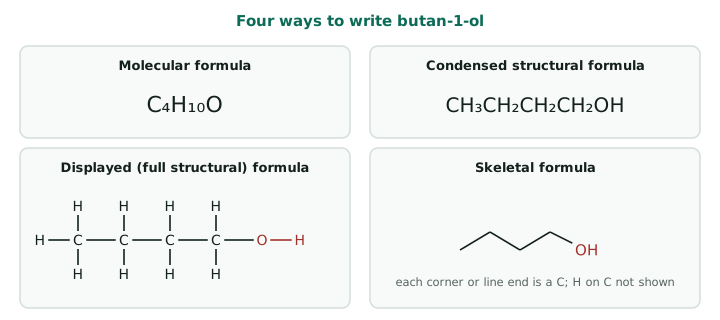
- Molecular formula: the actual number of each atom, C₄H₁₀O. It does not tell you the structure.
- Displayed (full structural) formula: every atom and every bond drawn.
- Condensed structural formula: the atoms on each carbon written in order, CH₃CH₂CH₂CH₂OH. Branches go in brackets: CH₃CH(CH₃)CH₃.
- Skeletal formula: only the carbon skeleton as a zigzag line. Every corner and line end is a carbon atom; H atoms on carbon are not shown, but all other atoms (and H on them) are.
The empirical formula is the simplest whole-number ratio of atoms (CH₂ for all alkenes). It comes from combustion analysis (Unit 3); the molar mass then gives the molecular formula.
Functional groups and homologous series
A functional group is an atom or group of atoms that gives a family of compounds its characteristic reactions. In ethanol, CH₃CH₂–OH, the –OH group reacts; the CH₃CH₂– part is almost unreactive.
| Family | Functional group | General formula | Example |
|---|---|---|---|
| alkane | (C–C only) | CₙH₂ₙ₊₂ | ethane CH₃CH₃ |
| alkene | C=C | CₙH₂ₙ | ethene CH₂=CH₂ |
| alkyne | C≡C | CₙH₂ₙ₋₂ | ethyne HC≡CH |
| haloalkane | –X (F, Cl, Br, I) | CₙH₂ₙ₊₁X | chloromethane CH₃Cl |
| alcohol | –OH | CₙH₂ₙ₊₁OH | ethanol CH₃CH₂OH |
| ether | –O– | R–O–R′ | methoxymethane CH₃OCH₃ |
| aldehyde | –CHO | RCHO | ethanal CH₃CHO |
| ketone | >C=O (between two C) | RCOR′ | propanone CH₃COCH₃ |
| carboxylic acid | –COOH | RCOOH | ethanoic acid CH₃COOH |
| ester | –COO– | RCOOR′ | methyl ethanoate CH₃COOCH₃ |
| acid chloride | –COCl | RCOCl | ethanoyl chloride CH₃COCl |
| amide | –CONH₂ | RCONH₂ | ethanamide CH₃CONH₂ |
| amine | –NH₂ | RNH₂ | methanamine CH₃NH₂ |
| nitrile | –C≡N | RCN | ethanenitrile CH₃CN |
R and R′ stand for alkyl groups (CH₃–, C₂H₅– …). Benzene compounds such as methylbenzene C₆H₅CH₃ and phenol C₆H₅OH contain the aromatic benzene ring (Unit 8).
A homologous series is a family of compounds that
- have the same functional group and the same general formula;
- differ from one member to the next by CH₂;
- have similar chemical properties;
- show a gradual change in physical properties (boiling point rises with chain length).
Example: An alcohol has molar mass $74\ \text{g mol}^{-1}$. CₙH₂ₙ₊₁OH has $M = 14n + 18$, so $14n + 18 = 74$ and $n = 4$: the formula is C₄H₉OH.
Primary, secondary and tertiary carbon atoms
A carbon atom is called primary (1°) if it is bonded to one other carbon, secondary (2°) if bonded to two, tertiary (3°) if bonded to three and quaternary (4°) if bonded to four. The same words describe alcohols, haloalkanes and carbocations by the carbon that carries the group: CH₃CH₂CH₂Br is a primary bromide, CH₃CHBrCH₃ secondary and (CH₃)₃CBr tertiary.
Exam tip: Count only the bonds to other carbon atoms. In CH₃OH the carbon has no C neighbour; methanol is usually grouped with primary alcohols because it reacts like them.
Exam tip: Before drawing skeletal formulae, check every carbon has exactly four bonds. A common mistake is a carbon with five bonds after adding a branch.