Ionisation energy, electron gain energy and electronegativity
First and successive ionisation energies and the factors that control them, the trends and dips across periods 2 and 3, electron gain energy, and Pauling electronegativity and its trends.
First ionisation energy
The first ionisation energy ($IE_1$) of an element is the minimum energy needed to remove the most loosely held electron from each atom in one mole of gaseous atoms in their ground state, forming one mole of gaseous unipositive ions: $$\text{X(g)} \rightarrow \text{X}^+\text{(g)} + e^- \qquad \Delta H = IE_1$$ Energy must always be supplied to pull an electron away from the nucleus, so ionisation energies are positive (endothermic). For sodium, $IE_1 = 496\ \text{kJ mol}^{-1}$. The atoms must be gaseous, so that no energy is needed to separate them from each other.
Four factors decide how hard it is to remove an electron:
- nuclear charge: more protons, stronger attraction, higher IE;
- distance from the nucleus: an electron in a higher shell is further out and easier to remove;
- shielding by inner electrons: more inner shells, weaker attraction;
- the subshell and pairing: a p electron is a little higher in energy than an s electron of the same shell; two electrons paired in one orbital repel each other.
Trends in the first ionisation energy
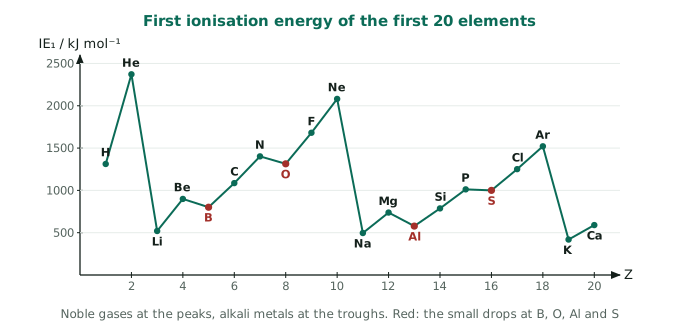
| Element | H | He | Li | Be | B | C | N | O | F | Ne |
|---|---|---|---|---|---|---|---|---|---|---|
| $IE_1$ / kJ mol⁻¹ | 1312 | 2372 | 520 | 899 | 801 | 1086 | 1402 | 1314 | 1681 | 2081 |
| Element | Na | Mg | Al | Si | P | S | Cl | Ar | K | Ca |
|---|---|---|---|---|---|---|---|---|---|---|
| $IE_1$ / kJ mol⁻¹ | 496 | 738 | 578 | 787 | 1012 | 1000 | 1251 | 1521 | 419 | 590 |
Across a period $IE_1$ increases in general, because the nuclear charge rises while the electrons are removed from the same shell with little extra shielding, so the atoms get smaller and hold their electrons more tightly. The noble gas at the end of each period has the highest value; helium has the highest of all.
Down a group $IE_1$ decreases (Li 520, Na 496, K 419): the outer electron is in a higher shell, further from the nucleus and better shielded. The increase in nuclear charge is outweighed.
There are two small drops in each of periods 2 and 3:
- Be → B and Mg → Al. B is $1s^2,2s^2,2p^1$: its outer electron is in a 2p orbital, which is higher in energy than 2s and partly shielded by the 2s electrons. It is easier to remove than one of Be's 2s electrons.
- N → O and P → S. N is $2p^3$, with one electron in each 2p orbital. In O ($2p^4$) two electrons share one orbital; their mutual repulsion makes one of them easier to remove. (N's half-filled $2p^3$ arrangement is sometimes described as "extra stable", but either this or the paired-electron repulsion in O is accepted in exam answers, and giving both is safest.)
The large drop from a noble gas to the next alkali metal (Ne 2081 → Na 496) is because the next electron starts a new shell.
Successive ionisation energies
The second ionisation energy is the energy for $\text{X}^+\text{(g)} \rightarrow \text{X}^{2+}\text{(g)} + e^-$, and so on. Successive ionisation energies always increase: each electron is pulled away from an ion that is more positive. The increases are gradual while electrons come from the same shell, and there is a very large jump when the next electron must be taken from an inner shell, closer to the nucleus and less shielded.
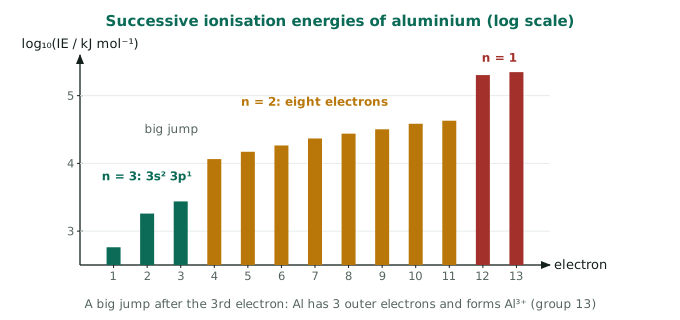
For aluminium ($1s^2,2s^2,2p^6,3s^2,3p^1$) the jump comes after the third electron ($IE_3 = 2745$, $IE_4 = 11,577\ \text{kJ mol}^{-1}$): aluminium has three outer electrons and is in group 13. A second huge jump after the 11th electron marks the move into the $n = 1$ shell. Successive ionisation energies were among the first evidence for shells.
Example: The first four ionisation energies of an element are 738, 1451, 7733 and 10 540 $\text{kJ mol}^{-1}$. The big jump is between $IE_2$ and $IE_3$, so the element has two outer electrons: it is in group 2 (it is magnesium), and it forms $\text{X}^{2+}$ ions.
Electron gain energy
The first electron gain energy (electron affinity) is the energy change when one mole of gaseous atoms each gain one electron to form one mole of gaseous uninegative ions: $$\text{X(g)} + e^- \rightarrow \text{X}^-\text{(g)}$$ For most non-metals energy is released (the value is negative), because the added electron is attracted by the nucleus.
| Atom | F | Cl | Br | I | O | S | N | C |
|---|---|---|---|---|---|---|---|---|
| electron gain energy / kJ mol⁻¹ | −328 | −349 | −325 | −295 | −141 | −200 | ≈ +7 | −122 |
- Group 17 elements release the most energy: one electron completes their outer p subshell.
- Chlorine, not fluorine, has the most negative value. Fluorine is so small that the incoming electron is strongly repelled by the electrons already crowded in its 2p subshell.
- Nitrogen ($2p^3$), the group 2 metals ($ns^2$) and the noble gases have values near zero or positive: the electron must go into a new or higher subshell, or pair up.
- The second electron gain energy is always positive (for O⁻ to O²⁻ it is about $+800\ \text{kJ mol}^{-1}$): an electron is being forced onto an ion that is already negative. Oxides still form because the large amount of energy released when the O²⁻ ions form the solid lattice (the lattice enthalpy of MgO is about 3800 kJ mol⁻¹) more than pays for it.
Electronegativity
Electronegativity is the ability of an atom in a covalent bond to attract the shared pair of electrons towards itself. It is not measured directly; Linus Pauling's scale gives fluorine the highest value.
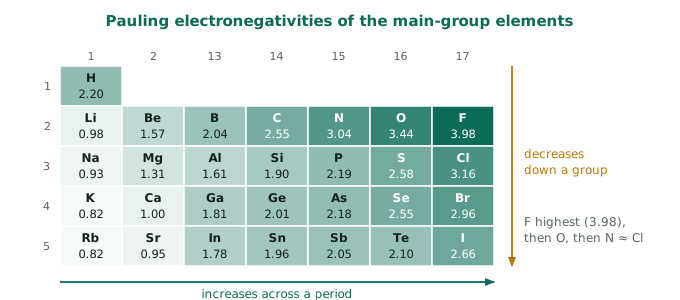
- It increases across a period (higher effective nuclear charge, smaller atom) and decreases down a group (bonding electrons further from the nucleus and better shielded).
- The most electronegative elements are F (3.98), O (3.44), N and Cl (about 3.0–3.2). The least are Cs and Fr (about 0.8), at the bottom left.
- Noble gases are usually given no value, because they rarely form bonds.
The difference in electronegativity between two bonded atoms decides how polar the bond is: equal values give a non-polar covalent bond, a small difference a polar covalent bond, and a large difference (roughly above 2) an essentially ionic bond. Unit 2 builds on this.
| Property | Across a period (left → right) | Down a group |
|---|---|---|
| atomic radius | decreases | increases |
| first ionisation energy | increases (with dips) | decreases |
| electronegativity | increases | decreases |
| metallic character | decreases | increases |
Exam tip: When asked to explain an ionisation energy trend, name the factors (nuclear charge, distance, shielding) and say which one wins. For the dips, quote the electron configurations (B: $2s^2,2p^1$; O: $2s^2,2p^4$ with one paired 2p orbital). Remember the definitions need gaseous atoms and one mole.