Ionic bonding, lattices and metallic bonding
Unit 2 · Structure and Bonding
How ions form, the ionic bond and lattice enthalpy, the sodium chloride lattice, properties of ionic compounds, polarisation and covalent character (Fajans' rules), and metallic bonding.
Chemical bonds
Atoms join together because the bonded arrangement has lower energy than the separate atoms. The strong forces that hold atoms or ions together are the primary bonds: ionic, covalent and metallic. The much weaker attractions between molecules (hydrogen bonds, dipole–dipole and London forces) are secondary interactions; they are covered in the last lesson of this unit. In most bonds the atoms end up with a stable outer arrangement of electrons, often eight (the octet), like a noble gas.
Forming ions
A metal atom with a low ionisation energy can lose its outer electrons to a non-metal atom with a high (negative) electron gain energy:
- $\text{Na}\ (2,8,1) \rightarrow \text{Na}^+\ (2,8) + e^-$
- $\text{Cl}\ (2,8,7) + e^- \rightarrow \text{Cl}^-\ (2,8,8)$
In a dot-and-cross diagram the electrons of one atom are drawn as dots and those of the other as crosses; the ions are written $\text{Na}^+$ and $[\text{Cl}]^-$, with all eight outer electrons drawn around Cl inside the bracket. Magnesium oxide is $\text{Mg}^{2+},\text{O}^{2-}$; calcium fluoride has one $\text{Ca}^{2+}$ for every two $\text{F}^-$.
An ionic (electrovalent) bond is the electrostatic attraction between oppositely charged ions. It acts equally in all directions, so each ion attracts as many oppositely charged neighbours as can fit around it: a giant ionic lattice forms, not separate molecules.
Why ionic compounds form: lattice enthalpy
Forming the gaseous ions alone costs energy: $$\text{Na(g)} \rightarrow \text{Na}^+\text{(g)} + e^- \quad +496\ \text{kJ mol}^{-1}$$ $$\text{Cl(g)} + e^- \rightarrow \text{Cl}^-\text{(g)} \quad -349\ \text{kJ mol}^{-1}$$ The total, $+147\ \text{kJ mol}^{-1}$, is endothermic. What makes NaCl stable is the energy released when the gaseous ions come together to form the solid lattice: $787\ \text{kJ mol}^{-1}$ for NaCl. (The lattice enthalpy, defined in the Energetics unit as the energy needed to separate the solid into gaseous ions, $\text{NaCl(s)} \rightarrow \text{Na}^+\text{(g)} + \text{Cl}^-\text{(g)}$, is $+787\ \text{kJ mol}^{-1}$; the reverse, lattice formation, is $-787$.) (The Born–Haber cycle in the Energetics unit puts all the steps together.)
The lattice enthalpy is larger when the ions are smaller (closer together) and have higher charges (Coulomb's law: force $\propto \dfrac{q_1 q_2}{r^2}$).
| Compound | Lattice enthalpy / kJ mol⁻¹ | Melting point / °C |
|---|---|---|
| NaF | +923 | 993 |
| NaCl | +787 | 801 |
| NaBr | +747 | 747 |
| MgO | +3791 | 2852 |
MgO, with $2+$ and $2-$ ions that are both small, has a lattice enthalpy about five times that of NaCl.
The sodium chloride lattice
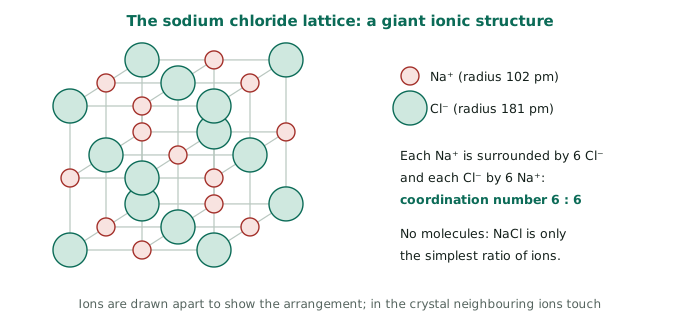
In sodium chloride each Na⁺ ion is surrounded by six Cl⁻ ions at the corners of an octahedron, and each Cl⁻ by six Na⁺: the coordination number is 6 : 6. The formula NaCl only gives the simplest ratio of ions in the lattice.
Properties of ionic compounds follow from the strong, non-directional forces in the lattice:
- high melting and boiling points: much energy is needed to separate the ions;
- hard but brittle: a small shift brings ions of the same charge side by side, and they repel, so the crystal splits;
- electrical conductors only when molten or in aqueous solution: the ions must be free to move; in the solid they are fixed;
- many are soluble in water (a polar solvent whose molecules surround and stabilise the ions) and insoluble in non-polar solvents such as hexane.
Covalent character in ionic bonds: polarisation
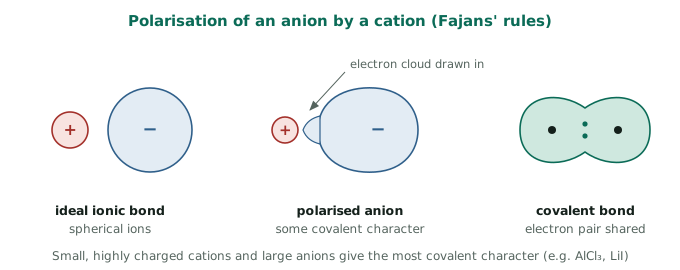
Ionic and covalent bonds are two ends of a range. A cation attracts the electron cloud of a neighbouring anion and distorts it; electron density is drawn into the region between the ions, which is the beginning of electron sharing. This is polarisation, and it gives the ionic bond some covalent character. Fajans' rules state that covalent character is greater when:
- the cation is small and highly charged: it has a high polarising power, roughly charge ÷ radius (Al³⁺ > Mg²⁺ > Na⁺; Li⁺ > Na⁺ > K⁺);
- the anion is large and highly charged: its outer electrons are far from its nucleus, so it is easily distorted, a high polarisability (I⁻ > Br⁻ > Cl⁻ > F⁻);
- the cation does not have a noble-gas configuration (for example Ag⁺ and Cu⁺, $d^{10}$).
| Chloride | NaCl | MgCl₂ | AlCl₃ |
|---|---|---|---|
| melting point / °C | 801 | 714 | sublimes at 178 |
| bonding | ionic | ionic, some covalent character | mainly covalent |
Example: Explain why LiI is more covalent than NaCl. Li⁺ is smaller than Na⁺, so its polarising power is greater; I⁻ is much larger than Cl⁻, so it is more polarisable. Both effects increase the distortion of the anion's electron cloud and the covalent character.
The opposite also happens: a covalent bond between atoms of different electronegativity has partial ionic character (lesson 5).
Metallic bonding
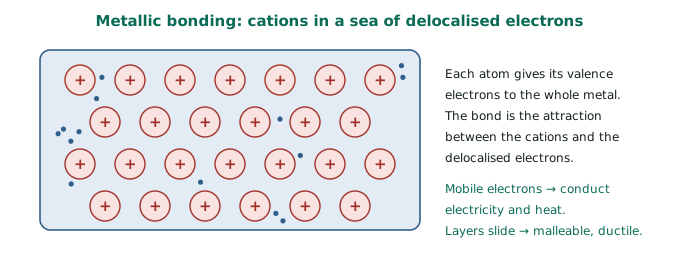
In a metal each atom releases its valence electrons, which become delocalised: free to move through the whole lattice. The metal is a regular lattice of positive ions held together by their attraction to this "sea" of electrons. This metallic bond is non-directional.
- Electrical and thermal conductivity: the delocalised electrons move when a potential difference is applied and carry kinetic energy quickly through the metal.
- Malleability and ductility: layers of ions can slide over each other without breaking the bonding, because the electron sea moves with them.
- Lustre: free electrons absorb and re-emit light.
- Strength of the bond increases with the number of delocalised electrons per atom and with a smaller ion: Na (1 electron, m.p. 98 °C) < Mg (2, m.p. 650 °C) < Al (3, m.p. 660 °C). Down group 1 the ions get larger and the melting point falls (Li 181 °C, Na 98 °C, K 63 °C).
Exam tip: When asked why an ionic compound conducts only when molten or dissolved, the key word is mobile ions. For a metal it is delocalised (mobile) electrons. Do not say that ionic solids conduct with electrons.