Hybridisation, σ and π bonds and giant covalent structures
Unit 2 · Structure and Bonding
Covalent bonds as overlapping orbitals, σ and π bonds, sp³, sp² and sp hybridisation (and sp³d, sp³d²), bond length and bond energy, and the structures of diamond, graphite and silicon dioxide.
Bonds as overlapping orbitals
In valence bond theory a covalent bond forms when an orbital on one atom overlaps an orbital on another, and the two electrons (of opposite spin) occupy the overlap region between the nuclei. The greater the overlap, the stronger the bond.
- A sigma (σ) bond is formed by head-on (end-to-end) overlap along the line joining the two nuclei. The electron density is concentrated on that axis, and the bond is symmetrical about it. It can form from s–s (H₂), s–p (H–Cl), p–p (Cl–Cl) or hybrid orbitals.
- A pi (π) bond is formed by sideways overlap of two parallel p orbitals. The electron density lies in two regions, above and below the axis, with none on the axis itself. Sideways overlap is smaller, so a π bond is weaker than a σ bond.
Between any two atoms the first bond is always σ. A double bond is one σ and one π; a triple bond is one σ and two π (the two π bonds are at right angles to each other). Rotation about a single bond is free, but rotating about a double bond would break the π overlap, so there is no free rotation about C=C.
Why hybridisation is needed
Carbon in its ground state is $1s^2,2s^2,2p^2$, with only two unpaired electrons. Yet it forms four bonds in CH₄, and all four C–H bonds are identical, at $109.5°$ to each other. The explanation:
- one 2s electron is promoted to the empty 2p orbital, giving four unpaired electrons ($2s^1,2p^3$); the energy cost is repaid by forming two extra bonds;
- the 2s and three 2p orbitals mix (hybridise) to give four identical sp³ hybrid orbitals, each with one electron, pointing to the corners of a tetrahedron.
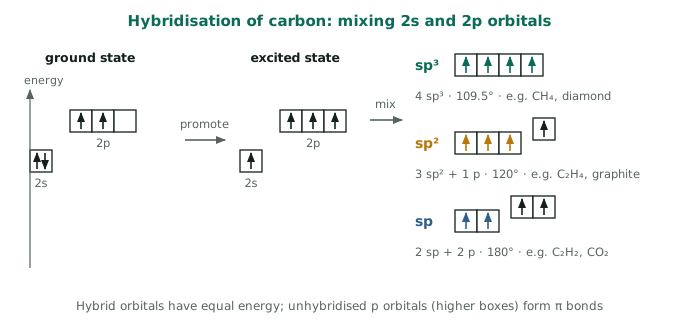
Hybrid orbitals have one large lobe and one small lobe. Their large lobes overlap well with other orbitals, so they form strong σ bonds. The number of hybrid orbitals always equals the number of atomic orbitals mixed.
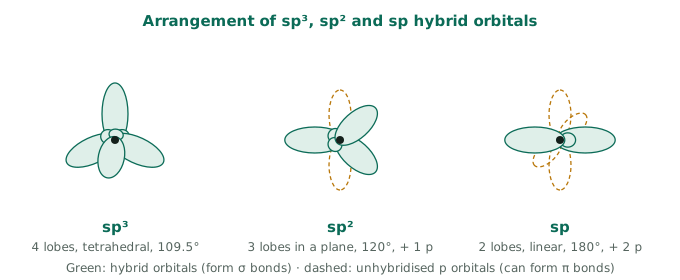
| Electron pairs on the atom | Hybridisation | Geometry | Unhybridised p orbitals | Examples |
|---|---|---|---|---|
| 2 | sp | linear, 180° | 2 | BeCl₂, C in C₂H₂, CO₂, HCN |
| 3 | sp² | trigonal planar, 120° | 1 | BF₃, C in C₂H₄, CO₃²⁻ |
| 4 | sp³ | tetrahedral, 109.5° | 0 | C in CH₄, N in NH₃, O in H₂O |
| 5 | sp³d | trigonal bipyramidal | – | P in PCl₅ |
| 6 | sp³d² | octahedral | – | S in SF₆ |
Lone pairs also occupy hybrid orbitals: N in NH₃ and O in H₂O are sp³ hybridised, with one and two lone pairs in sp³ orbitals.
σ and π bonds in ethene and ethyne
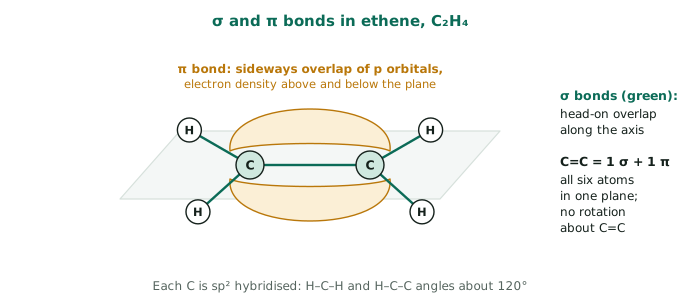
In ethene, C₂H₄, each carbon is sp². Its three sp² orbitals form σ bonds to two H atoms (C sp² – H 1s) and to the other carbon (C sp² – C sp²). The unhybridised 2p orbital on each carbon is perpendicular to the plane; the two overlap sideways to form the π bond. All six atoms lie in one plane, with angles close to $120°$.
In ethyne, C₂H₂, each carbon is sp: H–C≡C–H is linear. The C–C σ bond is sp–sp; the two remaining 2p orbitals on each carbon form two π bonds at right angles, which merge into a cylinder of electron density around the C–C axis.
Example: Count the σ and π bonds in propenenitrile, $\text{H}_2\text{C=CH–C}\equiv\text{N}$. Single bonds: 3 C–H and 1 C–C, all σ (4 σ). C=C: 1 σ + 1 π. C≡N: 1 σ + 2 π. Total: 6 σ and 3 π. The carbons are sp², sp² and sp from left to right, and N is sp.
Example: Which orbitals overlap to form the bonds in HCN? H–C σ: H 1s with C sp. C≡N σ: C sp with N sp. The two π bonds: C 2p with N 2p (each pair parallel). The lone pair on N is in an sp orbital.
Bond length and bond energy
| Bond | Bond length / pm | Average bond energy / kJ mol⁻¹ |
|---|---|---|
| C–C | 154 | 348 |
| C=C | 134 | 612 |
| C≡C | 120 | 838 |
| C–O | 143 | 360 |
| C=O | 120 | 743 |
More shared electron pairs pull the nuclei closer and hold them more strongly: bond length falls and bond energy rises from single to double to triple. Note that a C=C bond is less than twice as strong as C–C, because the π bond is weaker than the σ bond. Bond lengths also increase with the size of the atoms: H–F 92 pm, H–Cl 127 pm, H–Br 141 pm, H–I 161 pm, and the bonds get weaker in the same order.
Giant covalent (network) structures
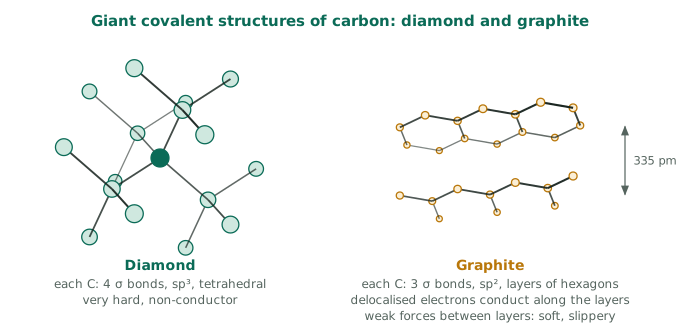
In some solids every atom is covalently bonded to its neighbours in a continuous network, with no separate molecules.
| Diamond | Graphite | |
|---|---|---|
| hybridisation of C | sp³ | sp² |
| bonding | each C bonded to 4 others, tetrahedral 3D network | each C bonded to 3 others in flat hexagonal layers; one delocalised electron per C |
| C–C distance | 154 pm | 142 pm within a layer; layers 335 pm apart |
| between layers | – | weak London forces |
| hardness | hardest natural substance | soft, slippery (layers slide): a lubricant, pencil "lead" |
| electrical conductivity | none (all electrons in σ bonds) | good, along the layers (delocalised π electrons) |
| melting point | very high (above 3500 °C) | very high (sublimes at about 3650 °C) |
Diamond and graphite are allotropes of carbon: different structural forms of the same element in the same physical state. Graphite is the thermodynamically more stable form at room temperature and pressure.
Silicon dioxide (quartz) is also a giant covalent structure: each Si is bonded tetrahedrally to four O atoms and each O to two Si atoms. That is why SiO₂ is a hard solid melting at about $1700\ ^\circ\text{C}$, while CO₂, made of small separate O=C=O molecules, is a gas.
Exam tip: To decide the hybridisation of any atom, count the σ bonds it forms plus its lone pairs (π bonds are not counted): 4 → sp³, 3 → sp², 2 → sp. For example, the O of C=O in propanone has one σ bond and two lone pairs, so it is sp².