Electromagnetic radiation and the hydrogen spectrum
Wave properties of light, photons and E = hν, emission and absorption spectra, Bohr's energy levels, the Lyman, Balmer and Paschen series and ionisation energy from the convergence limit.
Electromagnetic radiation
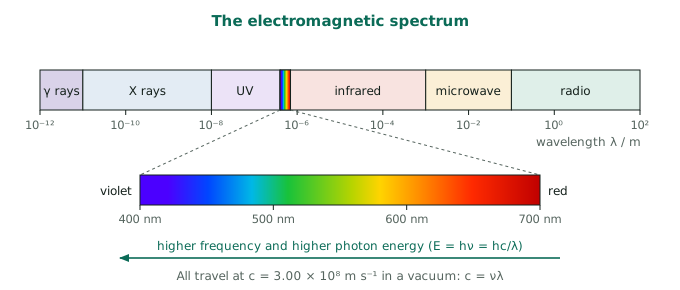
Light is one kind of electromagnetic radiation: oscillating electric and magnetic fields that travel through a vacuum at $c = 3.00 \times 10^8\ \text{m s}^{-1}$. A wave is described by its
- wavelength $\lambda$, the distance between two neighbouring crests (m, nm; $1\ \text{nm} = 10^{-9}\ \text{m}$);
- frequency $\nu$, the number of waves passing a point per second (Hz $= \text{s}^{-1}$);
- wavenumber $\bar{\nu} = 1/\lambda$, the number of waves per unit length ($\text{m}^{-1}$ or $\text{cm}^{-1}$).
$$c = \nu\lambda$$ The visible region is only a narrow band, from about $400\ \text{nm}$ (violet) to $700\ \text{nm}$ (red). Ultraviolet, X rays and γ rays have shorter wavelengths and higher frequencies; infrared, microwaves and radio waves have longer wavelengths.
Photons: E = hν
Max Planck (1900) proposed that radiation is emitted and absorbed only in packets (quanta) of energy. A quantum of light is called a photon. Its energy is proportional to the frequency: $$E = h\nu = \frac{hc}{\lambda}, \qquad h = 6.626 \times 10^{-34}\ \text{J s}$$ So short wavelength means high energy. The photoelectric effect, in which only light above a threshold frequency can eject electrons from a metal, however bright the light, is evidence that light behaves as particles. Light therefore has a dual nature: it shows wave properties (diffraction, interference) and particle properties.
Example: Find the energy of one photon of green light, $\lambda = 500\ \text{nm}$, and of one mole of such photons. $E = \dfrac{hc}{\lambda} = \dfrac{6.626 \times 10^{-34} \times 3.00 \times 10^8}{500 \times 10^{-9}} = 3.98 \times 10^{-19}\ \text{J}$. For a mole: $3.98 \times 10^{-19} \times 6.022 \times 10^{23} = 2.39 \times 10^5\ \text{J} = 239\ \text{kJ mol}^{-1}$.
Continuous and line spectra
White light from a hot solid gives a continuous spectrum: all wavelengths, merging into one another. Atoms of a gas excited in a discharge tube or a flame give an emission line spectrum: a few sharp bright lines on a dark background. Each element has its own pattern of lines, like a fingerprint; this is why flame colours identify metals (sodium yellow, $589\ \text{nm}$; potassium lilac; lithium and strontium crimson; calcium brick red; barium apple green). If white light passes through a cool gas, the same wavelengths are removed, giving dark lines: an absorption spectrum.
Line spectra show that an electron in an atom can have only certain fixed energies: its energy is quantised.
Bohr's model of the hydrogen atom
Niels Bohr (1913) proposed that:
- the electron moves round the nucleus only in certain allowed circular orbits (energy levels or shells), numbered $n = 1, 2, 3, \dots$ (the principal quantum number);
- while in an allowed orbit the electron does not radiate energy;
- the electron moves from one level to another only by absorbing or emitting a photon whose energy equals the difference between the levels: $\Delta E = E_{upper} - E_{lower} = h\nu$.
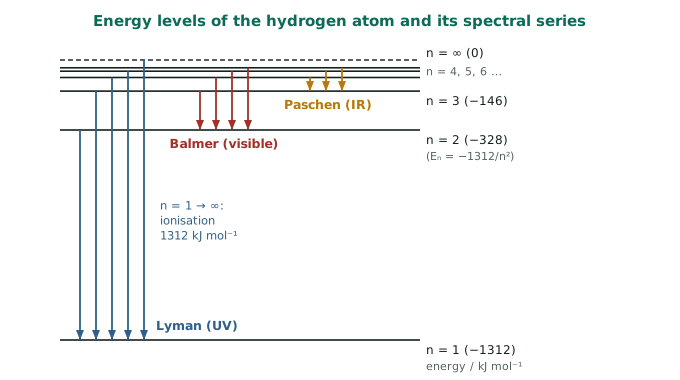
For hydrogen the energy of level $n$ is $$E_n = -\frac{2.18 \times 10^{-18}}{n^2}\ \text{J per atom} = -\frac{1312}{n^2}\ \text{kJ mol}^{-1}$$ Energies are negative because the zero is taken as the electron completely removed ($n = \infty$). The lowest level, $n = 1$, is the ground state; higher levels are excited states. The levels get closer together as $n$ increases.
The spectral series of hydrogen
| Series | Electron falls to | Region |
|---|---|---|
| Lyman | $n = 1$ | ultraviolet |
| Balmer | $n = 2$ | visible |
| Paschen | $n = 3$ | infrared |
| Brackett, Pfund | $n = 4$, $n = 5$ | infrared |
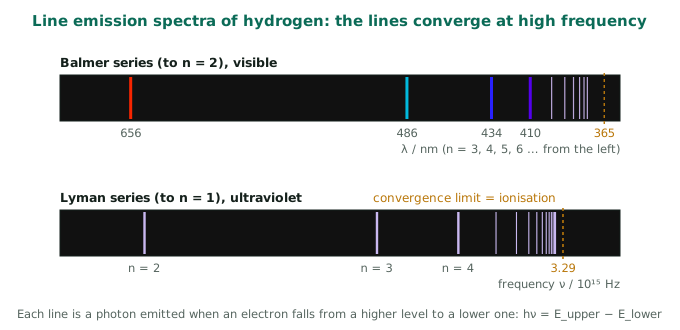
Because the levels crowd together, the lines in each series get closer and closer at higher frequency and finally merge at the convergence limit. For the Lyman series the convergence limit corresponds to a jump from $n = 1$ to $n = \infty$: the electron is removed, so it gives the ionisation energy of hydrogen.
Example: The Lyman series converges at $\nu = 3.29 \times 10^{15}\ \text{Hz}$. $E = h\nu = 6.626 \times 10^{-34} \times 3.29 \times 10^{15} = 2.18 \times 10^{-18}\ \text{J}$ per atom. Per mole: $2.18 \times 10^{-18} \times 6.022 \times 10^{23} = 1.31 \times 10^{6}\ \text{J mol}^{-1} = 1312\ \text{kJ mol}^{-1}$.
Example: Calculate the wavelength of the red Balmer line ($n = 3 \rightarrow n = 2$). $\Delta E = 2.18 \times 10^{-18}\left(\dfrac{1}{2^2} - \dfrac{1}{3^2}\right) = 3.03 \times 10^{-19}\ \text{J}$, so $\lambda = \dfrac{hc}{\Delta E} = \dfrac{6.626 \times 10^{-34} \times 3.00 \times 10^8}{3.03 \times 10^{-19}} = 6.56 \times 10^{-7}\ \text{m} = 656\ \text{nm}$.
An electron that has been excited to level $n$ can return to the ground state by many routes. The number of different lines it can produce is $\dfrac{n(n-1)}{2}$; from $n = 4$ that is 6 lines.
Beyond Bohr: the electron as a wave
Bohr's model works only for one-electron species (H, He⁺, Li²⁺). Louis de Broglie suggested that moving particles also behave as waves, with $\lambda = \dfrac{h}{mv}$; electron diffraction confirmed it. Heisenberg's uncertainty principle says that the position and momentum of an electron cannot both be known exactly, so fixed orbits are meaningless. Modern theory describes only the probability of finding an electron in a region of space, an orbital, which leads to the quantum numbers of the next lesson.
Exam tip: Keep the units straight. $E = h\nu$ gives joules per photon (per atom); multiply by $N_A$ and divide by 1000 to get $\text{kJ mol}^{-1}$. Wavelengths in nm must be changed to metres before using $c = \nu\lambda$.