Diazonium salts and azo dyes
Unit 10 · Nitrogen Containing Organic Compounds
Making benzenediazonium chloride, replacing the –N₂⁺ group by OH, Cl, Br, I, CN and H, coupling with phenol and 2-naphthol to make azo dyes, and using these reactions in aromatic synthesis.
Benzenediazonium chloride
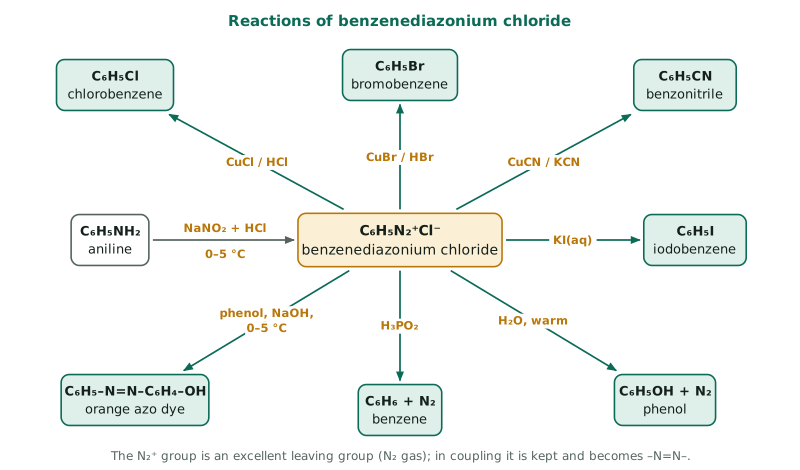
Dissolve aniline in excess dilute hydrochloric acid and cool it in ice to 0–5 °C. Then add cold sodium nitrite solution slowly, keeping the temperature below 5 °C: $$\mathrm{C_6H_5NH_2 + NaNO_2 + 2HCl \rightarrow C_6H_5N_2^+Cl^- + NaCl + 2H_2O}$$ The product, benzenediazonium chloride, stays in solution. It is not isolated, because the dry solid can explode, and it is used straight away.
- Why cold? Above about 10 °C the diazonium ion reacts with water, giving phenol and N₂ gas. The excess acid stops the diazonium ion coupling with unreacted aniline.
- Why more stable than C₂H₅N₂⁺? In the aryl ion the π electrons of the ring overlap with the –N≡N⁺ group, delocalising the positive charge. An alkyldiazonium ion has no such help and loses N₂ at once, which is why ethylamine gives bubbles even in the cold.
Replacement reactions (N₂ is lost)
The –N₂⁺ group leaves as nitrogen gas, a very stable molecule, so it is easily replaced:
| Reagent and conditions | Product | Name |
|---|---|---|
| H₂O, warm (above 10 °C) | C₆H₅OH | phenol |
| KI(aq), room temperature | C₆H₅I | iodobenzene |
| CuCl in HCl | C₆H₅Cl | chlorobenzene |
| CuBr in HBr | C₆H₅Br | bromobenzene |
| CuCN in KCN | C₆H₅CN | benzonitrile |
| H₃PO₂ (phosphinic acid) | C₆H₆ | benzene |
$$\mathrm{C_6H_5N_2^+Cl^- + H_2O \rightarrow C_6H_5OH + N_2 + HCl}$$ $$\mathrm{C_6H_5N_2^+ + I^- \rightarrow C_6H_5I + N_2}$$ The copper(I) reactions are called Sandmeyer reactions. Iodobenzene needs no copper catalyst. These reactions matter because chlorine and bromine cannot be put onto a ring that already carries –NH₂ or –OH without over-substitution, iodine does not substitute benzene directly, and –CN cannot be put onto a ring by direct substitution at all. Benzonitrile can then be hydrolysed to benzoic acid or reduced to phenylmethylamine C₆H₅CH₂NH₂.
Coupling reactions (N₂ is kept)
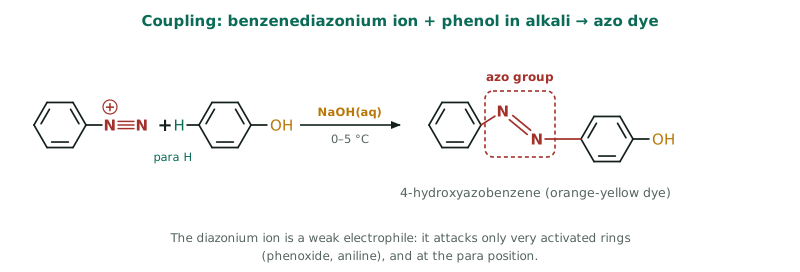
The diazonium ion is a weak electrophile. It attacks only very electron-rich rings, those carrying –O⁻ or –NH₂, and substitutes at the para position (ortho if para is blocked). The two rings end up joined by an azo group, –N=N–.
- With phenol in NaOH(aq) at 0–5 °C: the phenoxide ion couples to give 4-hydroxyazobenzene, an orange-yellow precipitate: $$\mathrm{C_6H_5N_2^+ + C_6H_5O^- \rightarrow C_6H_5{-}N{=}N{-}C_6H_4{-}OH}$$ The alkali turns phenol into phenoxide, which is much more reactive.
- With naphthalen-2-ol (2-naphthol, β-naphthol) in NaOH(aq): an intensely red-orange precipitate. This is the standard test for a primary aromatic amine: diazotise at 0–5 °C, then add alkaline 2-naphthol.
- With aniline in a weakly acidic solution: 4-aminoazobenzene, a yellow dye.
Azo compounds are coloured because the –N=N– group joins the two aromatic rings into one long delocalised π system that absorbs visible light. Many dyes (for cotton, food and textiles) and acid–base indicators such as methyl orange are azo compounds.
Using diazonium salts in synthesis
Benzene → nitrobenzene → aniline → diazonium salt is a route to many substituted benzenes.
Example: Benzene to phenol in three steps. (1) conc. HNO₃ + conc. H₂SO₄, below 55 °C → nitrobenzene; (2) Sn + conc. HCl, then NaOH → aniline; (3) NaNO₂ + HCl at 0–5 °C, then warm the solution → phenol.
Example: Aniline to 1,3,5-tribromobenzene. Direct bromination of benzene puts bromines ortho/para to each other, never 1,3,5. Instead, (1) bromine water → 2,4,6-tribromoaniline, where –NH₂ places the three Br atoms meta to each other; (2) NaNO₂ + HCl at 0–5 °C → the diazonium salt; (3) H₃PO₂ → removes the N₂⁺, giving 1,3,5-tribromobenzene. The –NH₂ was used only to steer the bromines and is then removed.
Example: Aniline to benzoic acid: diazotise (NaNO₂ + HCl, 0–5 °C), then CuCN/KCN → benzonitrile, then reflux with dilute acid → C₆H₅COOH.
Exam tip: Know which reactions keep nitrogen (coupling, giving coloured –N=N– compounds) and which lose it as N₂ (all the replacements). In a structure-identification question, an orange or red precipitate with alkaline phenol or 2-naphthol after diazotisation points to an Ar–NH₂ group.
Common mistake: writing that iodobenzene needs CuI; doing the coupling reaction in acid with phenol (it needs alkali to make phenoxide); and putting the azo group ortho to –OH when the para position is free.