Dalton's law of partial pressures and mole fraction
Unit 4 · Gaseous State of Matter
Partial pressure, Dalton's law, mole fraction and p = xP, mixing gases from connected vessels, collecting a gas over water, average molar mass of air, and pressure changes in reacting gas mixtures.
Partial pressure
In a mixture of gases that do not react, each gas behaves as if the others were not there: its molecules move independently and hit the walls on their own. The partial pressure $p_A$ of gas A is the pressure it would exert if it alone occupied the whole volume at the same temperature: $$p_A = \frac{n_A RT}{V}$$
Dalton's law of partial pressures
The total pressure of a mixture of non-reacting gases is the sum of the partial pressures of its components: $$P = p_A + p_B + p_C + \cdots = (n_A + n_B + \cdots)\frac{RT}{V}$$
Mole fraction
The mole fraction of A is its share of the total number of moles: $$x_A = \frac{n_A}{n_A + n_B + \cdots}, \qquad x_A + x_B + \cdots = 1$$ Dividing $p_A = n_ART/V$ by $P = n_{total}RT/V$ gives $$p_A = x_A P$$ For gases, the mole fraction is also the volume fraction: air is 78% $\text{N}_2$ and 21% $\text{O}_2$ by volume, so at $1.00 \times 10^5\ \text{Pa}$, $p(\text{N}_2) = 0.78 \times 10^5\ \text{Pa}$ and $p(\text{O}_2) = 0.21 \times 10^5\ \text{Pa}$.
Example: A mixture of $4.0\ \text{g}$ of He ($1.0\ \text{mol}$) and $14.0\ \text{g}$ of $\text{N}_2$ ($0.50\ \text{mol}$) has a total pressure of $1.5 \times 10^5\ \text{Pa}$. $x(\text{He}) = \dfrac{1.0}{1.5} = \dfrac{2}{3}$, so $p(\text{He}) = 1.0 \times 10^5\ \text{Pa}$ and $p(\text{N}_2) = 0.50 \times 10^5\ \text{Pa}$. Note that the mass fractions (22% He) are quite different from the mole fractions.
Average molar mass. A mixture behaves as a gas with $\bar{M} = \sum x_iM_i$. For air, $\bar{M} = 0.78(28) + 0.21(32) + 0.01(40) = 29\ \text{g mol}^{-1}$. Gases with $M < 29$ ($\text{NH}_3$, $\text{CH}_4$, $\text{H}_2$) are less dense than air and rise; $\text{CO}_2$ ($M = 44$) and $\text{Cl}_2$ collect in low places.
Mixing gases from connected vessels
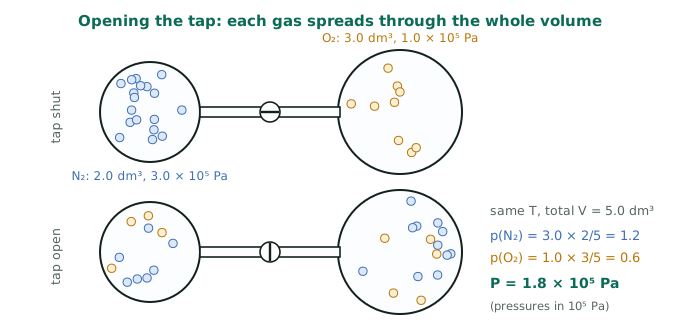
When a tap between two vessels at the same temperature is opened, each gas spreads into the total volume. Its new partial pressure follows from Boyle's law, $p_{new} = p_{old} \times \dfrac{V_{old}}{V_{total}}$.
Example: A $2.0\ \text{dm}^3$ flask of $\text{N}_2$ at $3.0 \times 10^5\ \text{Pa}$ is joined to a $3.0\ \text{dm}^3$ flask of $\text{O}_2$ at $1.0 \times 10^5\ \text{Pa}$ at the same temperature. After mixing, $p(\text{N}_2) = 3.0 \times 10^5 \times \dfrac{2.0}{5.0} = 1.2 \times 10^5\ \text{Pa}$, $p(\text{O}_2) = 1.0 \times 10^5 \times \dfrac{3.0}{5.0} = 0.60 \times 10^5\ \text{Pa}$, and $P = 1.8 \times 10^5\ \text{Pa}$. The mole fraction of $\text{N}_2$ is $\dfrac{1.2}{1.8} = \dfrac{2}{3}$.
Collecting a gas over water
A gas collected over water is saturated with water vapour. When the water levels inside and outside the collecting vessel are equal, the pressure inside equals atmospheric pressure, so $$P_{atm} = p(\text{gas}) + p(\text{H}_2\text{O})$$ where $p(\text{H}_2\text{O})$ is the saturated vapour pressure of water at that temperature (it depends only on temperature).
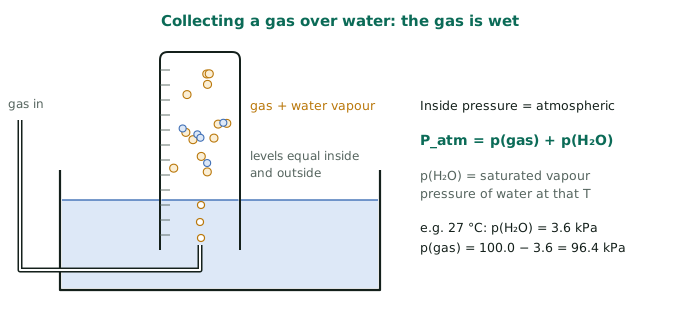
Example: $250\ \text{cm}^3$ of hydrogen is collected over water at $27\ ^\circ\text{C}$ and $100.0\ \text{kPa}$; the vapour pressure of water at $27\ ^\circ\text{C}$ is $3.6\ \text{kPa}$. $p(\text{H}_2) = 96.4\ \text{kPa}$, so $n(\text{H}_2) = \dfrac{96.4 \times 10^3 \times 250 \times 10^{-6}}{8.314 \times 300} = 9.66 \times 10^{-3}\ \text{mol}$.
Reacting gas mixtures
Dalton's law adds pressures of gases that do not react. If the gases react, first find the amounts after the reaction from the equation, then use $p_i = n_iRT/V$.
Example: A $1.00\ \text{dm}^3$ vessel at $400\ \text{K}$ contains $0.020\ \text{mol}$ of $\text{H}_2$ and $0.020\ \text{mol}$ of $\text{O}_2$ (total pressure $1.33 \times 10^5\ \text{Pa}$). The mixture is sparked and returned to $400\ \text{K}$, where water is a gas. $2\text{H}_2 + \text{O}_2 \rightarrow 2\text{H}_2\text{O}$: all the $\text{H}_2$ reacts with $0.010\ \text{mol}$ $\text{O}_2$, giving $0.020\ \text{mol}$ $\text{H}_2\text{O}$ and leaving $0.010\ \text{mol}$ $\text{O}_2$. Total $0.030\ \text{mol}$, so $P = \dfrac{0.030 \times 8.314 \times 400}{1.00 \times 10^{-3}} = 1.00 \times 10^5\ \text{Pa}$, with $p(\text{H}_2\text{O}) = 6.65 \times 10^4\ \text{Pa}$ and $p(\text{O}_2) = 3.33 \times 10^4\ \text{Pa}$.
Exam tip: At constant $V$ and $T$, pressure is proportional to moles, so you can often work with pressures directly as if they were moles, for example in a reaction such as $\text{N}_2\text{O}_4 \rightleftharpoons 2\text{NO}_2$. Make sure the temperature and volume really are the same before and after.