Covalent bonds, Lewis structures and resonance
Unit 2 · Structure and Bonding
Shared electron pairs, single, double, triple and dative bonds, a step-by-step method for Lewis structures, exceptions to the octet rule, formal charge and resonance structures.
The covalent bond
When two non-metal atoms, both with high electronegativity, combine, neither can take electrons from the other. Instead they share a pair of electrons. The shared pair is attracted by both nuclei, and this holds the atoms together: a covalent bond. It is directional: it lies along the line between the two nuclei.
- Single bond: one shared pair, H–H, H–Cl.
- Double bond: two shared pairs, O=O, O=C=O.
- Triple bond: three shared pairs, N≡N, H–C≡N.
Pairs of valence electrons that are not shared are lone pairs (non-bonding pairs). In H₂O the oxygen has two bond pairs and two lone pairs.
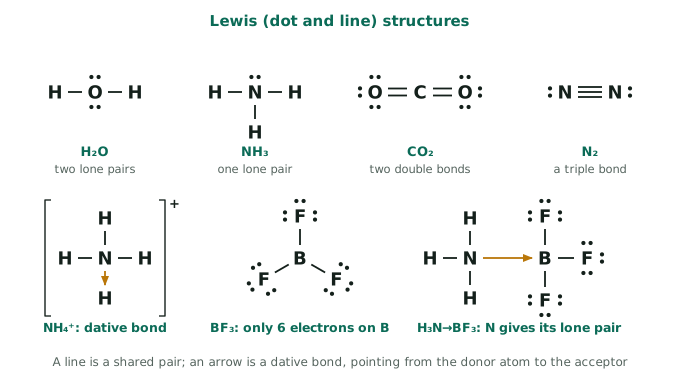
Dative (coordinate) bonds
In a dative bond both electrons of the shared pair come from the same atom: a donor with a lone pair gives it to an acceptor that has an empty orbital. It is drawn as an arrow, donor → acceptor. Once formed it is exactly like any other covalent bond.
- $\text{NH}_3 + \text{H}^+ \rightarrow \text{NH}_4^+$: all four N–H bonds in the ammonium ion are identical.
- $\text{H}_2\text{O} + \text{H}^+ \rightarrow \text{H}_3\text{O}^+$ (the oxonium ion).
- $\text{H}_3\text{N} \rightarrow \text{BF}_3$: boron has only six electrons and accepts nitrogen's lone pair.
- Carbon monoxide, $:\text{C}\equiv\text{O}:$, has one dative bond from O to C. Aluminium chloride vapour forms the dimer $\text{Al}_2\text{Cl}_6$ through two Cl → Al dative bonds.
Drawing Lewis structures step by step
- Count the valence electrons of all the atoms. Add one for each negative charge; subtract one for each positive charge.
- Choose the skeleton. The central atom is usually the one that is least electronegative and forms the most bonds (never H or F). In oxoacids H is bonded to O.
- Join the atoms with single bonds: two electrons each.
- Complete the octets of the outer atoms with lone pairs (H needs only two).
- Put any electrons left over on the central atom as lone pairs.
- If the central atom has fewer than eight electrons, turn lone pairs on outer atoms into multiple bonds.
- Check the formal charges and choose the best structure (below).
Example: The Lewis structure of HCN. Valence electrons $= 1 + 4 + 5 = 10$. Skeleton H–C–N uses 4; a lone-pair set of 6 on N leaves 0 for C, which then has only 4 electrons. Move two lone pairs on N into bonds: $\text{H–C}\equiv\text{N:}$. Now C and N both have octets, using all 10 electrons.
Exceptions to the octet rule
- Incomplete octets: Be and B have too few valence electrons. BeCl₂ (4 electrons around Be), BF₃ and AlCl₃ (6 around B or Al). Such molecules are electron-deficient and act as acceptors (Lewis acids).
- Odd-electron molecules: NO (11 valence electrons), NO₂ (17), ClO₂ (19). One atom must have an unpaired electron; these are free radicals.
- Expanded octets: atoms from period 3 onwards (P, S, Cl, Xe …) can have more than eight electrons around them, using their vacant d orbitals: PCl₅ (10 electrons around P), SF₆ (12 around S), XeF₄. Period 2 atoms (C, N, O, F) can never have more than eight, because the second shell has no d orbitals.
Formal charge
When more than one Lewis structure can be drawn, formal charges decide which is best. The formal charge on an atom is the charge it would have if each bonding pair were shared equally: $$\text{formal charge} = V - L - \tfrac{1}{2}B$$ where $V$ = valence electrons of the free atom, $L$ = electrons in lone pairs on the atom, and $B$ = electrons in the bonds to it. The formal charges add up to the overall charge of the species. The preferred structure:
- has formal charges as close to zero as possible;
- puts any negative formal charge on the more electronegative atom;
- avoids like charges on neighbouring atoms.
Example: The cyanate ion OCN⁻ (16 valence electrons, C central). (a) $[\text{N=C=O}]^-$: N $= 5 - 4 - 2 = -1$, C $= 0$, O $= 6 - 4 - 2 = 0$. (b) $[\text{N}\equiv\text{C–O}]^-$: N $= 5 - 2 - 3 = 0$, C $= 0$, O $= 6 - 6 - 1 = -1$. Both have a single −1, but (b) puts it on oxygen, the more electronegative atom, so (b) contributes most to the real structure. (c) $[\text{N–C}\equiv\text{O}]^-$ gives N −2 and O +1 and is the least important.
For atoms that can expand the octet, formal charges are often reduced by adding double bonds. In the sulfate ion, the structure with two S=O and two S–O⁻ bonds gives S a formal charge of 0, while the all-single-bond structure gives S +2 and every O −1. The first is usually preferred in A/L answers; both are acceptable if the octet rule is required.
The formal charge is a bookkeeping device, not the real charge. The oxidation number is found differently: give both electrons of each bond to the more electronegative atom and then count. In CO₂ carbon has formal charge 0 but oxidation number +4; in H₂O₂ each O has oxidation number −1.
Resonance
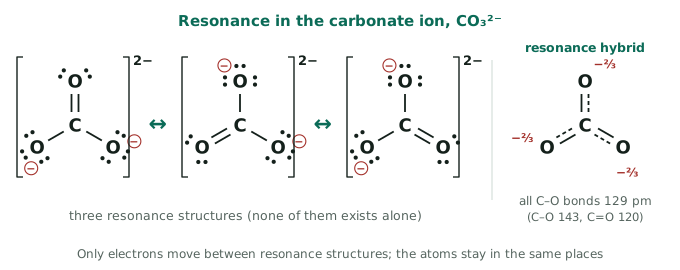
For some species a single Lewis structure does not describe the bonding. The carbonate ion can be drawn with the C=O double bond to any of the three oxygen atoms. Experiment shows that all three C–O bonds are identical ($129\ \text{pm}$, between a C–O single bond, $143\ \text{pm}$, and a C=O double bond, $120\ \text{pm}$). The three drawings are resonance structures, linked by a double-headed arrow ↔; the real ion is a resonance hybrid of them, with the π electrons delocalised over all four atoms and a charge of $-\tfrac{2}{3}$ on each oxygen.
- Resonance structures differ only in the positions of electrons (lone pairs and π bonds); the atoms stay where they are.
- No single resonance structure exists by itself; the molecule does not switch between them.
- The hybrid is more stable (lower in energy) than any one structure: the extra stability is the resonance (delocalisation) energy.
Other examples: the nitrate ion NO₃⁻ (three equal N–O bonds), ozone O₃ (two equal O–O bonds of $128\ \text{pm}$, between O–O $148\ \text{pm}$ and O=O $121\ \text{pm}$), the ethanoate ion CH₃COO⁻ and benzene, C₆H₆ (six equal C–C bonds, $139\ \text{pm}$).
Exam tip: In Paper II you are often given a skeleton and asked for "the most acceptable Lewis structure", then for resonance structures. Keep the skeleton exactly as given, show all lone pairs, mark formal charges next to the atoms, and check that the total number of electrons drawn equals your count from step 1.