Atomic theory and the subatomic particles
Dalton's atomic theory, the discovery of the electron, proton, nucleus and neutron, atomic and mass numbers, isotopes and relative atomic mass.
Dalton's atomic theory
In 1808 John Dalton proposed that:
- all matter is made of tiny, indivisible particles called atoms;
- atoms of the same element are identical in mass and properties, and atoms of different elements differ;
- atoms can be neither created nor destroyed in a chemical reaction;
- atoms combine in simple whole-number ratios to form compounds.
The theory explained the laws of chemical combination, but two of its ideas were later shown to be wrong: atoms can be divided into smaller particles, and atoms of one element can have different masses (isotopes).
The electron: cathode rays
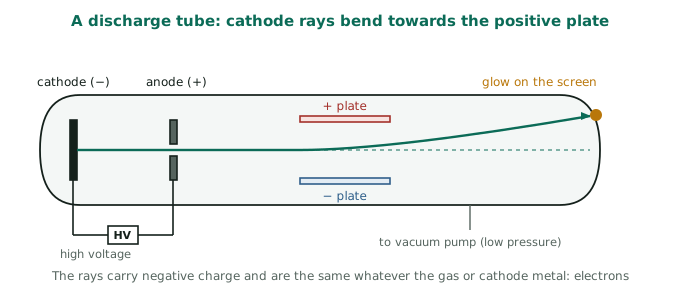
When a high voltage (about $10,000\ \text{V}$) is applied across a gas at very low pressure in a discharge tube, rays stream from the cathode. These cathode rays:
- travel in straight lines (an object in their path casts a sharp shadow);
- are deflected towards the positive plate of an electric field and by a magnetic field, so they are negatively charged;
- can turn a light paddle wheel, so they have mass and momentum;
- are the same whatever the gas in the tube and whatever metal the cathode is made of.
The last point shows that these particles are present in all atoms. J. J. Thomson (1897) measured their charge-to-mass ratio, $e/m = 1.76 \times 10^{11}\ \text{C kg}^{-1}$, and called them electrons. R. A. Millikan's oil drop experiment (1909) gave the charge, $e = 1.602 \times 10^{-19}\ \text{C}$. Together these give the mass of the electron: $$m_e = \frac{e}{e/m} = \frac{1.602 \times 10^{-19}}{1.76 \times 10^{11}} = 9.11 \times 10^{-31}\ \text{kg}$$
The proton: positive rays
Atoms are neutral, so they must also contain positive charge. Using a cathode with holes in it, Goldstein (1886) observed rays travelling the opposite way, behind the cathode (anode rays or canal rays). They are positive ions formed when electrons knock electrons out of the gas atoms. Unlike cathode rays, their $e/m$ depends on the gas. The largest $e/m$ comes from hydrogen; the hydrogen ion, $\text{H}^+$, is the proton.
The nucleus: Rutherford's experiment
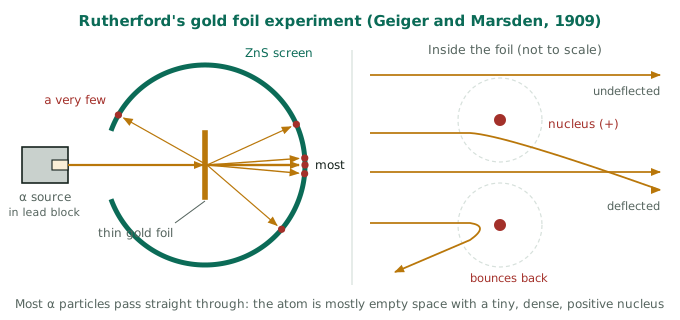
Thomson pictured the atom as a sphere of positive charge with electrons embedded in it (the "plum pudding" model). In 1909 Geiger and Marsden, working with Rutherford, fired α particles (He²⁺ ions) at a very thin gold foil and watched for flashes on a zinc sulfide screen.
| Observation | Conclusion |
|---|---|
| Most α particles passed straight through | Most of the atom is empty space |
| Some were deflected through small angles | There is a concentrated positive charge that repels them |
| Very few (about 1 in 8000) bounced back by more than 90° | The positive charge and almost all the mass are in a tiny nucleus |
The nucleus has a radius of about $10^{-15}\ \text{m}$, while the atom has a radius of about $10^{-10}\ \text{m}$: the atom is about $100,000$ times wider than its nucleus. In Rutherford's nuclear model, electrons move around the nucleus. Its weakness: an orbiting charge should radiate energy and spiral into the nucleus, so the model could not explain why atoms are stable. Bohr's model (next lesson) dealt with this.
The neutron
Atoms are heavier than the mass of their protons alone. In 1932 James Chadwick bombarded beryllium with α particles and detected uncharged particles with almost the same mass as the proton: neutrons.
| Particle | Symbol | Relative charge | Mass / kg | Relative mass |
|---|---|---|---|---|
| proton | $p$ | $+1$ | $1.673 \times 10^{-27}$ | 1 |
| neutron | $n$ | 0 | $1.675 \times 10^{-27}$ | 1 |
| electron | $e$ | $-1$ | $9.109 \times 10^{-31}$ | $\frac{1}{1840}$ |
Atomic number, mass number and isotopes
- Atomic number $Z$: the number of protons in the nucleus. It identifies the element. In a neutral atom it is also the number of electrons.
- Mass number $A$: the number of protons plus neutrons (nucleons). Number of neutrons $= A - Z$.
- A nuclide is written $^{A}{Z}\text{X}$, for example $^{23}{11}\text{Na}$ (11 protons, 12 neutrons, 11 electrons).
Isotopes are atoms of the same element (same $Z$) with different numbers of neutrons (different $A$): $^{1}{1}\text{H}$, $^{2}{1}\text{H}$ (deuterium) and $^{3}{1}\text{H}$ (tritium); $^{12}{6}\text{C}$, $^{13}{6}\text{C}$ and $^{14}{6}\text{C}$; $^{35}{17}\text{Cl}$ and $^{37}{17}\text{Cl}$. Isotopes have the same electron configuration, so they have the same chemical properties; physical properties that depend on mass (density, rate of diffusion) differ slightly.
Example: How many protons, neutrons and electrons are in $^{32}{16}\text{S}^{2-}$? Protons $= 16$, neutrons $= 32 - 16 = 16$, electrons $= 16 + 2 = 18$. For a cation such as $^{27}{13}\text{Al}^{3+}$: 13 protons, 14 neutrons, $13 - 3 = 10$ electrons.
Relative atomic mass
Atoms are far too light to weigh in kilograms, so masses are compared with the carbon-12 atom. The unified atomic mass unit is $1\ \text{u} = \tfrac{1}{12}$ of the mass of one $^{12}\text{C}$ atom $= 1.661 \times 10^{-27}\ \text{kg}$. $$A_r = \frac{\text{average mass of one atom of the element}}{\tfrac{1}{12} \times \text{mass of one } ^{12}\text{C atom}}$$ $A_r$ has no unit. It is an average over the isotopes in their natural abundances, which are measured with a mass spectrometer: gaseous atoms are ionised, accelerated and deflected by a magnetic field; lighter ions (smaller $m/z$) are deflected more, and the detector records how many ions of each $m/z$ arrive.
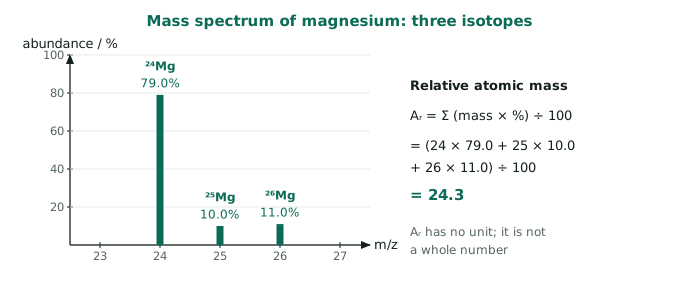
Example: Chlorine is 75.8% $^{35}\text{Cl}$ (mass 34.97) and 24.2% $^{37}\text{Cl}$ (mass 36.97). $A_r = \dfrac{75.8 \times 34.97 + 24.2 \times 36.97}{100} = 35.45$.
Example: Boron ($A_r = 10.8$) has the isotopes $^{10}\text{B}$ and $^{11}\text{B}$. Let the percentage of $^{10}\text{B}$ be $x$: $10x + 11(100 - x) = 1080$, so $x = 20$. Boron is 20% $^{10}\text{B}$ and 80% $^{11}\text{B}$.
Exam tip: The mass number is a whole number for one nuclide; the relative atomic mass is an average for the element and is usually not a whole number. Do not confuse them. When counting electrons in an ion, add electrons for a negative charge and subtract for a positive charge.