Alcohols: classification, properties, preparation and reactions
Unit 9 · Oxygen Containing Organic Compounds
Primary, secondary and tertiary alcohols, hydrogen bonding and boiling points, ways of making alcohols, and their reactions: sodium, halogenating agents, dehydration, oxidation and esterification.
Structure and classification
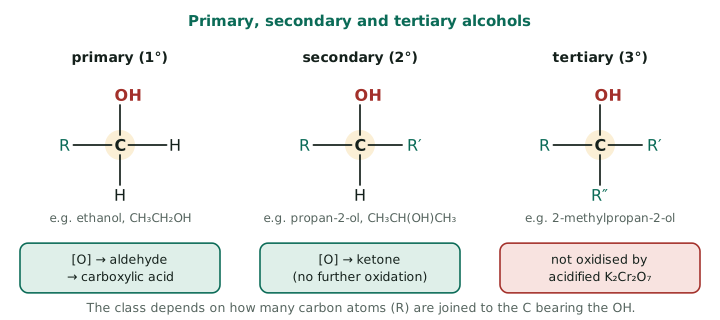
An alcohol contains the hydroxyl group –OH joined to an sp³ (saturated) carbon atom. The general formula of the open-chain, saturated alcohols is CₙH₂ₙ₊₁OH. The carbon carrying the –OH decides the class:
- primary (1°): that carbon is bonded to one other carbon (or none, in methanol): RCH₂OH, e.g. ethanol CH₃CH₂OH, propan-1-ol;
- secondary (2°): bonded to two carbons: R₂CHOH, e.g. propan-2-ol CH₃CH(OH)CH₃, butan-2-ol;
- tertiary (3°): bonded to three carbons: R₃COH, e.g. 2-methylpropan-2-ol (CH₃)₃COH.
Compounds with two or three –OH groups are diols and triols: ethane-1,2-diol (antifreeze) and propane-1,2,3-triol (glycerol). An –OH joined directly to a benzene ring is a phenol, not an alcohol (next lesson); C₆H₅CH₂OH (phenylmethanol) is an alcohol, a primary one.
Physical properties
The O–H bond is very polar, so alcohol molecules form hydrogen bonds with each other. Much more energy is needed to separate them than for alkanes or ethers of similar molar mass, which have only weaker intermolecular forces.
| Compound | Mr | Boiling point |
|---|---|---|
| propane, CH₃CH₂CH₃ | 44 | −42 °C |
| methoxymethane, CH₃OCH₃ | 46 | −24 °C |
| ethanol, CH₃CH₂OH | 46 | 78 °C |
- Methanol, ethanol and propanol mix with water in all proportions because they hydrogen-bond with water molecules. As the hydrocarbon chain grows, solubility falls (butan-1-ol is only partly soluble, hexan-1-ol hardly at all).
- Among isomers, branching lowers the boiling point (smaller surface area): butan-1-ol 118 °C, 2-methylpropan-2-ol 83 °C.
Preparing alcohols
- From alkenes (hydration). Absorb the alkene in cold conc. H₂SO₄ to form the alkyl hydrogensulfate, then warm with water. The addition follows Markovnikov's rule, so propene gives mainly propan-2-ol. Industrially ethene and steam are passed over H₃PO₄ at about 300 °C and 60–70 atm.
- From haloalkanes. Heat under reflux with aqueous NaOH or KOH (nucleophilic substitution): CH₃CH₂Br + OH⁻ → CH₃CH₂OH + Br⁻.
- By reducing aldehydes and ketones with LiAlH₄ (in dry ether, then dilute acid) or NaBH₄: aldehydes give 1° alcohols, ketones give 2° alcohols.
- From Grignard reagents (RMgX, in dry ether), then dilute acid: methanal gives a 1° alcohol, any other aldehyde a 2° alcohol, a ketone a 3° alcohol. A new C–C bond is formed, so this lengthens the chain.
- Fermentation of sugars by yeast gives ethanol: C₆H₁₂O₆ → 2C₂H₅OH + 2CO₂.
Reactions of alcohols
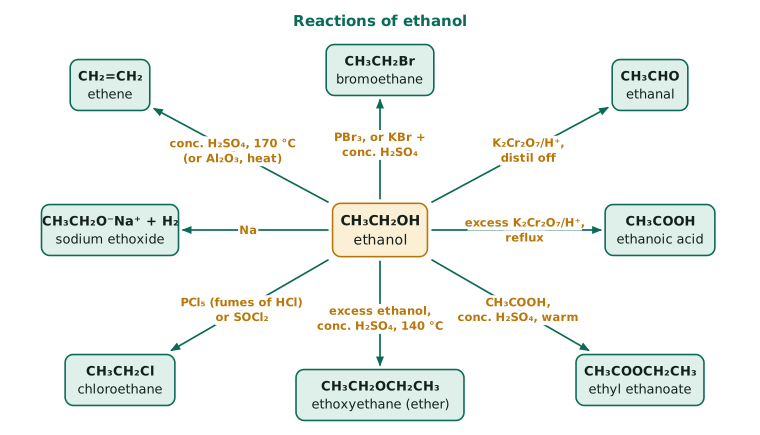
Alcohols react either by breaking the O–H bond or by breaking the C–O bond.
Breaking O–H
With sodium hydrogen is given off and a sodium alkoxide forms. The reaction is gentler than sodium with water, because ethanol is a slightly weaker acid than water. $$\mathrm{2CH_3CH_2OH + 2Na \rightarrow 2CH_3CH_2O^-Na^+ + H_2}$$ Esterification: warming with a carboxylic acid and a few drops of conc. H₂SO₄ gives an ester and water. The reaction is reversible and slow; the ester has a fruity smell. $$\mathrm{CH_3COOH + CH_3CH_2OH} \rightleftharpoons \mathrm{CH_3COOCH_2CH_3 + H_2O}$$ Experiments with ¹⁸O in the alcohol show that the ester keeps the alcohol's oxygen: the acid loses its –OH and the alcohol loses H. Acid chlorides give esters faster and completely (lesson 5).
Breaking C–O (substitution of –OH)
- HX: HBr (made in the flask from KBr + conc. H₂SO₄) gives the bromoalkane; HI similarly. With HCl a catalyst, ZnCl₂, is needed except for tertiary alcohols.
- PCl₅, at room temperature, gives the chloroalkane and steamy fumes of HCl. This is a test for an –OH group (alcohols and carboxylic acids both give it; the sample must be dry): $$\mathrm{ROH + PCl_5 \rightarrow RCl + POCl_3 + HCl}$$
- PCl₃ (or red phosphorus + iodine/bromine): $\mathrm{3ROH + PCl_3 \rightarrow 3RCl + H_3PO_3}$.
- SOCl₂ (thionyl chloride): $\mathrm{ROH + SOCl_2 \rightarrow RCl + SO_2 + HCl}$; both by-products are gases, so the product is easy to purify.
The C–O bond breaks most easily in tertiary alcohols, because they react through the most stable carbocation. Reactivity: 3° > 2° > 1°.
Dehydration
Heating with excess conc. H₂SO₄ at about 170 °C (or passing the vapour over hot Al₂O₃) removes water to give an alkene. When two alkenes are possible, the more substituted one is the main product (Saytzeff's rule): butan-2-ol gives mainly but-2-ene. With excess alcohol at a lower temperature, about 140 °C, two molecules lose one water to give an ether: 2CH₃CH₂OH → CH₃CH₂OCH₂CH₃ + H₂O.
Oxidation
The usual oxidising agent is acidified potassium dichromate, K₂Cr₂O₇/H₂SO₄. It turns from orange (Cr₂O₇²⁻) to green (Cr³⁺). Acidified KMnO₄ (purple → colourless) also works but is harder to control.
- 1° alcohol → aldehyde → carboxylic acid. To stop at the aldehyde, add the oxidant slowly and distil the aldehyde off as it forms (aldehydes boil lower because they have no hydrogen bonding). To get the acid, use excess oxidant and heat under reflux. Pyridinium chlorochromate (PCC) in dichloromethane oxidises a 1° alcohol to the aldehyde only.
- 2° alcohol → ketone. Ketones are not oxidised further by these reagents.
- 3° alcohol: no reaction. There is no H on the carbon bearing the OH, so the dichromate stays orange.
$$\mathrm{CH_3CH_2OH} \xrightarrow{\mathrm{[O]}} \mathrm{CH_3CHO} \xrightarrow{\mathrm{[O]}} \mathrm{CH_3COOH} \qquad \mathrm{CH_3CH(OH)CH_3} \xrightarrow{\mathrm{[O]}} \mathrm{CH_3COCH_3}$$
Alcohols containing CH₃CH(OH)– (ethanol and the propan-2-ol type) also give a positive iodoform test, because I₂/NaOH first oxidises them to CH₃CO– (lesson 3).
Telling 1°, 2° and 3° alcohols apart
| Test | 1° | 2° | 3° |
|---|---|---|---|
| warm with K₂Cr₂O₇/H⁺ | orange → green; aldehyde (then acid) | orange → green; ketone | stays orange |
| Lucas reagent (conc. HCl + ZnCl₂), room temp. | stays clear | cloudy in about 5 min | cloudy at once |
| product of oxidation with Tollens' reagent | silver mirror (aldehyde) | no mirror (ketone) | no oxidation |
The cloudiness in the Lucas test is the insoluble chloroalkane separating out.
Example: Three isomers C₄H₁₀O, P, Q and R, all react with sodium. P is not oxidised by acidified dichromate; Q is oxidised to a compound that gives an orange precipitate with 2,4-DNP but no silver mirror with Tollens' reagent; R is oxidised to a compound that does give a silver mirror and R has an unbranched chain. P is 2-methylpropan-2-ol (3°), Q is butan-2-ol (2°, gives butanone) and R is butan-1-ol (1°, gives butanal). (The ether isomers, such as ethoxyethane, do not react with sodium.)
Exam tip: Sodium is not a test for alcohols on its own: water, phenols and carboxylic acids all give H₂ as well. Say "dry" sample, and combine the observation with others (for example no CO₂ with NaHCO₃ rules out a carboxylic acid).
Common mistake: writing that 3° alcohols are oxidised to ketones; using alcoholic KOH to make an alcohol from a haloalkane (alcoholic KOH gives the alkene, aqueous KOH gives the alcohol); and forgetting that "distil" gives the aldehyde while "reflux" gives the acid.