Chemical elements and water in living systems
Unit 2 · Chemical and Cellular Basis of Life
The elements and ions found in organisms, why water is the medium of life, its hydrogen bonding and properties, and how biomolecules are built and broken down.
Elements in living things
About 25 of the 92 natural elements are essential to life. Four of them, carbon, hydrogen, oxygen and nitrogen, make up about 96% of the mass of living matter. Carbon can form four covalent bonds, including long chains and rings, which is why it is the backbone of every organic molecule.
| Group | Examples | Roles |
|---|---|---|
| Macro-elements (needed in relatively large amounts) | C, H, O, N, P, S, Ca, K, Na, Cl, Mg | Structure of biomolecules; Ca in bones and teeth, in muscle contraction and blood clotting; P in nucleic acids, ATP and phospholipids; Mg in chlorophyll; K and Na in nerve impulses and water balance; S in some amino acids |
| Micro-elements (trace elements) | Fe, Zn, Cu, Mn, Mo, I, Co, B | Fe in haemoglobin and cytochromes; I in thyroxine; Zn and Cu in some enzymes; Co in vitamin B₁₂; B in plant growth |
A shortage of an element causes a deficiency symptom, for example iron deficiency causes anaemia in humans, and magnesium deficiency causes yellowing of leaves (chlorosis) in plants.
The structure of water
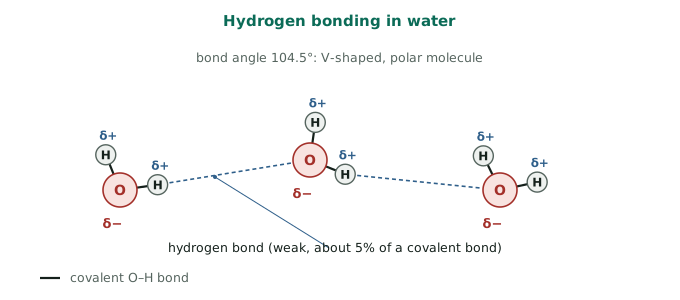
In a water molecule the oxygen atom attracts the shared electrons more strongly than the hydrogen atoms do, so oxygen carries a small negative charge ($\delta^-$) and each hydrogen a small positive charge ($\delta^+$). Water is therefore a polar molecule. The $\delta^-$ oxygen of one molecule is attracted to the $\delta^+$ hydrogen of a neighbour, forming a hydrogen bond. Each hydrogen bond is weak, but there are enormous numbers of them, and they continually break and re-form in liquid water.
Biological importance of water
- Solvent. Polar molecules (sugars, amino acids) and ions (Na⁺, Cl⁻) dissolve because water molecules surround them. Metabolic reactions take place in solution, and blood and xylem sap transport dissolved substances.
- Cohesion and adhesion. Water molecules stick to each other (cohesion) and to the walls of xylem vessels (adhesion). This allows an unbroken column of water to be pulled up a tall tree in the transpiration stream.
- Surface tension. Cohesion gives the surface a "skin" that supports small animals such as pond skaters.
- High specific heat capacity. A lot of energy is needed to raise the temperature of water because it first breaks hydrogen bonds. Cells and aquatic habitats therefore change temperature slowly.
- High latent heat of vaporisation. Evaporation of sweat and transpiration removes a large amount of heat and cools the organism.
- Density. Ice is less dense than liquid water, so it floats and insulates the water below, which lets aquatic life survive in cold regions.
- Reactant. Water takes part in hydrolysis and is the source of electrons and hydrogen in photosynthesis.
- Support. Water in vacuoles gives plant cells turgor and supports herbaceous plants; the fluid in a hydrostatic skeleton supports earthworms.
Building and breaking biomolecules
Large biological molecules (macromolecules) are polymers made of many similar small units called monomers.
- A condensation reaction joins two monomers by removing a molecule of water, forming a covalent bond (glycosidic, ester, peptide or phosphodiester).
- A hydrolysis reaction breaks that bond by adding a molecule of water. Digestion is hydrolysis.
| Class | Monomer | Bond between units |
|---|---|---|
| Polysaccharides | Monosaccharide | Glycosidic bond |
| Proteins | Amino acid | Peptide bond |
| Nucleic acids | Nucleotide | Phosphodiester bond |
| Triglycerides (not true polymers) | Glycerol + fatty acids | Ester bond |
The next lessons describe each class in turn.
Deshapriya Senevirathne. B.Sc. (Hons) Biology Special, University of Peradeniya — graduated with a class pass. All the content and lessons in A/L Biology on Paadama are reviewed by Deshapriya Senevirathne, and the lessons are taught by him.